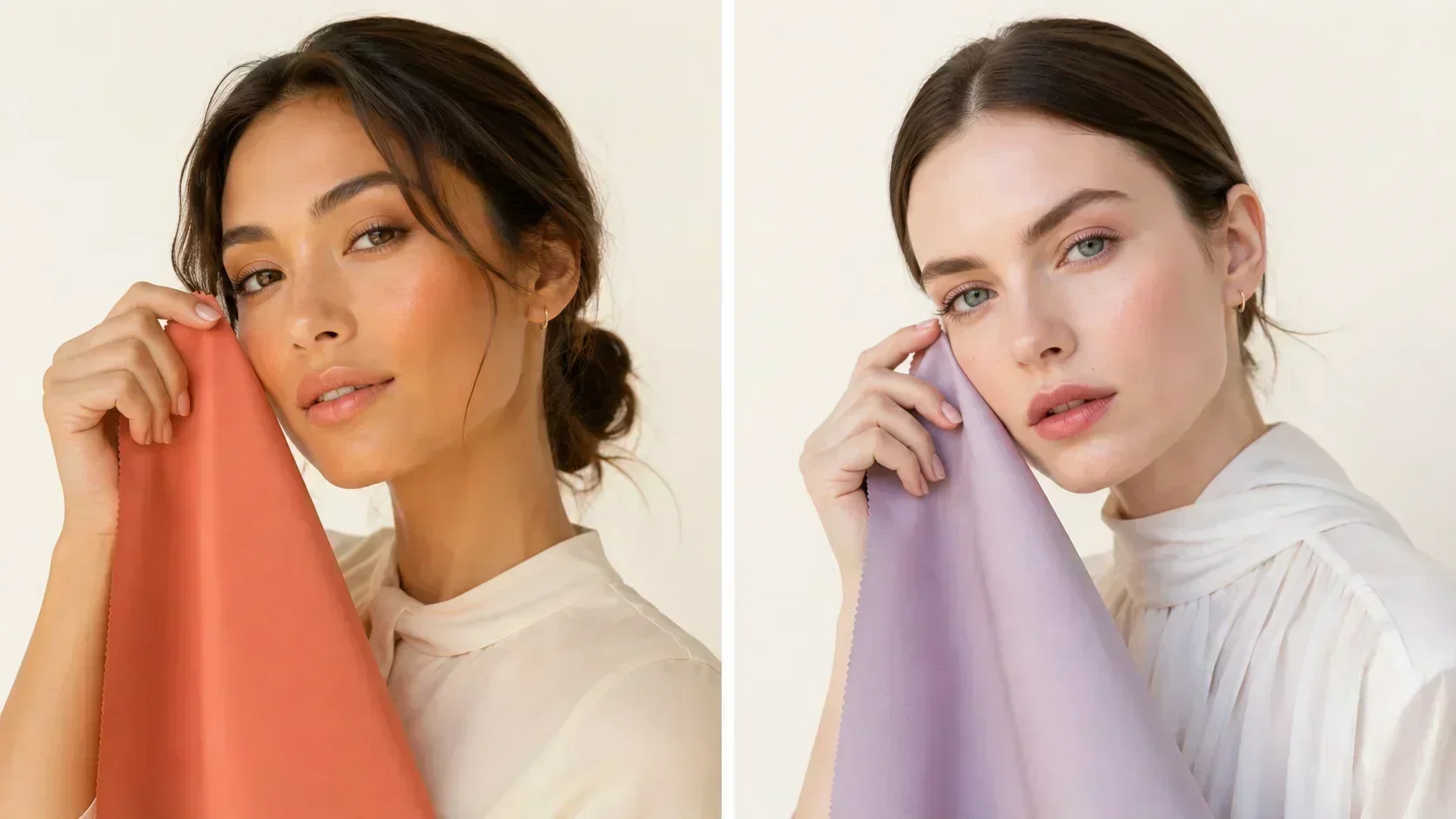
The difference between warm and cool undertone is the most important distinction in personal colour. More important than skin depth. More important than eye colour. More important than hair colour.
It is important because it is fundamental — it sits beneath all the other variables and determines which colour temperature harmonises with the face, and which fights it.
And yet it is also the most misunderstood variable in popular colour advice, confused routinely with skin depth ("if you have dark skin, you're warm"), with hair colour ("if you're blonde, you're warm"), and with the seasonal categories themselves ("if you're Autumn, you have warm undertone" — which is true — but knowing the Autumn label does not explain what the undertone actually is or why it matters).
This guide explains warm and cool undertone from first principles: what causes them, how they interact with colour, and why the difference produces such dramatically different results when the wrong temperature is chosen.
What Causes Undertone
Skin colour is produced by three primary pigments:
Melanin: the brown-black pigment produced by melanocytes. Primarily determines skin depth — how fair or deep the skin is. Higher melanin concentration = deeper skin. Melanin comes in two types: eumelanin (brown-black) and pheomelanin (red-yellow). The ratio of eumelanin to pheomelanin influences whether deeper skin reads as cool brown-black or warm red-brown.
Haemoglobin: the red pigment in blood. More visible in fair skin, where the blood vessels sit closer to the surface. Contributes a pink-red cast, particularly in the cheeks. Higher haemoglobin visibility → more redness → cooler impression.
Carotenoids: yellow-orange pigments from food. Deposited in the skin's fatty layer. Contribute a yellow-golden cast, particularly in the centre of the face and on the palms.
Warm undertone occurs when carotenoid pigmentation dominates or when pheomelanin (red-yellow) is the more prominent melanin type — the result is a golden, peachy, or yellow cast beneath the surface colour.
Cool undertone occurs when haemoglobin visibility is high and carotenoid pigmentation is lower, or when eumelanin (blue-black) is dominant — the result is a pink, rosy, or blue-red cast beneath the surface colour.
This is why undertone is structural and stable: it is determined by the genetic composition of the pigment system, not by sun exposure, ageing, or surface variables.
Warm Undertone: Characteristics
Warm undertone produces a golden, peachy, or yellow-golden cast in the skin. In natural daylight, the skin may appear to have a slight glow or warmth — a quality often described as "olive" in some skin tones (though olive has its own specific meaning, covered in the olive skin article).
Visual characteristics of warm undertone:
- ✦Skin reads golden, peachy, yellow-toned, or bronze in daylight
- ✦Veins on the inside of the wrist appear greenish or olive
- ✦The skin tans relatively easily and the tan reads golden or bronze, not pink
- ✦Gold jewellery sits more harmoniously than silver near the face
- ✦Stark white reads slightly harsh against the skin; warm ivory or cream is softer
In fair skin: the warmth may read as a peachy or apricot quality
In medium skin: golden or honey-toned
In olive skin: a warm olive or amber quality
In deep skin: a warm brown, caramel, or bronze quality
Warm undertone spans a wide range of skin depths — Light Spring (fair, warm) through True Autumn (medium-deep, warm) through Deep Autumn (deep, warm). The undertone is consistent across the depth range; only the surface colour changes.
Cool Undertone: Characteristics
Cool undertone produces a pink, rosy, or blue-red cast in the skin. The skin may read as "porcelain" in very fair cool skin, or as a rich cool brown in deep cool skin. The defining quality is the absence of yellow or golden pigmentation and the presence of pink or blue-red.
Visual characteristics of cool undertone:
- ✦Skin reads pink, rosy, or grey-toned in daylight — no golden quality
- ✦Veins on the inside of the wrist appear blue, purple, or blue-violet
- ✦The skin burns before it tans; when it does tan, the tan has a pinkish or ruddy cast
- ✦Silver jewellery sits more harmoniously than gold near the face
- ✦Ivory and cream can appear slightly yellow against cool skin; pure white or soft white is cleaner
In fair skin: porcelain, ivory-pink, or rosy quality
In medium skin: rosy-beige or cool sand
In olive skin: cool olive with a grey or greenish cast (this is cool olive, distinct from warm olive)
In deep skin: rich cool brown, blue-black, or ebony
Cool undertone also spans a wide depth range — Light Summer (fair, cool) through True Winter (medium-deep, cool) through Deep Winter (very deep, cool).
How Temperature Interacts With Colour
The mechanism that makes undertone matter is simultaneous contrast — the same optical principle that Johannes Itten described at the Bauhaus and that underpins all colour harmony.
Every colour placed adjacent to another colour modifies how both appear. Specifically, each colour shifts the perceived colour of what is next to it toward its own complementary.
When a warm-temperature colour sits next to warm skin:
- ✦The warmth in the colour and the warmth in the skin are congruent
- ✦The skin appears more alive, more luminous, more itself
- ✦The eye rests on the face rather than fighting a temperature conflict
When a cool-temperature colour sits next to warm skin:
- ✦The cool colour pushes the warm skin toward its complement — making the skin read slightly more grey or flat
- ✦The face appears less alert, less vibrant
- ✦The eye registers something "off" without being able to identify it
The same mechanism operates in reverse for cool undertones. A warm colour next to cool skin shifts the perceived skin colour toward its complement — the cool pink reads slightly orange or muddy. A cool colour next to cool skin is congruent — the skin reads clearly, the eyes are vivid, the impression is natural.
This is not a subjective aesthetic preference. It is a measurable optical effect. The same mechanism operates whether you are aware of it or not.
The Temperature Mistake: Why It Looks Wrong
The most common colour mistake is wearing the wrong temperature in the colours closest to the face — specifically in tops, necklines, scarves, and foundation.
For warm-undertone people: stark white, cool grey, ash-toned neutrals, and cool blue-based navy. All of these fight the warm undertone. The face appears slightly flat. The skin looks less healthy than it actually is. The person often compensates unconsciously by wearing more makeup — more concealer, more blush, more highlighter — without realising that the colour temperature is the problem, not the skin.
For cool-undertone people: warm camel, golden yellow, orange, rust, and warm brown. All of these fight the cool undertone. The skin can appear slightly olive, muddy, or washed out. The rosy quality of cool skin — which is its defining luminosity — disappears.
The solution is never to wear more makeup. The solution is to change the temperature of the colour near the face.
Warm vs Cool in Neutrals
The highest-impact application of undertone knowledge is in neutrals, because neutrals form the base of almost every wardrobe and are worn most frequently.
Warm versions of neutrals:
- ✦White → warm ivory, cream, warm white
- ✦Grey → camel, warm tan, warm khaki
- ✦Dark → warm dark brown, dark warm olive, warm charcoal (charcoal with a slight warm cast)
- ✦Black → dark warm brown, very dark warm brown (reads as black in outfit contexts)
Cool versions of neutrals:
- ✦White → pure white, bright white, soft cool white
- ✦Grey → cool grey, silver-grey, cool charcoal
- ✦Dark → cool dark charcoal, navy-black, cool navy
- ✦Black → true black (perfectly in season for Winter undertones)
The practical test: the neutral that disappears when you wear it — that makes the face the focus rather than drawing attention to itself — is the neutral in your temperature. The neutral that sits there, slightly visible as a note of "something is off" — that is the wrong temperature.
Warm vs Cool in Makeup
Foundation: The most consequential makeup decision for undertone. Foundation formula families are typically warm (yellow-peach base), cool (pink-rose base), or neutral. Warm undertone needs a warm or neutral formula; cool undertone needs a cool or neutral formula. The tell: a foundation that matches at the centre of the face but turns orange at the jaw is too warm for a cool undertone. A foundation that matches at the jaw but reads grey at the cheeks is too cool for a warm undertone.
Blush: Warm undertone → peachy, coral, warm rose, warm berry. Cool undertone → cool rose, soft pink, berry with cool cast, soft mauve. The specific colours are covered in the blush-by-season article; the principle is always temperature first.
Lip colour: Warm undertone → coral, warm red, warm nude, warm berry, warm orange-red. Cool undertone → cool red (blue-red), berry, cool pink, plum, cool nude.
Highlight: Warm undertone → gold, peach-gold, warm champagne. Cool undertone → silver, icy champagne, cool pearl.
The Neutral Undertone Question
Most colour analysis systems acknowledge neutral undertone as a category — skin that is neither clearly warm nor clearly cool. Genuinely neutral undertones exist, but they are rarer than most people assume.
Many people who think they are neutral are actually:
- ✦Warm with some redness in the skin (the redness reads as "cool" but the base is warm)
- ✦Cool with yellow pigmentation from diet or lifestyle (the yellow reads as "warm" but the base is cool)
- ✦At a boundary season that sits between the warm and cool families (Bright Spring and Bright Winter both have clear chroma and may read as borderline)
If you are genuinely neutral, you will find that both warm and cool colours in their mid-temperature versions work reasonably — warm teal and cool teal, warm rose and cool rose. You will not achieve the same luminosity enhancement from either direction that a strongly warm or strongly cool person achieves from their correct temperature, but neither will you be dramatically wrong.
Warm Undertone Seasons and Cool Undertone Seasons
For reference: the 12 seasons mapped to undertone.
Warm undertone seasons: Light Spring, True Spring, Bright Spring, Soft Autumn, True Autumn, Deep Autumn
Cool undertone seasons: Light Summer, True Summer, Soft Summer, True Winter, Bright Winter, Deep Winter
Within the warm group, Spring and Autumn are distinguished by chroma (Springs are clearer, Autumns are more muted) and value (Springs are lighter overall, Autumns are deeper). Within the cool group, Summer and Winter are distinguished by chroma (Summers are softer, Winters are clearer) and value (Summers are lighter overall, Winters are deeper).
Knowing your undertone places you in one of these two groups. Your season sits within that group — determined by value and chroma. Undertone is the essential first filter. The season is the full picture.
Undertone biology draws on dermatological pigmentation research, including Fitzpatrick skin phototype classification. Colour theory and simultaneous contrast: Itten, J. (1974), The Art of Color. Seasonal undertone mapping: 12-season system as implemented in the In My Colors analysis.