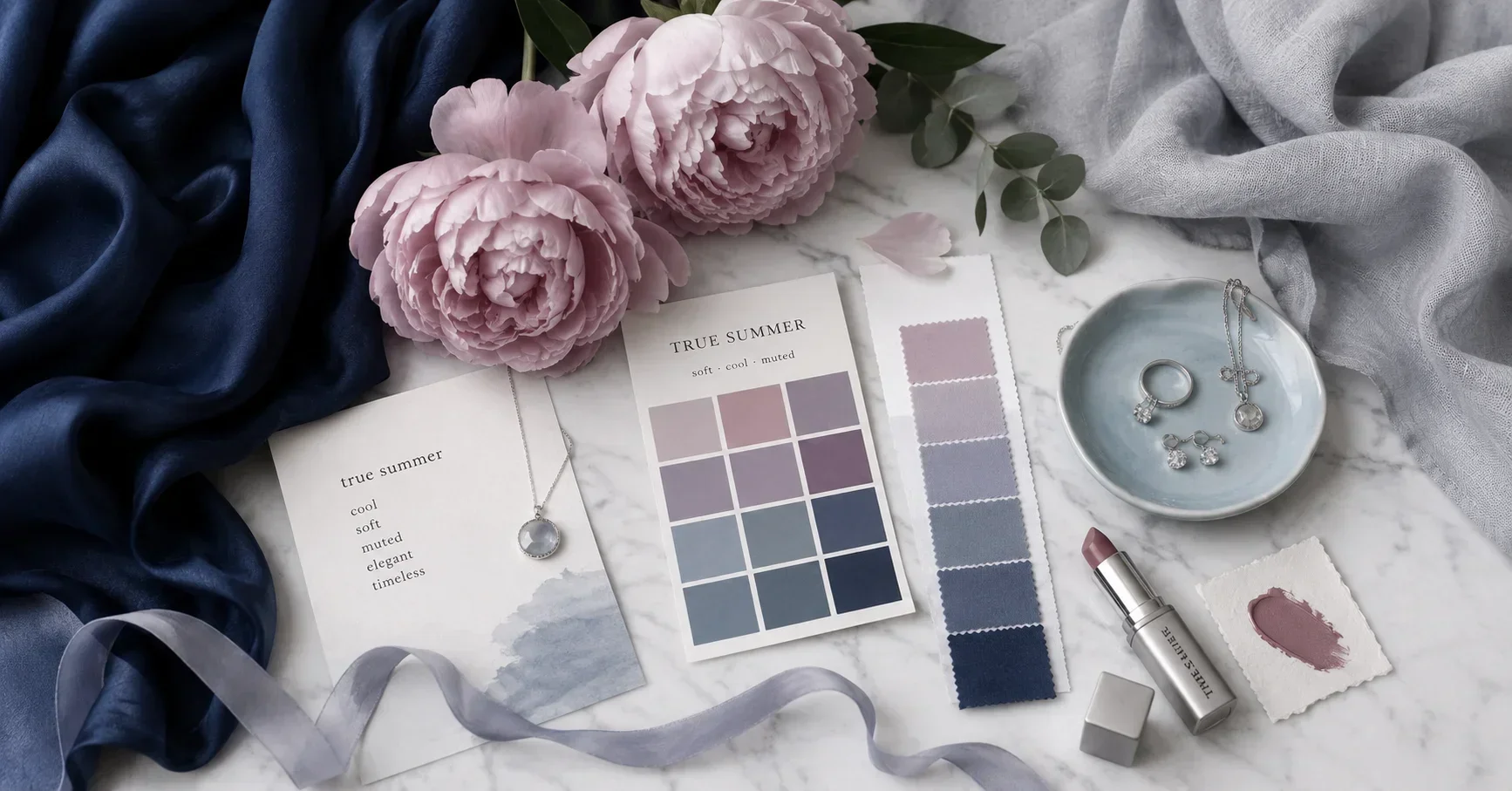
There is a season that sits at the very heart of the cool spectrum — not the frostiest, not the most saturated, but precisely, quietly elegant. True Summer, sometimes called Cool Summer, is the archetypal cool-and-soft season: a colouring defined by cool undertones, moderate depth, and a characteristic softness that reads as refined rather than washed out. If you have ever been told to "wear more colour" and felt worse for it, or if stark white makes you look tired while a muted blue-grey makes your skin come alive, this is likely your season.
This guide covers everything you need to understand True Summer colour analysis — the underlying theory, your ideal palette, wardrobe and makeup guidance, and the celebrities who share your colouring.
What Makes a True Summer
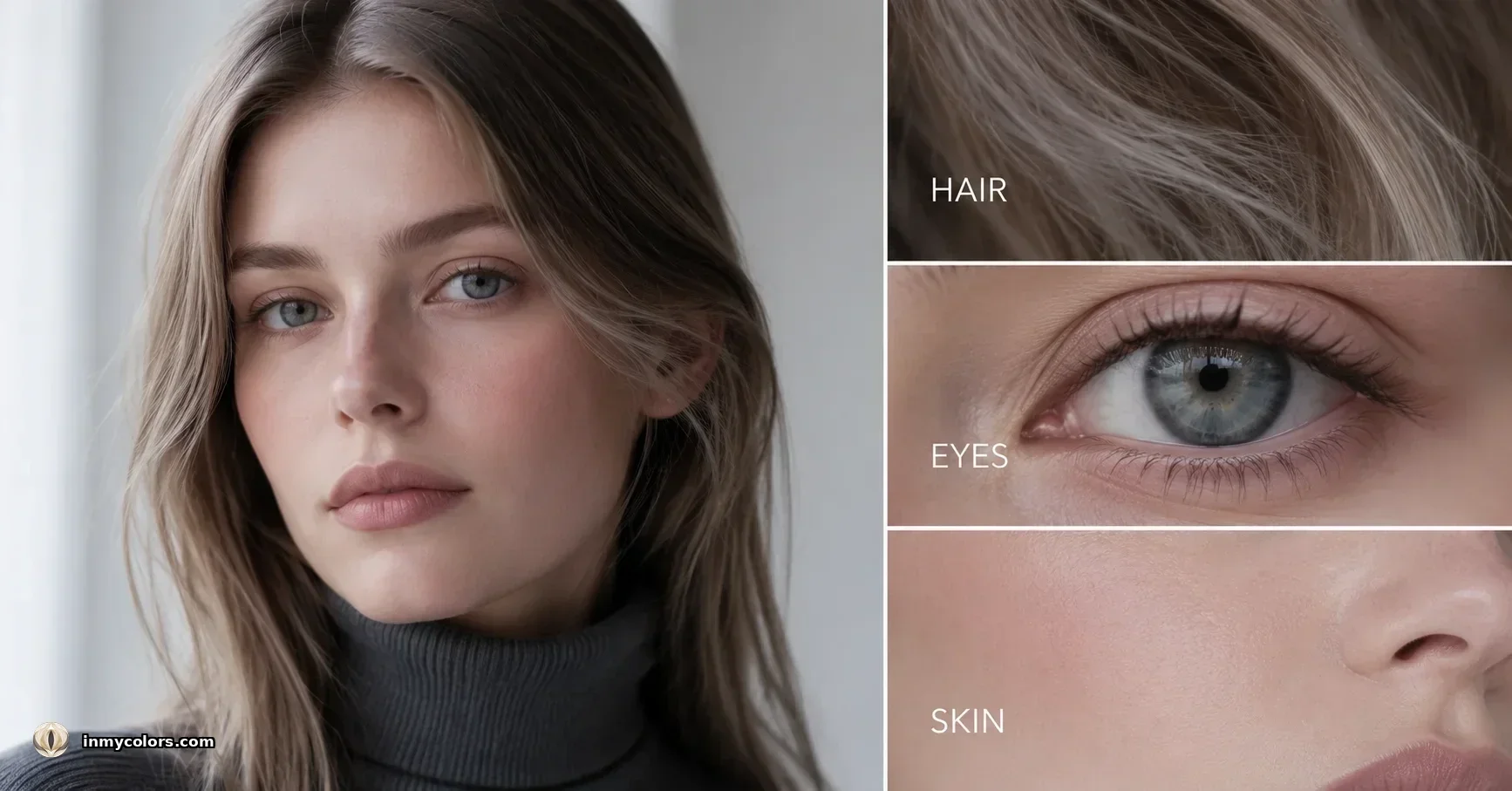
Colour analysis operates across three axes: temperature (warm to cool), value (light to dark), and chroma (vivid to muted). Your season is determined by which combination of these axes best matches your natural colouring.
True Summer sits firmly cool, moderate in value, and moderate-low in chroma. Break that down:
Cool temperature. Your skin, hair, and eyes all carry no discernible warmth. Skin reads as rosy, pinkish, or neutral-cool — not peachy, not golden. Hair is ash-toned, whether blonde or brown. There is no golden or honey quality to it. Eyes are cool: blue-grey, grey-green, or a cool, soft blue.
Moderate value. True Summer is not the lightest season (that is Light Summer) nor particularly deep. You sit in the mid-range — a medium to medium-fair complexion with moderate contrast between skin, hair, and eyes.
Moderate-low chroma. This is the defining quality that separates Summer from Winter. Your colouring is muted — soft rather than vivid. Vivid, saturated colours do not harmonise with your natural palette; they overpower it. The impression your colouring creates is one of elegant restraint, like an overcast summer's day: cool, soft, and beautifully diffused.
The True Summer Colour Palette
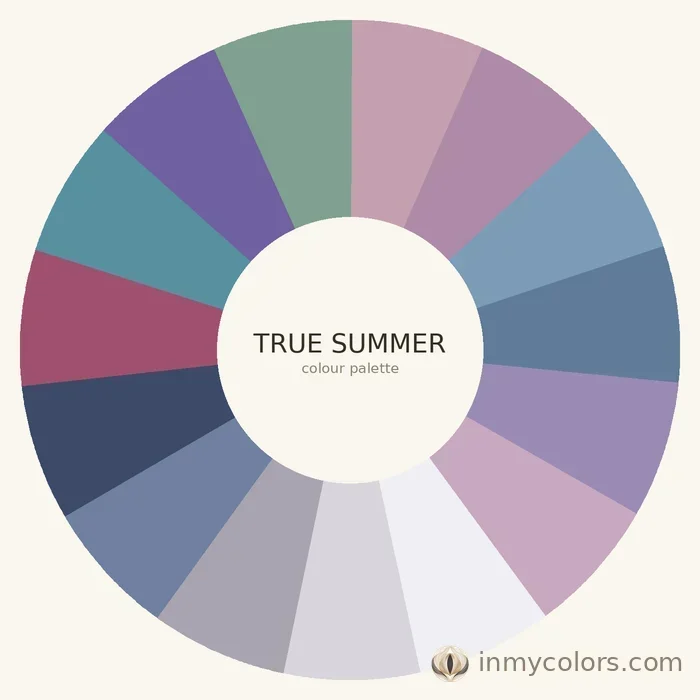
Your palette is built around cool, muted tones at moderate depth. Every colour you wear should share these qualities — cool in temperature, never vivid.
Foundation neutrals replace the warm defaults that dominate most wardrobes. Soft cool white (not stark bright white, which reads as harsh), pale grey, blue grey, and greyed navy form the base. These neutrals harmonise with True Summer's natural colouring — cool, slightly silvery, never golden.
Core colours are where True Summer's character comes through. Soft navy is perhaps the single most powerful colour in this palette — it does what black cannot, providing depth without harshness. Dusty rose, mauve, and lavender echo the rosy quality of the skin. Cornflower blue, steel blue, muted periwinkle, and soft plum complete the range.
Accent colours for accessories and focal pieces: soft berry, dusty teal, dusty plum, and cool sage. These introduce dimension without breaking the cool, muted register that defines the palette.
What to avoid — and why. Warm tones across the board: orange, gold, caramel, olive, warm brown. These fight your cool undertone and make your complexion look sallow or unwell. Vivid, saturated colours overwhelm your soft chroma and make your features disappear behind the colour rather than beside it. Black is generally too heavy — it creates an abrupt contrast that summer colouring cannot carry gracefully. Stark white is similarly too sharp; opt for soft cool white instead.
True Summer in the Wardrobe
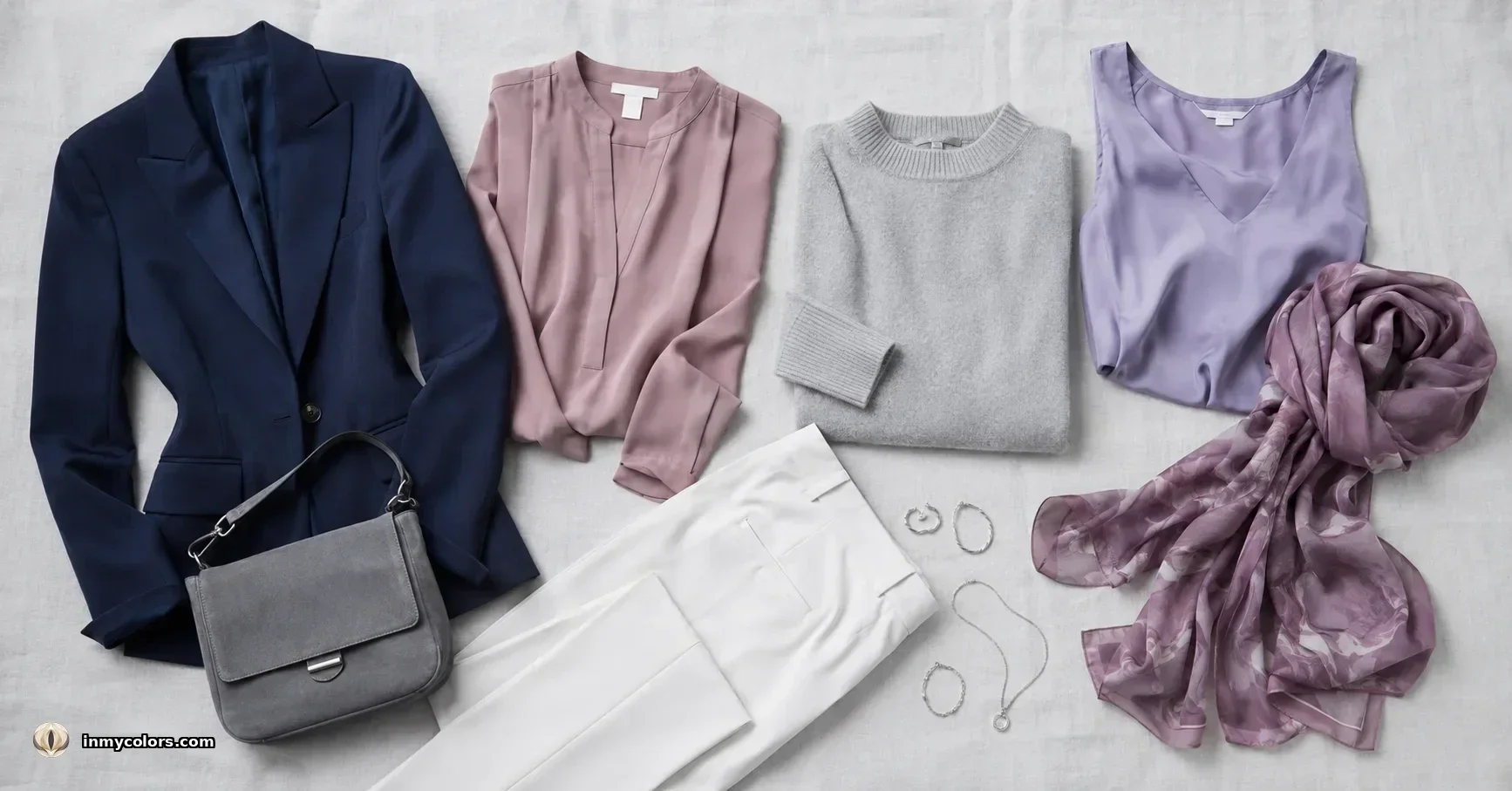
Building a True Summer wardrobe means replacing the conventional "neutral" defaults with a set of cool, muted alternatives that work just as well — often better.
The base layer. Swap black for soft navy or cool charcoal. Swap warm white for soft cool white or palest cool grey. These anchors form the backbone of your wardrobe and let you build outfits without fighting your undertone at every step.
Tops and blouses. Powder blue, dusty rose, cool teal, mauve, and muted periwinkle are your workhorses. In fabrics that photograph well and feel refined — linen, silk, fine cotton — these shades create the kind of quiet polish that True Summer colouring is built for.
Outerwear. Greyed navy is exceptional as a coat or blazer — sophisticated and season-appropriate in a literal sense. Cool grey and soft plum also work beautifully in overcoat weights. Avoid camel (a classic wrong choice for this season) and any tan or warm beige.
Patterns. Florals in dusty rose and powder blue, cool watercolour prints, soft geometric patterns in your core palette range. Scale matters: medium-scale patterns tend to work well. Avoid high-contrast graphic prints or anything with warm-toned colours mixed in.
Metals. Silver is your primary metal. White gold, platinum, and cool pewter all work. Yellow gold — the warmer and more saturated it is, the more it conflicts with your undertone. Rose gold can work if it is pale and not too warm.
True Summer Makeup
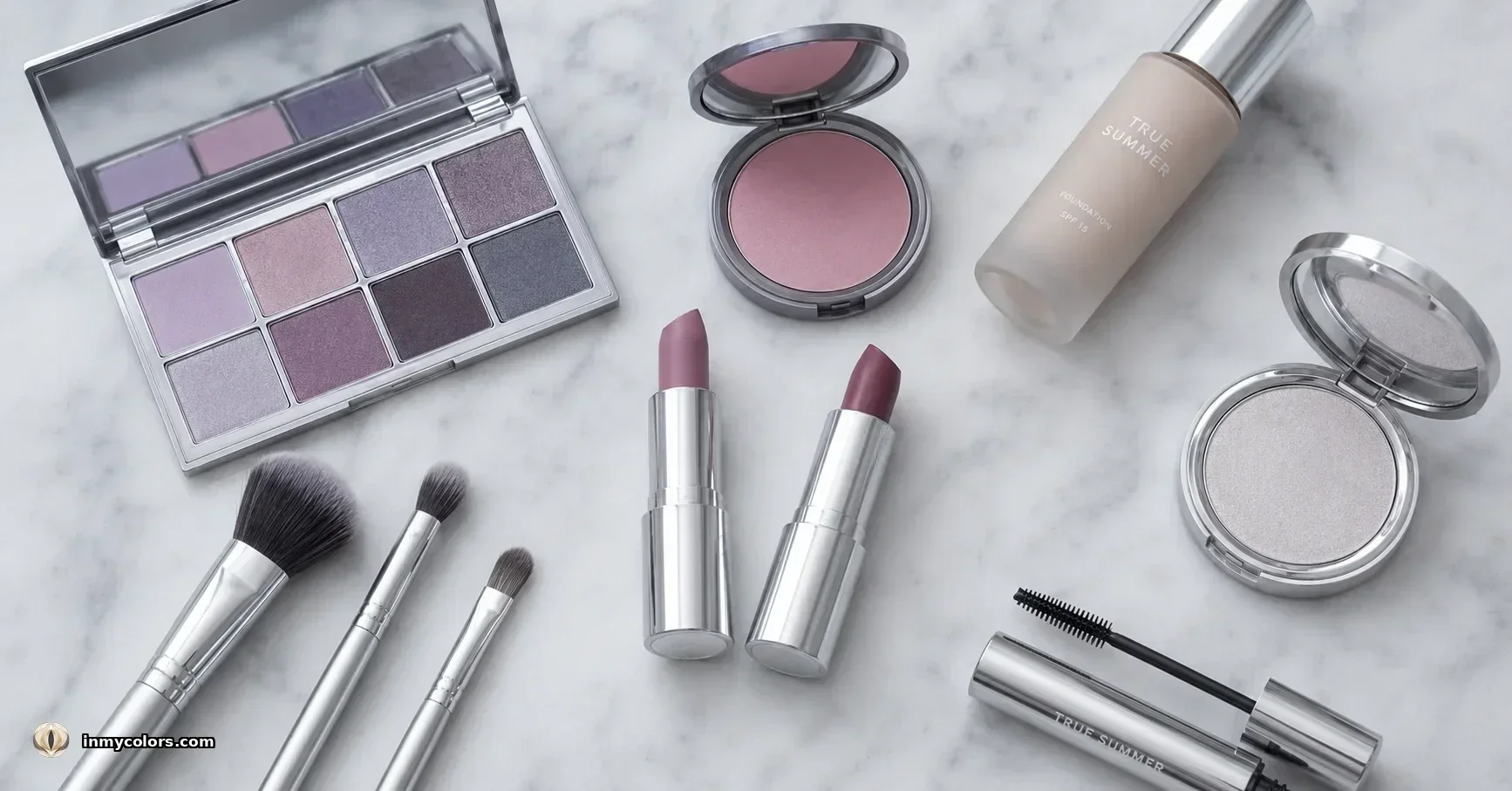
Makeup for True Summer follows one rule: stay cool, stay soft. There is no warmth allowed, and no vivid saturation.
Foundation. Look for foundations with pink-beige or neutral-cool undertones. Avoid anything labelled "warm", "golden", or "neutral-warm". Many foundations are slightly warm by default — test on your jawline in natural light. If it disappears, it matches; if it looks orange or yellow against your skin, it is too warm.
Blush. Soft cool rose, mauve, and cool pink — all at a gentle intensity. True Summer blush should look like a natural flush, not a bold statement. Peachy or warm-toned blushes will read as discordant.
Lips. Soft mauve, cool rose, dusty pink, and burgundy-rose are your strongest options. A muted cool red can work for evenings. Avoid orange-red, coral, and warm nude (which often looks grey on cool skin). Your lip colour should share the softness of the rest of your palette — vivid or glossy brights tend to look at odds with True Summer colouring.
Eyes. Cool taupe, soft grey, lavender, and muted cool brown for eyeshadow. Silver liner instead of gold. Soft cool brown or grey mascara can be more flattering than black, though a soft black works well for True Summer (unlike very fair Light Summer). Avoid warm bronze, copper, or gold eyeshadow — these will make your eye colour look greyer and flatter rather than more vivid.
True Summer Hair
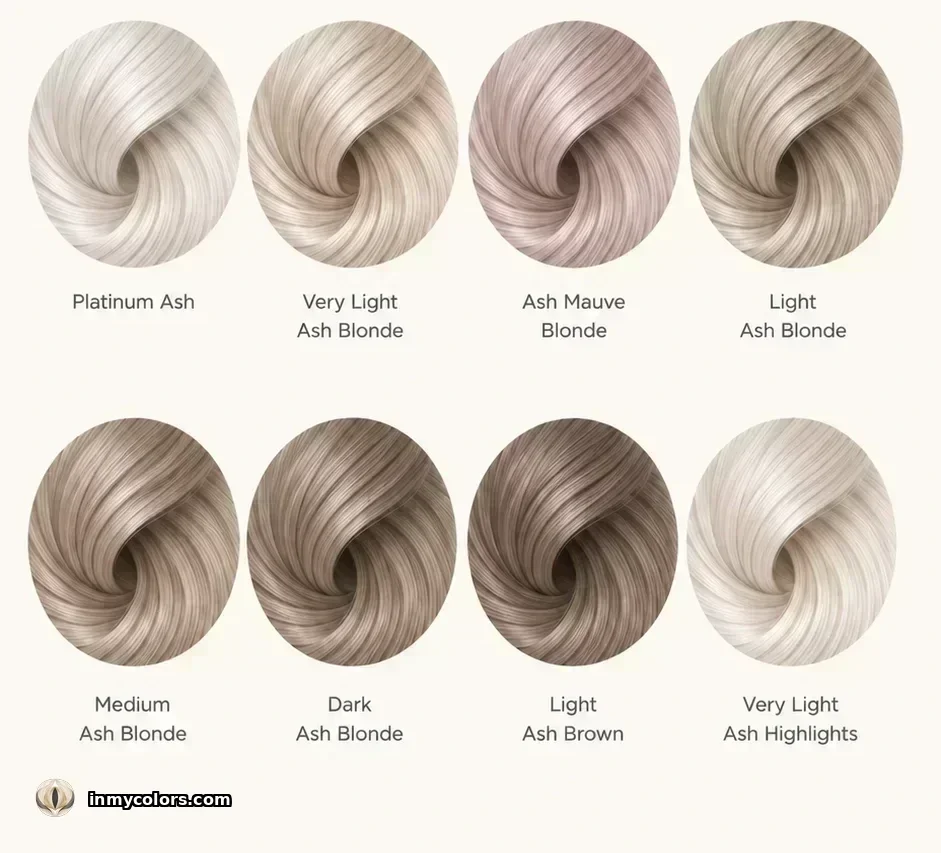
Natural colouring. True Summers typically have ash-toned hair: ash blonde, cool medium brown, or ash-toned darker blonde. The common quality is the absence of golden or warm undertones — even in lighter shades, the tone is cool and slightly greyed.
If you colour your hair. Work with your natural cool quality, not against it. Ash highlights, cool blonde tones, and soft ash-brown shades all support your natural colouring. The goal is to maintain or enhance the cool, slightly muted quality of your hair.
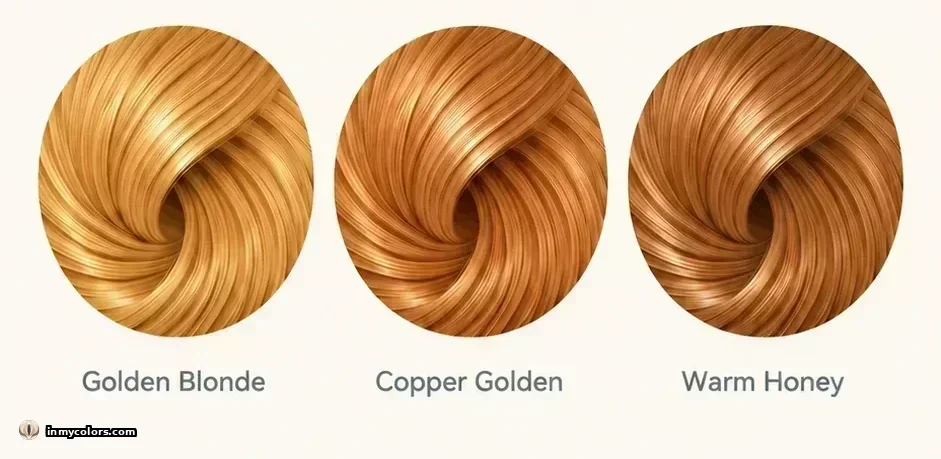
What to avoid. Golden highlights are perhaps the most common mistake for True Summers — they fight the undertone at the highest-visibility level (hair frames the face) and can make the skin look sallow. Warm reds are similarly wrong. Very dark brown (particularly warm dark brown) creates too much contrast and weight for this season.
True Summer Celebrities
A note on celebrity examples: these assignments are educated guesses — celebrity photos are professionally edited, lighting varies, and makeup is always applied. These names are commonly cited examples, not verified classifications. Use them as a rough visual reference, not a confirmation of your own season. The only reliable way to find your season is an objective analysis of your actual colouring — not a comparison to someone else's. Find yours at inmycolors.com.

Claire Foy is one of the most natural True Summer references in contemporary acting. Her ash blonde hair has no warmth — it reads cool and slightly silvery even in strong light. Her skin is cool and porcelain-fair, with a delicate rosy quality rather than any peachy or golden warmth. In the warm, vivid costumes required of some of her roles she can appear overwhelmed; in cool, muted tones she is effortlessly striking.

Nicole Kidman is one of the most cited True Summer examples. Very fair porcelain skin with a cool undertone, ash-strawberry blonde hair (the red quality is always muted and cool, never vivid orange-red), and cool blue-grey eyes. In warm or saturated colours she can appear washed out; in cool, muted tones — dusty rose, soft navy, cool lavender — she is at her most polished.

Joey King demonstrates True Summer at a younger, fresher expression: very fair cool skin, ash-toned blonde hair with no golden warmth, and pale blue eyes with a cool, clear quality. Her most striking looks are consistently in the cool, muted end of the palette — cool rose, soft navy, dusty mauve.

Miranda Kerr shows the rosy-skin quality that defines many True Summers: porcelain cool skin with a pink undertone, cool-toned blonde-brown hair, and cool blue-grey eyes. Her most harmonious looks are in the soft, cool, refined tones that characterise this season.
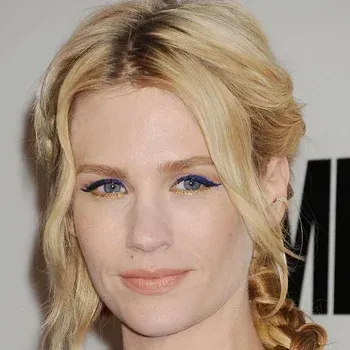
January Jones is one of the most consistently cited True Summer references. Ash blonde hair with no golden warmth, pale cool blue eyes, and very fair cool skin with a rosy undertone — her natural colouring has the quietly striking, cool-and-muted quality that defines the season.

Emily DiDonato demonstrates True Summer in a model context: cool ash-brown hair with no golden warmth, clear blue-grey eyes, and very fair cool skin. Her natural colouring has the quiet, refined clarity that makes this season so distinctive — understated but genuinely striking.

Helen Mirren is the iconic older True Summer reference. Formerly ash blonde (now silver-white, which sits beautifully on cool skin), grey-blue eyes, and fair cool skin. Her career-long instinct for refined, cool, understated colour is a masterclass in dressing the season correctly.
Common Misclassifications
True Summer vs. Light Summer. Light Summer is the palest, most delicate Summer — lower contrast, lighter features overall, lower chroma. True Summer has more depth and slightly more contrast. If you can wear soft navy without it overwhelming you, you are likely True Summer rather than Light Summer.
True Summer vs. Soft Summer. Soft Summer is the most muted of all seasons — sitting even lower in chroma than True Summer, with a slightly deeper quality and sometimes a greyed or dusty cast to the skin. True Summer has a little more clarity and a slightly fresher, cooler quality. Both are cool and muted, but True Summer is not quite as blended and low-contrast as Soft Summer.
True Summer vs. True Winter. Both sit firmly on the cool side of the temperature axis — but this is where the similarity ends. True Winter is vivid, high-contrast, and deep. True Summer is always muted and moderate. If you put on a vivid, saturated colour and it makes you look alive and powerful, you may be Winter. If it overwhelms you, you are almost certainly Summer.
Getting Your Season
True Summer is one of the most frequently mislabelled seasons — partly because the cultural defaults (stark white, black, vivid colour) are so far from what actually works, and partly because the cool-and-muted combination can be misread as neutral or "no season at all". The result is a lot of True Summers wearing the wrong palette without ever understanding why something feels off.
The right colours for True Summer do not shout. They do not ask for attention. They simply make you look more rested, more refined, and more like yourself — which is, in the end, the whole point of colour analysis.
Find your season at inmycolors.com.