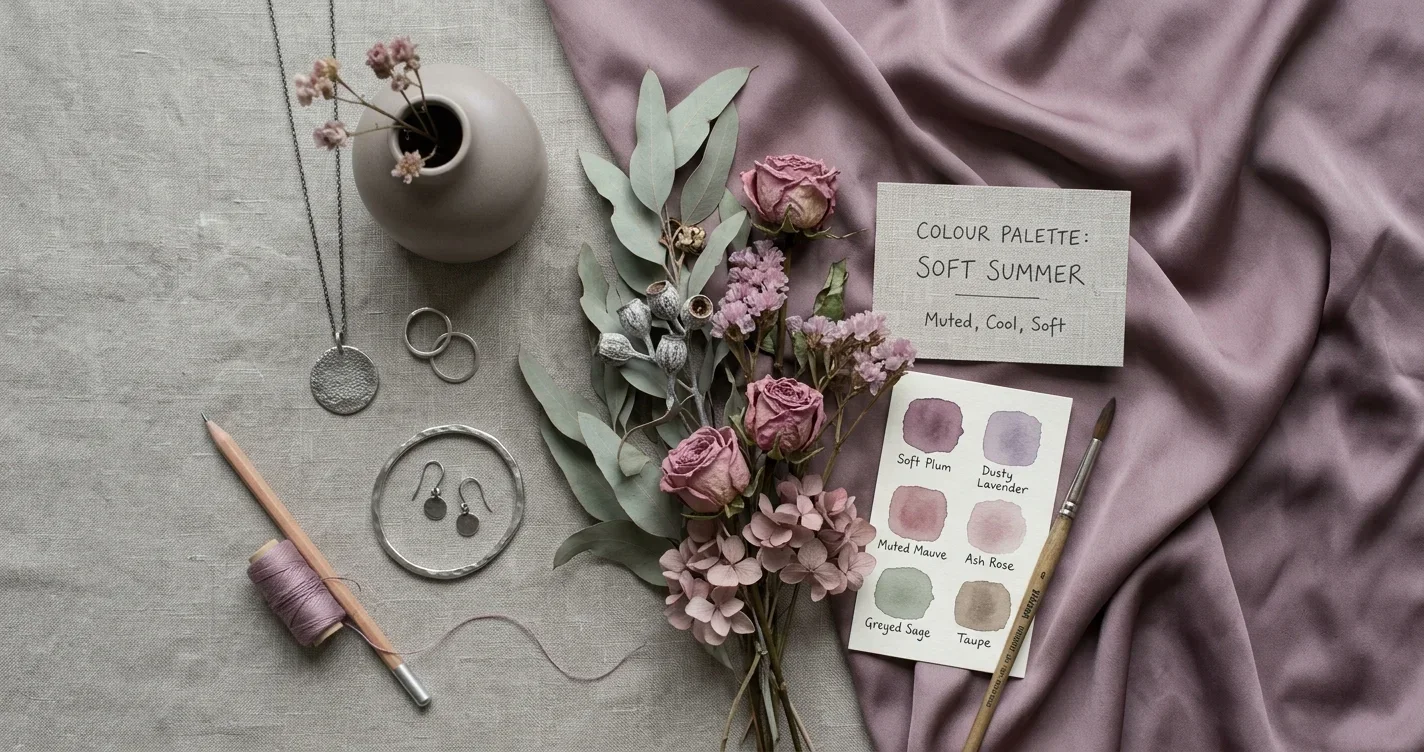
If you have heard "you look tired" when you wear what seem like perfectly reasonable colours — earthy tones, vivid shades, even black — but feel quietly right in dusty mauves and muted blue-greys you would never have chosen yourself, Soft Summer may be your answer. This is the most muted season in the entire 12-season system. Not the softest of the Summers, not just a muted version of something else — it is the season with the lowest overall chroma of all twelve.
Soft Summer sits where cool temperature meets the absolute minimum in colour saturation. Understanding this season is largely about understanding what "muted" actually means at its most extreme — and why the right palette, once found, looks so effortlessly polished.
What Makes a Soft Summer
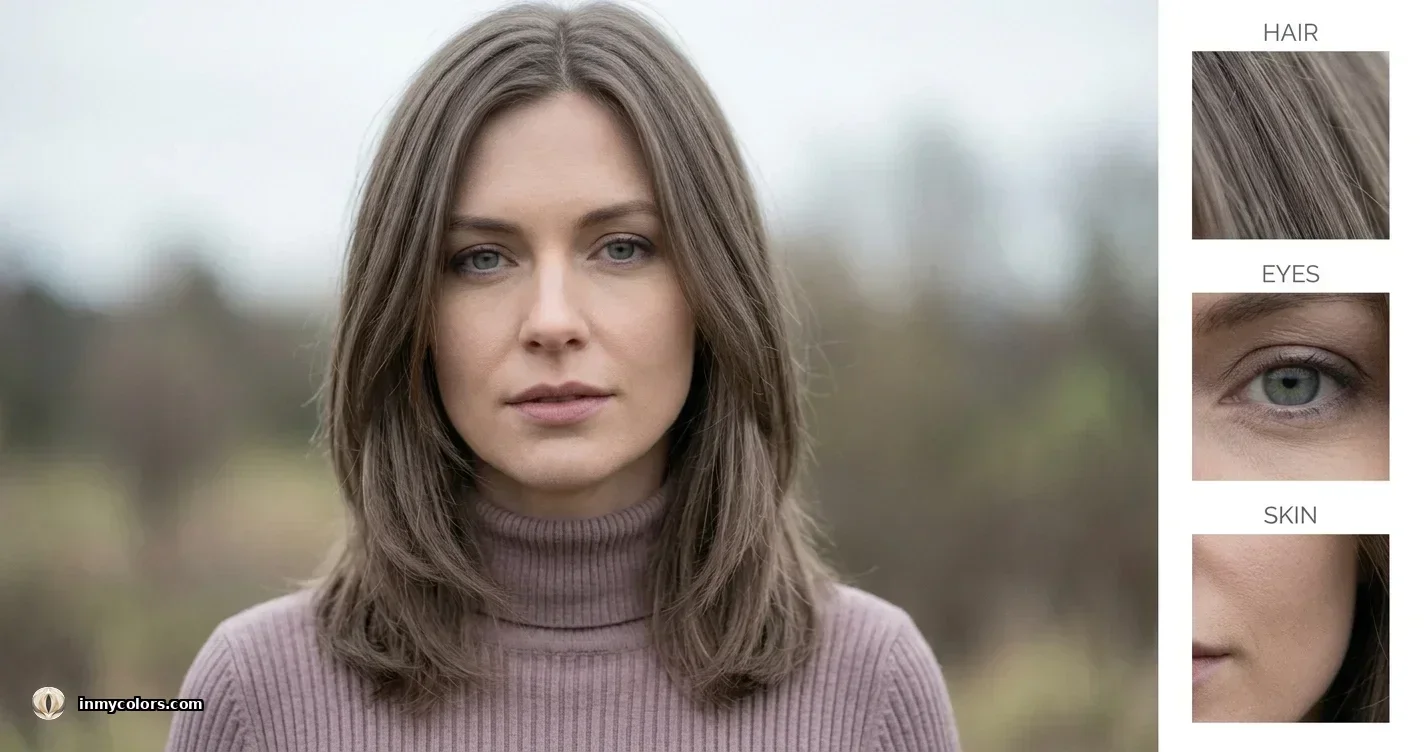
The three axes — temperature, value, and chroma — define every season. For Soft Summer:
Cool temperature. Soft Summer is definitively cool. This is the fact that distinguishes it from its nearest neighbour, Soft Autumn, and it is the most important diagnostic point for this season. Your skin, hair, and eyes all carry a cool quality — no warmth, no peachy or golden cast. Skin may appear slightly greyed or rosy-beige. Hair is ash or cool medium-brown. Eyes tend to have a greyed quality — grey-green, grey-blue, soft cool hazel.
Moderate value. Soft Summer sits at a moderate depth — not as light as Light Summer, not as deep as some Winter or Autumn seasons. There is a medium quality to the complexion and features that places it in the middle of the value axis.
Lowest chroma — the defining feature. No season sits lower in chroma than Soft Summer. Every colour in the natural Soft Summer palette is heavily muted — blended, greyed, diffused. This is what makes Soft Summer the hardest season for outsiders to dress correctly. The palette can look bland or without character until it is placed next to the right colouring, at which point it suddenly looks perfectly calibrated.
The seasonal analogy: Soft Summer is a watercolour painting washed with grey. Every colour is present but blended into a unified, low-contrast, beautifully muted whole. The aesthetic is understated in a way that looks considered rather than accidental.
The Soft Summer Colour Palette
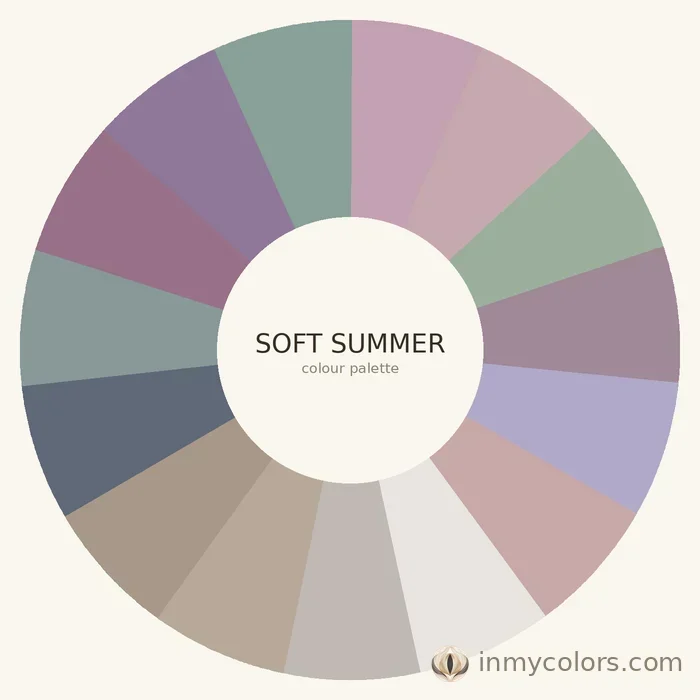
Soft Summer's palette is the most blended and muted available. Every colour must share the quality of being greyed, diffused, and cool.
Foundation neutrals are themselves muted and slightly complex — they do not read as simply "grey" or "beige" but as a hybrid of the two, which mirrors the season's own blended quality. Cool greige, warm grey, soft taupe, muted cocoa, and deep navy form the base.
Core colours all share the greyed, low-saturation, cool quality that makes them right for this season. Dusty mauve is perhaps the single most characteristic Soft Summer colour. Ash rose, greyed sage, soft plum, dusty lavender, and muted blue-grey complete the working palette.
Accent colours are consistent with the low-chroma principle — even the season's most statement pieces should be muted. Dusty teal, muted berry, greyed plum, and cool sage.
What to avoid. Warm tones are the most common error — rust, terracotta, camel, gold, warm brown all look jarring against Soft Summer's cool undertone. Vivid, saturated colours overwhelm a chroma level built around muting. Stark black creates too much contrast. Pure white reads as harsh. Vivid warm orange and rust are perhaps the worst choices of all.
Soft Summer in the Wardrobe
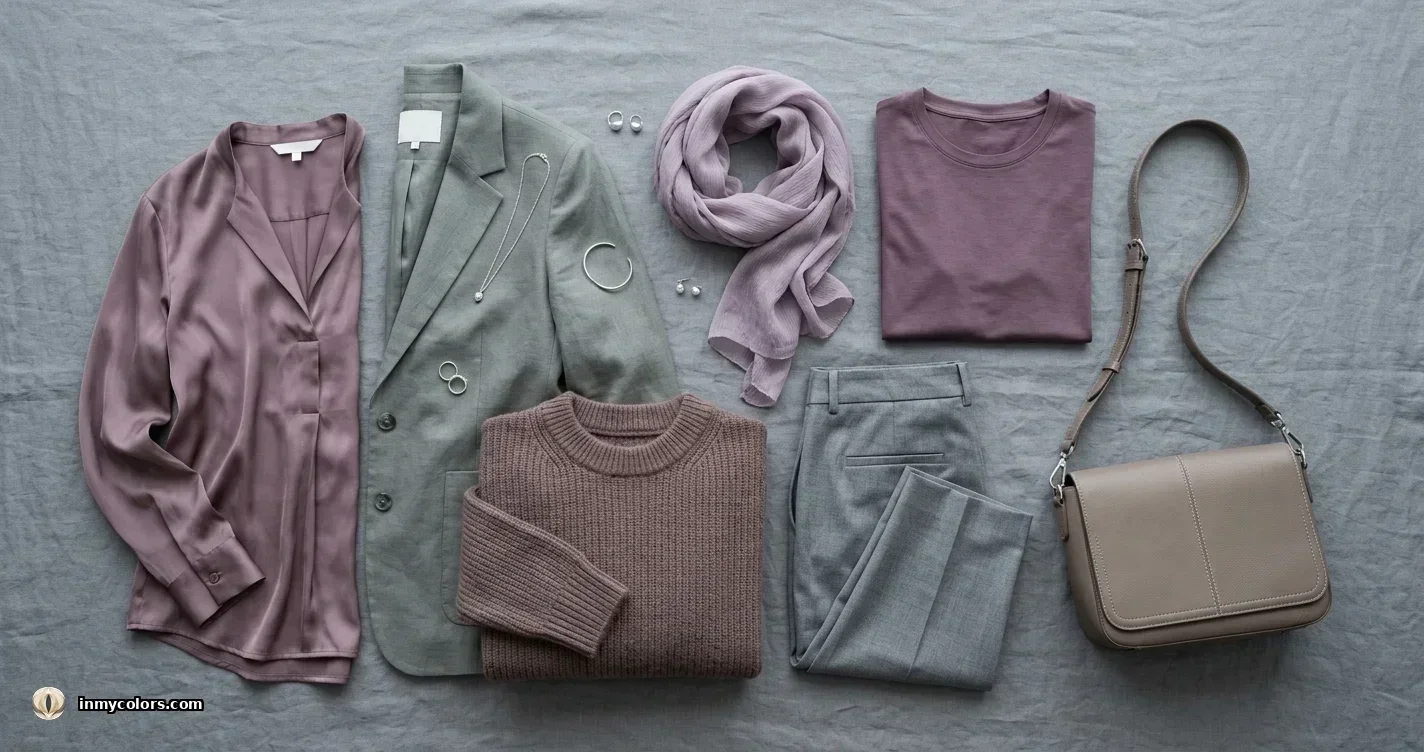
Building a Soft Summer wardrobe means accepting that vibrancy is not the goal. The palette works by cohesion — everything within it blends harmoniously, creating an overall impression of refined quietness.
The base layer. Cool greige and soft pewter replace black as the anchor neutral. Muted blue-grey and dusty mauve can both function as near-neutral foundations for a Soft Summer wardrobe — they are close enough in tone to the skin and hair that they read as understated basics. If you need more depth in an anchor piece, soft cool charcoal rather than black or warm dark brown.
Tops and blouses. Dusty mauve, muted blue-grey, cool greyed sage, soft plum, and dusty rose are all excellent. The consistent quality to look for when shopping: does the colour look slightly greyed or dusty? If so, it is likely in range. Vivid or saturated versions of otherwise right-direction colours — a vivid plum instead of a muted plum, a bright teal instead of a muted teal — are wrong even if the hue is correct.
Outerwear. Cool greige is an excellent coat colour for Soft Summer — sophisticated, understated, and entirely in range. Soft pewter, muted taupe, and dusty blue-grey all work well. The classic camel coat, beloved of many style guides, is genuinely wrong for this season despite its prestige — it brings warmth that fights the undertone.
Patterns. Muted florals in the core palette range. Soft watercolour effects. Fine prints where no single colour is vivid. Abstract patterns in greyed, blended tones. The pattern should read overall as muted — even if it contains multiple colours, none of them should read as bright or high-contrast.
Metals. Pewter is the natural metal for Soft Summer — it mirrors the season's own greyed, cool quality precisely. Silver and white gold also work. Cool rose gold (more silver than pink) can occasionally work. Yellow gold and warm-toned metals conflict with the cool undertone.
Soft Summer Makeup
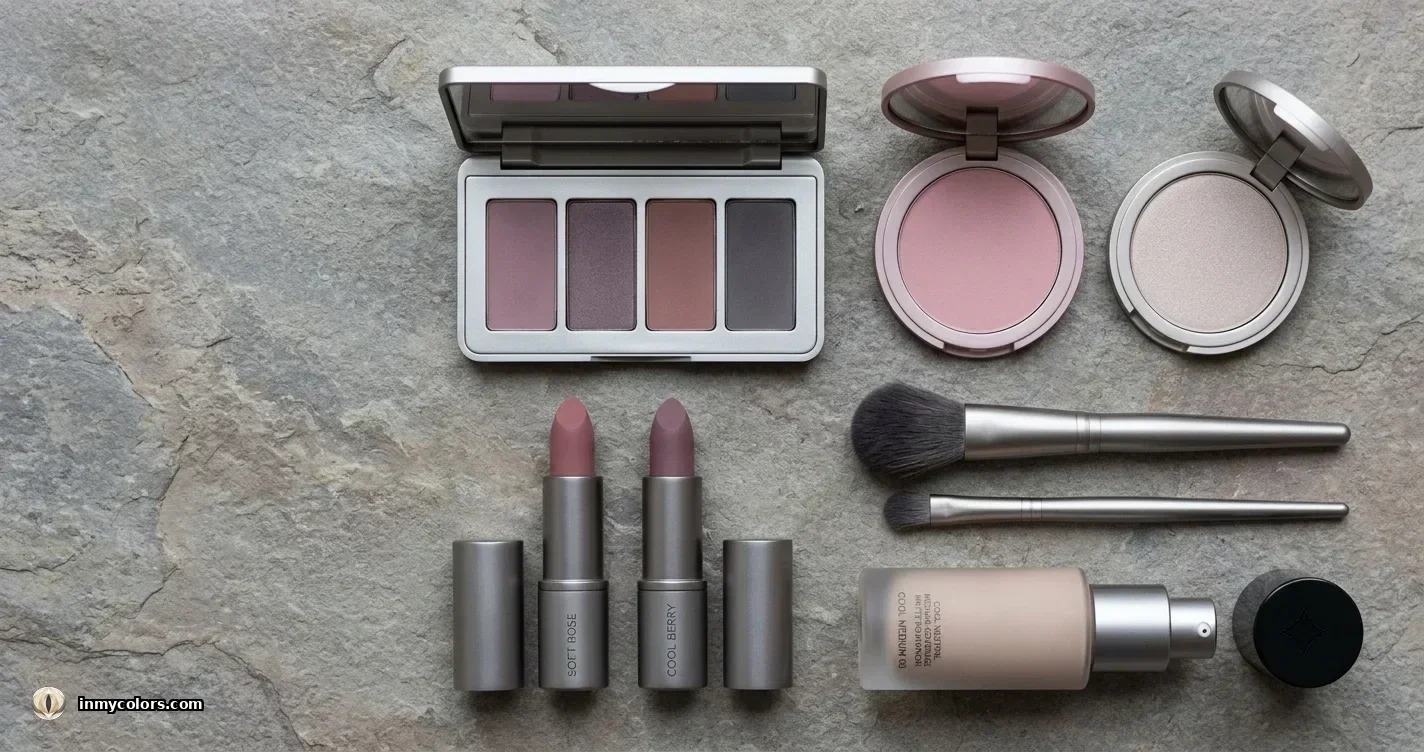
Soft Summer makeup follows the same principle as the palette: everything cool, everything muted, nothing vivid.
Foundation. A cool-undertoned base, slightly deeper in tone than Light Summer's, to match the moderate-value complexion. Look for foundations with pink-beige or neutral-cool undertones. The complexion often has a slightly greyed or muted quality that warm foundations make worse — a cool, accurately matched base removes any greyness and makes the skin read as fresh.
Blush. Very muted cool rose or dusty mauve blush. The key word is "very muted" — Soft Summer blush should read as barely perceptible colour rather than a defined placement. Any warmth in a blush shade (peach, apricot, warm coral) will read as incongruous against the cool undertone.
Lips. Dusty mauve is the signature Soft Summer lip — it sits precisely within the season's core palette and works across a range of occasions. Soft plum, muted cool burgundy, and greyed rose-berry all work. Nude lip colours are tricky for this season: warm nudes go grey, and too-light nudes disappear. A mid-depth dusty mauve nude tends to be the most functional option.
Eyes. Muted grey-taupe, soft plum, greyed brown, and cool blue-grey for shadow. Nothing vivid. The defining quality to look for in an eyeshadow palette: everything should be muted, and the range should contain no bright or warm tones. Pewter or very soft silver liner. Brown-black or soft grey mascara.
What to avoid. Bronzer — it introduces warmth that directly conflicts with the undertone. Vivid eyeshadow colours. Heavy contrast, whether in liner, shadow placement, or contouring. The temptation, with a complexion that can read as greyed or slightly flat without makeup, is to add drama — but Soft Summer colouring needs blending, not drama.
Soft Summer Hair
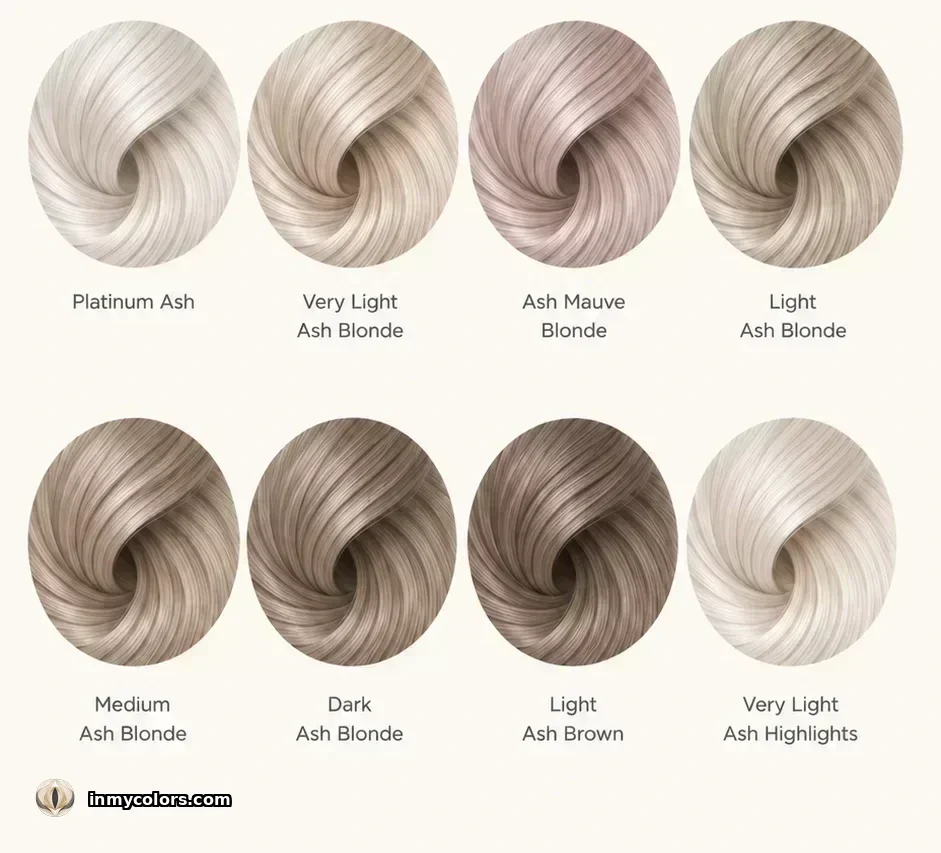
Natural colouring. Soft Summer hair tends to be ash or cool medium-brown, or sometimes a darker ash blonde. The consistent quality is that it is distinctly not warm — no golden, honey, or reddish cast. There may be a slightly greyed quality to the tone in certain lights.
If you colour your hair. The aim is to maintain the cool, muted quality of the natural hair. Muted ash highlights, cool dark blonde tones, and cool brown shades with no warmth are all appropriate. Subtle cool balayage — adding dimension without warmth — can work well.
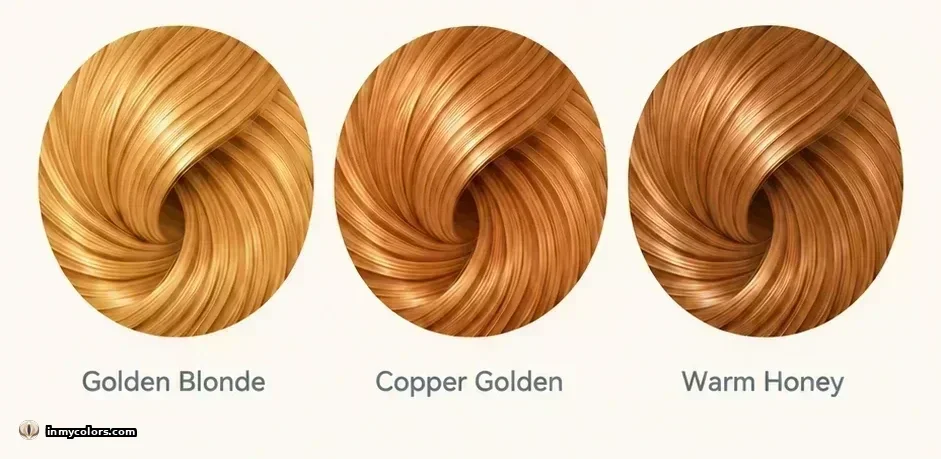
What to avoid. Warm tones are particularly dangerous for Soft Summer, for the same reason they are dangerous in the wardrobe and makeup: the season's muting and moderate depth can superficially suggest it might tolerate warmth. It cannot. Golden highlights, warm honey, caramel, warm red, and auburn all fight the undertone visibly — the contrast between warm hair and cool skin is immediately apparent at the highest-visibility point (the face).
Soft Summer Celebrities
A note on celebrity examples: these assignments are educated guesses — celebrity photos are professionally edited, lighting varies, and makeup is always applied. These names are commonly cited examples, not verified classifications. Use them as a rough visual reference, not a confirmation of your own season. The only reliable way to find your season is an objective analysis of your actual colouring — not a comparison to someone else's. Find yours at inmycolors.com.
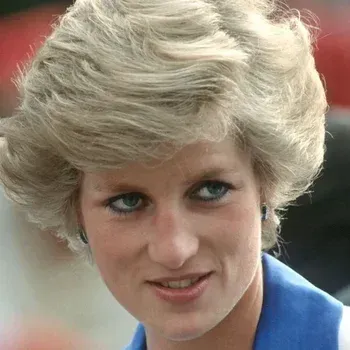
Princess Diana is perhaps the most iconic Soft Summer reference. Her ash-to-medium cool blonde hair carried no golden warmth, her complexion was fair and cool with a subtle rosy quality, and her eyes were a characteristic Soft Summer grey-blue. Her most memorable wardrobe choices — dusty rose, soft powder blue, muted lavender — mapped precisely to the season's palette. She is one of the clearest historical examples of how Soft Summer colouring responds to its correct colours with quiet radiance.
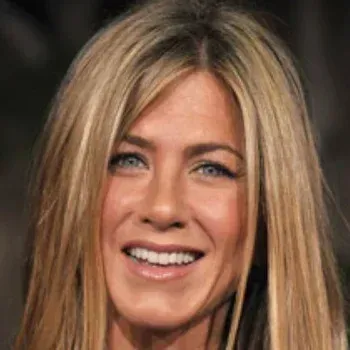
Jennifer Aniston is often cited in this context — cool medium complexion, ash or cool medium-brown hair in its natural state, and eyes with a soft greyed quality. Her colouring has the characteristic muted, blended quality of the season, and she is most effortlessly striking in the cool, understated tones that define this palette.
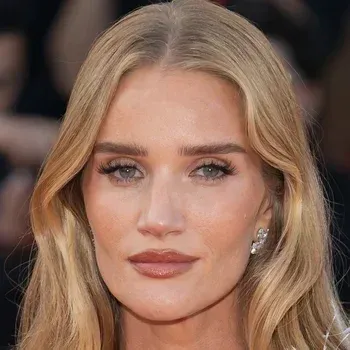
Rosie Huntington-Whiteley demonstrates Soft Summer at its most contemporary: very fair cool skin, ash-to-light blonde hair with a distinctly cool, non-golden quality, and cool blue-grey eyes. Her most consistently successful looks are in the muted, understated cool range — pale greys, dusty nudes, and soft cool tones that mirror her natural colouring.
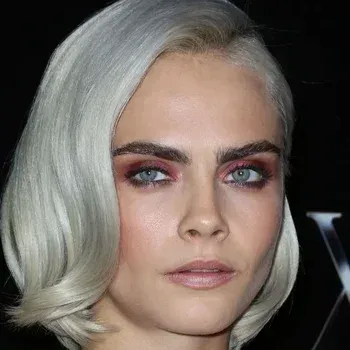
Cara Delevingne shows Soft Summer colouring anchored by her distinctly cool features: cool blue-grey eyes, a fair cool complexion, and naturally ash-brown colouring. Her colouring has the blended, moderate quality of the season, and she is at her most natural in cool, muted tones rather than vivid or warm colour choices.

Olivia Wilde demonstrates Soft Summer with a clear, recognisable set of cool traits: blue-grey eyes, a fair cool complexion with no peachy or golden warmth, and medium blonde hair. Her colouring has the moderate value and muted, blended quality the season is built around — most effortless in understated cool tones.
Common Misclassifications
Soft Summer vs. Soft Autumn — the critical diagnostic. This is the most important distinction in colour analysis for this season, and the most difficult to call correctly. Both Soft Summer and Soft Autumn share the lowest-chroma end of the spectrum. Both have moderate value. Both have a muted, blended quality that can look similar at first glance. The only diagnostic is temperature.
Soft Summer is cool. Soft Autumn is warm. In practice, the best diagnostic tool is the vein test: look at the inside of your wrist in natural light. Blue or blue-purple veins indicate a cool undertone — Summer. Green veins indicate a warm undertone — Autumn. Additionally: does gold or silver jewellery look better against your skin? Silver or white gold confirms cool (Summer); yellow gold confirms warm (Autumn). This single axis — temperature — is the complete diagnostic between these two seasons.
Soft Summer vs. True Summer. True Summer has slightly more clarity and slightly more contrast than Soft Summer. True Summer is cool and moderately muted; Soft Summer takes the muting to its extreme. If you feel that even soft navy is a little much, and find yourself most comfortable in the most diffused, blended version of any colour, you are likely Soft Summer rather than True Summer.
Getting Your Season
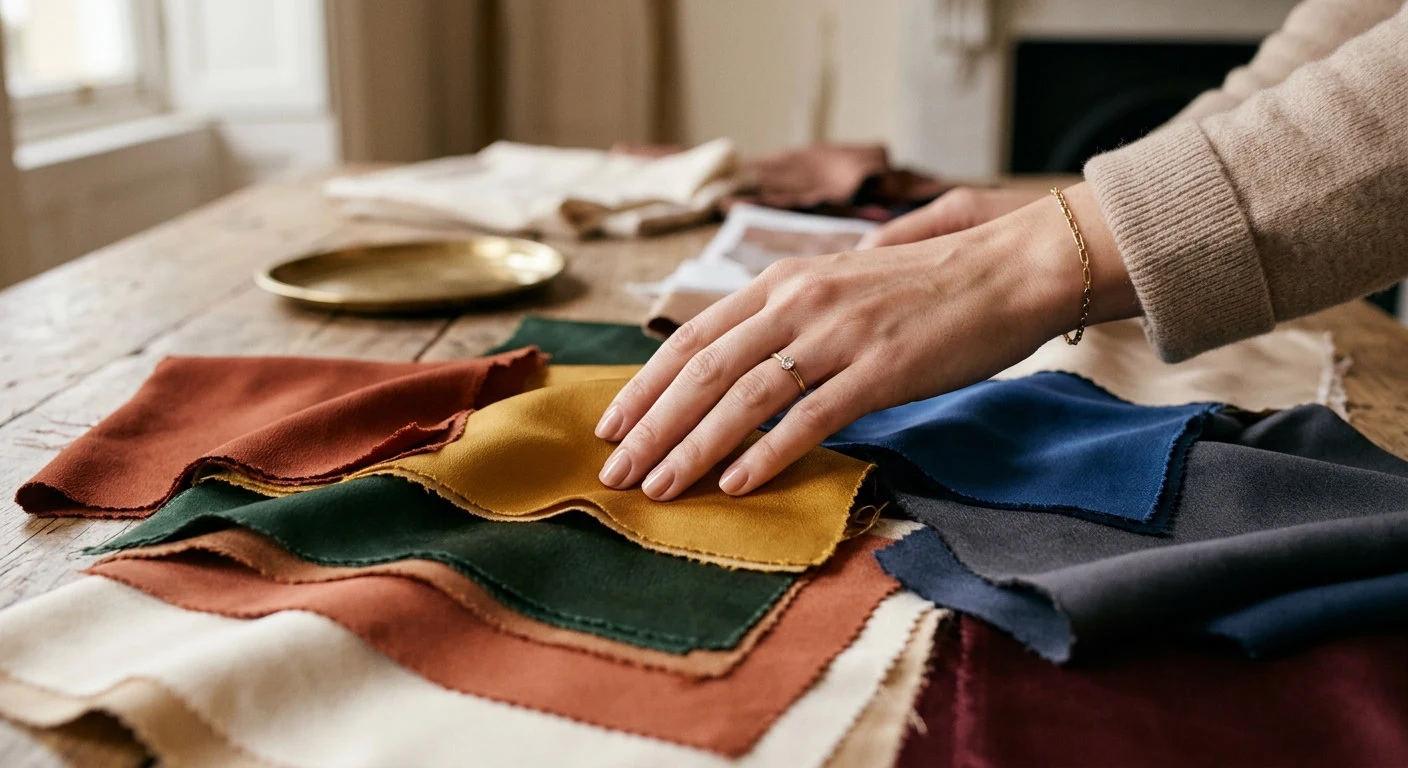
Soft Summer is genuinely one of the most under-discussed seasons in popular colour analysis content — partly because its palette looks unremarkable on a swatch sheet, and partly because it sits so close to Soft Autumn that misclassification is common. Many Soft Summers have been told they are warm when they are, in fact, definitively cool.
The practical cost of that misclassification is significant. A Soft Summer wearing a warm palette may feel that her colours are "earthy" and "grounding" but never entirely right — a persistent sense of something slightly off that she cannot name. In the correct cool, muted palette, that dissonance disappears entirely.
Find your season at inmycolors.com.