The most common misuse of personal colour analysis is treating the season as a list of banned colours.
"I'm a Summer so I can't wear orange."
"I'm a Winter so I can't wear camel."
"I'm an Autumn so I can't wear blue."
All three of these statements are wrong. Not slightly wrong — fundamentally wrong. They misrepresent how the season system works and produce a result that is more restrictive, more confusing, and ultimately less useful than the system is designed to be.
The Shade Principle is the corrective. It is the most important single concept in personal colour analysis, and it is surprisingly rarely stated clearly.
The Shade Principle, Stated Simply
Your season does not restrict which colour families you can wear. It specifies which shade of every colour family harmonises with your natural colouring.
Every colour family — every hue on the colour wheel — exists in both warm and cool variants, in both muted and clear variants, in both light and deep variants. The season tells you which position on those axes is yours. It does not exclude colour families. It filters shades within families.
There is a shade of orange for every season.
There is a shade of blue for every season.
There is a shade of green for every season.
There is even a shade of black-equivalent for every season.
The work of understanding your season is not learning which colours to avoid. It is learning which version of every colour belongs to you.
Why the Myth Persists
The "banned colours" interpretation of seasonal colour analysis comes from how season palettes are typically presented. A palette card for True Summer includes roughly 30–50 colours. Those colours represent the safe, clearly in-season shades — the ones that most reliably harmonise with True Summer colouring.
What the palette card cannot convey is that the colours NOT on the card are not banned — they simply require more careful shade selection. The palette shows you the clear wins. It doesn't show you the many adjacent shades that also work, or explain the principle that lets you navigate shades not on the card.
The result: people treat the palette as a complete list, conclude that anything outside it is forbidden, and end up with an unnecessarily restricted wardrobe and a distorted understanding of what their season means.
The Temperature Filter
The operative filter for most shade selection is temperature. Within almost any colour family, you can find a warm version and a cool version. Your season's temperature tells you which one is yours.
Blue for warm seasons:
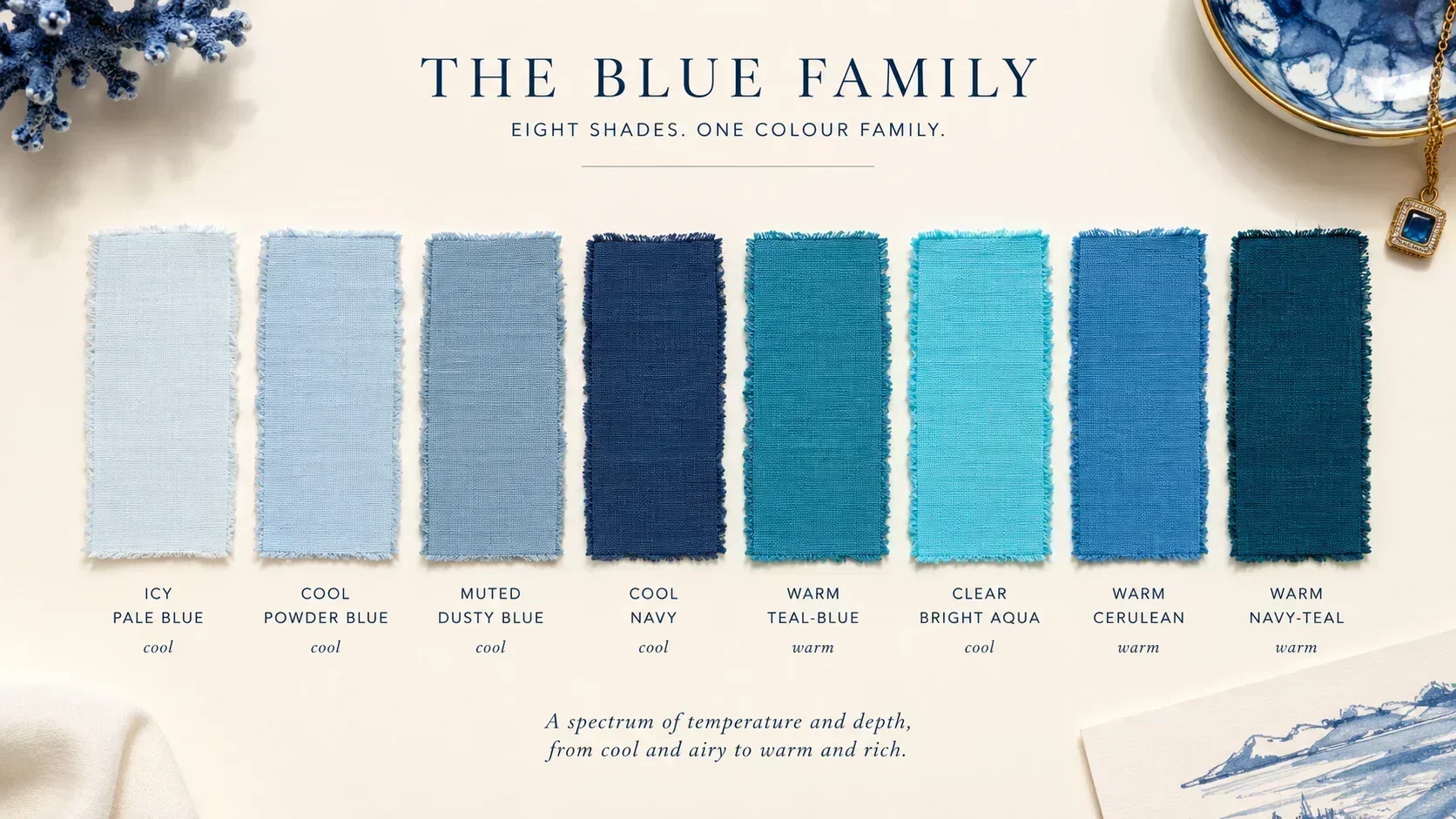
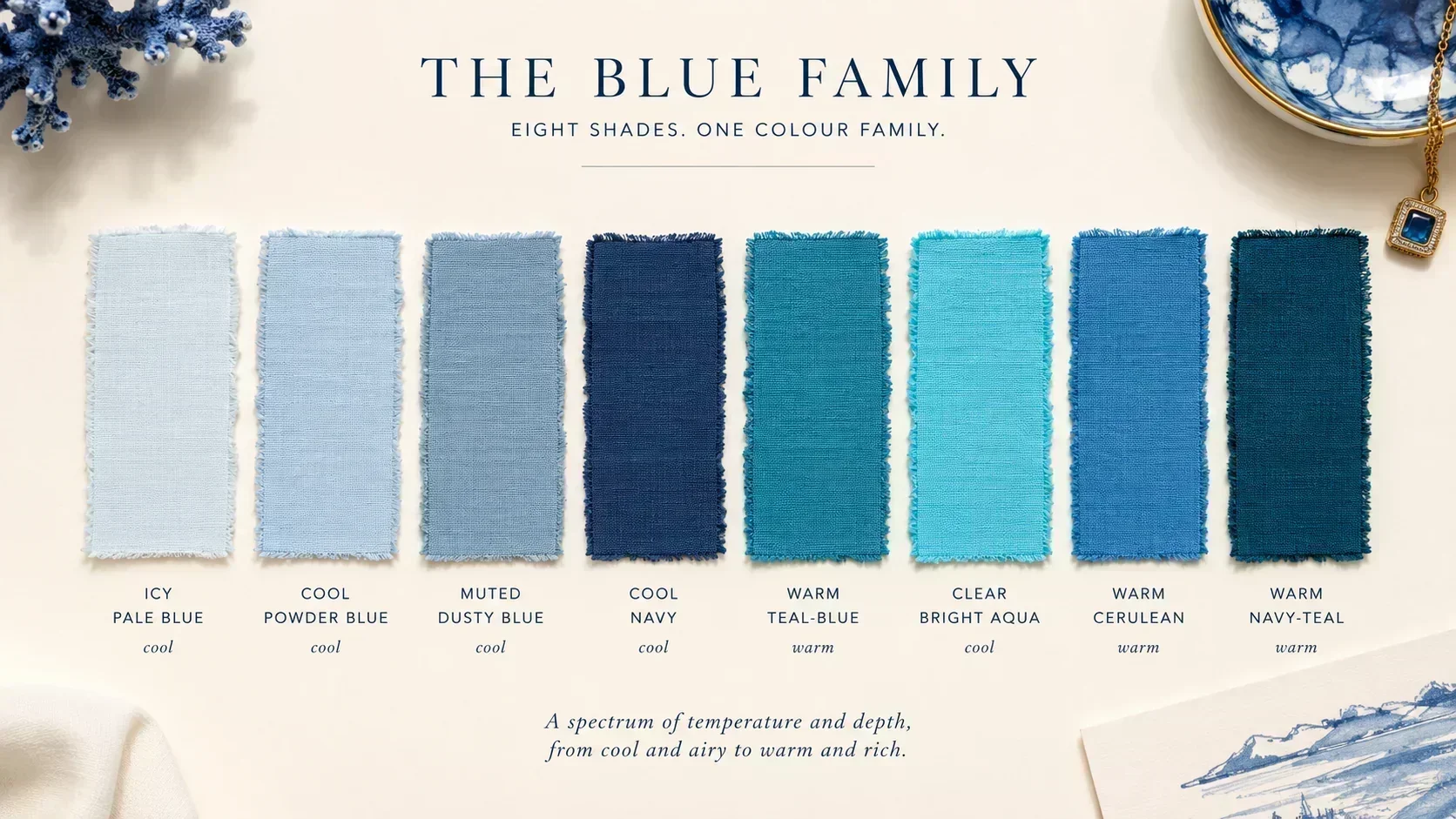
Warm undertone does not mean no blue. It means the blue needs to have warmth in it — a slight green (teal), a slight yellow (warm cobalt), or depth without coolness (warm navy). Warm seasons — Springs and Autumns — can wear: warm teal, warm aqua, warm cerulean, warm navy-teal, periwinkle with warm cast. They should avoid: icy blue, cool powder blue, cool steel blue, blue-grey.
Blue for cool seasons:
Cool seasons — Summers and Winters — can wear the full range of cool blues: icy blue, powder blue, cool navy, cool steel blue, blue-grey, royal blue. The one limitation for Summers is chroma — vivid electric blue is a Winter colour, not a Summer one.
The colour family is the same. The temperature is different. The result is two entirely valid approaches to wearing blue — one for warm seasons, one for cool seasons.
Orange: A Case Study
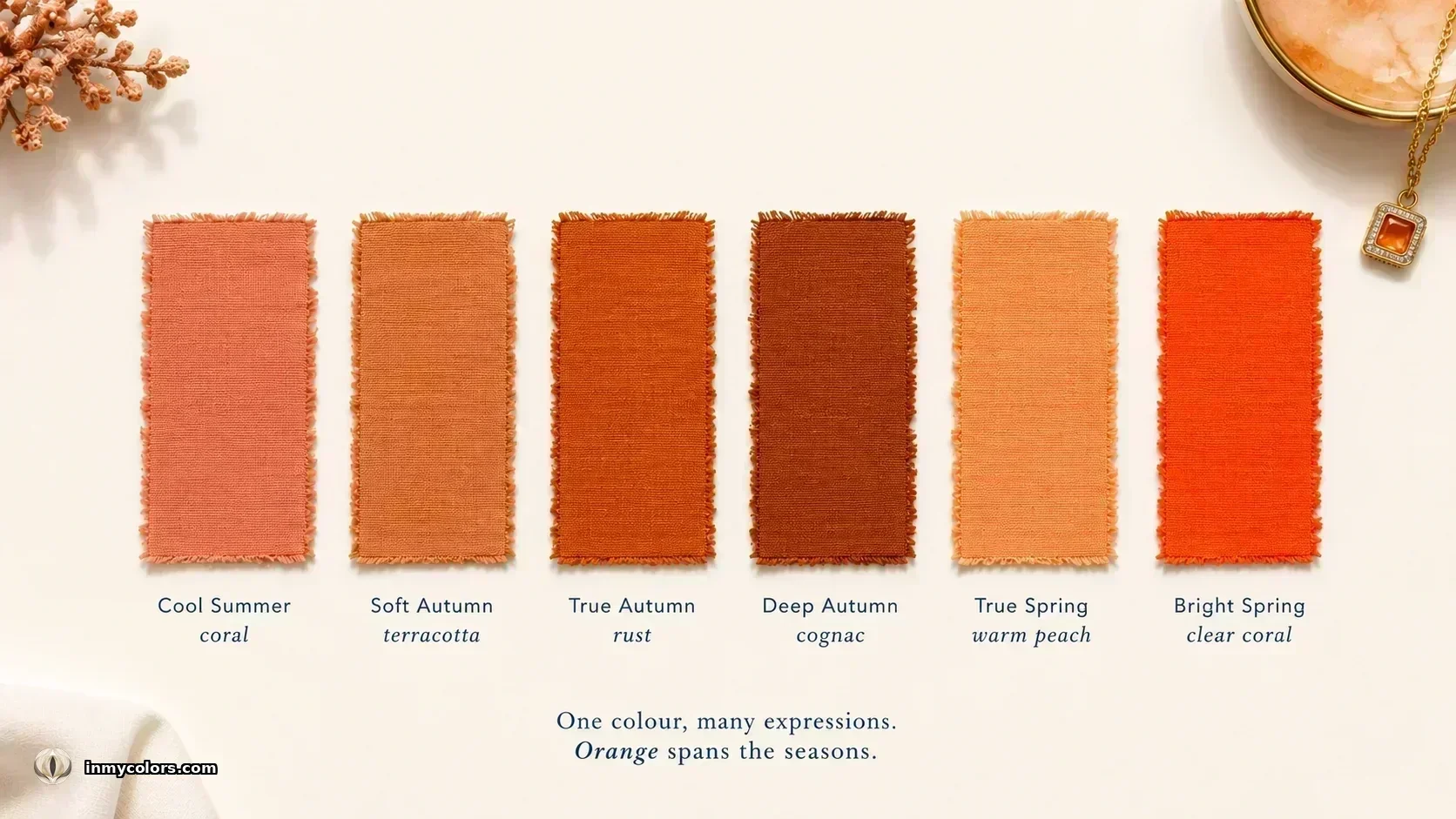
Orange is the colour most often treated as forbidden by the wrong seasons. "Oranges are for Autumns" is a common piece of colour advice that, in this blunt form, is incorrect.
What orange looks like in each season family:
Summer (cool, soft): cooled-down, muted coral. A terracotta that has been greyed down until it reads almost as a neutral. Muted salmon. Dusty melon. These are orange-family colours — they would be classified as orange or near-orange in a colour wheel — but they have been cooled and muted until they sit within Summer's range. A True Summer in muted terracotta is wearing orange. She is wearing the cool, muted version of orange that belongs to her season.
Autumn (warm, muted): rust, terracotta, warm burnt sienna, deep amber. These are the archetypal orange-family colours — warm, rich, earthy. A True Autumn in rust is wearing orange fully and correctly.
Winter (cool, clear): vivid red-orange with cool cast, or vivid coral with a cool blue-red lean. A stark, vivid version of orange that reads as sharp and bright. Rare in Winter palettes but not absent — a True Winter can wear a vivid coral with cool undertones, often described as "neon coral" or "clear coral." The cool, vivid version of orange.
Spring (warm, clear): warm peach, warm salmon, warm coral, clear warm orange. Light Springs wear lighter, peachy versions. True Springs wear warm clear coral-orange. Bright Springs can wear vivid warm orange.
Every season has access to the orange family. Every season has a specific shade of that family. The shade is everything.
Black: The Most Misunderstood Case
Black is the colour most often declared "off-limits" for warm seasons — and the declaration is imprecise.
The accurate statement: stark optical black — the black of a tuxedo lapel, the deepest, most neutral black — is a Winter colour. It is cool, deep, and neutral. Worn by Winters, it is exactly right. Worn by a True Spring, it creates visual tension: the cool depth of the black fights the warm, lighter Spring colouring.
The Shade Principle applied: the equivalent of black for warm seasons is not "no dark neutrals." It is dark warm brown or very dark warm charcoal. A very dark warm brown, in a tailored blazer, reads as functionally black in most outfit contexts — dark enough to be a neutral anchor, versatile enough to work with all other pieces in the wardrobe. The temperature is warm; the value is dark; the effect is the same dark anchor that black provides for Winters.
Deep Autumns and True Autumns can wear near-black in the form of very dark warm brown or very dark warm charcoal. The colour reads as black. The temperature is theirs. The Shade Principle applies perfectly.
Similarly, Summers — who are advised to avoid stark black — can wear cool dark charcoal or very dark cool navy, which function as effective neutral anchors within the Summer palette without the high-contrast starkness of pure black.
White: The Nuanced Case
White, like black, appears to be a single colour. It is not.
Stark optical white — the white of printer paper, the white of a stark white shirt — is a cool colour. It is high in value, low in warmth. For cool seasons (Summers and Winters), it is available in varying degrees of brightness: bright white for Winters, soft cool white for Summers.
For warm seasons (Springs and Autumns), warm white or ivory is the equivalent shade. Warm ivory has a slight golden or cream cast that sits within the warm temperature range. In outfit contexts, warm ivory reads as white — the outfit's white anchor — but without the temperature conflict that stark cool white creates against warm skin.
The distinction is subtle enough that most people would not notice it in a garment on a hanger. The distinction on the face, in natural light, is visible: stark white against warm skin reads slightly cold, slightly harsh. Warm ivory against warm skin reads clear and luminous.
The Pattern Rule
The Shade Principle extends to patterns.
A pattern consists of multiple colours in a specific relationship. The temperature of those colours, and the contrast between them, determines whether the pattern is in-season.
A warm-season person can wear a stripe. The stripe needs to be warm-warm (camel and cream, rust and ivory, olive and warm tan) or warm-neutral (warm navy-teal and warm ivory). A stripe that is stark navy-and-white will have the same temperature problem as wearing stark navy and stark white separately.
A cool-season person can wear a plaid. The plaid needs to be in cool tones — cool grey and navy, soft blue and white, plum and grey. A warm tartan in rust, golden yellow, and camel is a temperature mismatch.
The pattern is in-season when the colours that compose it are individually in-season. The principle is the same at the pattern level as at the single-colour level.
Using the Shade Principle in Practice
The practical application: when you encounter a colour you want to wear that seems to be "outside your season," before accepting the verdict, ask:
What is the temperature of this specific shade? Not the colour family — the specific piece in front of you. Warm, cool, or neutral? If it matches your temperature, it is likely to work regardless of what the colour family label says.
What is the chroma? Vivid or muted? If your season is muted (Soft Summer, Soft Autumn) and the piece is vivid, it may be too saturated regardless of temperature. If your season is clear (Bright Spring, Bright Winter) and the piece is muted, it may not provide enough saturation to harmonise.
What is the value? Light or deep? If your season is light (Light Spring, Light Summer) and the piece is very dark, the value contrast may be too high for your colouring to carry.
If the specific shade passes all three filters — correct temperature, appropriate chroma, compatible value — it is likely in your season, even if the colour family is not on your palette card.
This is not a licence to wear anything. It is a framework for making intelligent shade decisions rather than defaulting to either "follow the palette card rigidly" or "ignore the season entirely."
The Shade Principle and Shopping
In practice, the Shade Principle means that shopping with a season is not about avoiding colour departments. It is about developing a rapid temperature filter that you apply to every piece you consider.
You pick up a blue blouse. Immediately: warm blue or cool blue? If you are True Autumn, you need warm blue — does this one have it? The teal cast makes it warm. Yes, this works.
You pick up a white shirt. Warm white or cool white? If you are True Spring, you need warm white — is this one ivory or stark? It has a cream quality. Yes, this works.
You pick up an orange dress. Is the orange warm-muted (in season for Autumn), warm-clear (in season for Spring), cool-muted (in season for Summer), or cool-vivid (possible for a Winter edge case)? The answer tells you whether this specific piece is yours.
The season gives you the filter. The Shade Principle teaches you how to apply it to every colour in existence, not just the ones on the palette card.