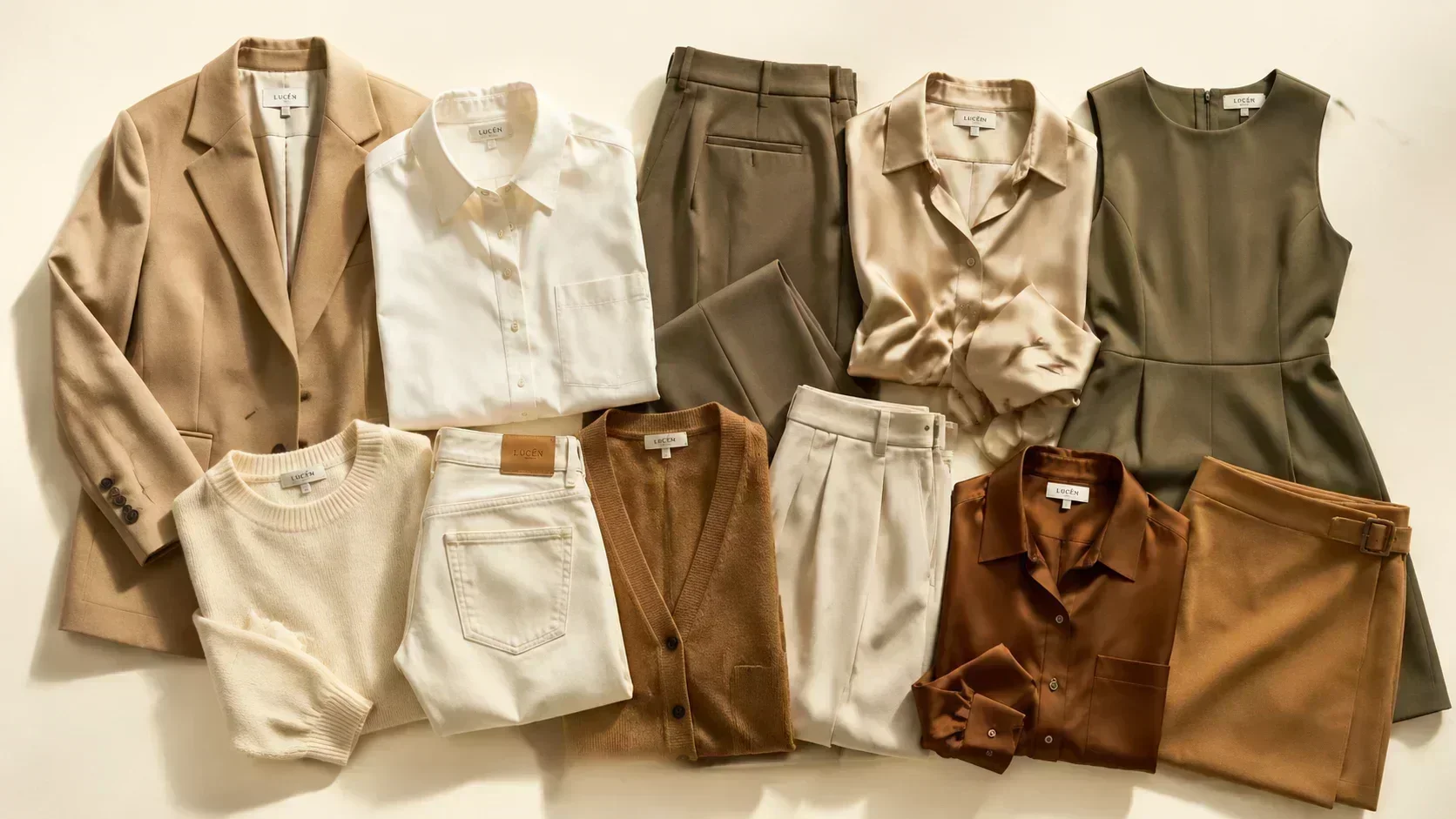
The capsule wardrobe concept has been one of the most widely shared ideas in fashion for the past decade. The principle is simple and correct: a small collection of well-chosen, coordinating pieces provides more outfit variety than a large collection of pieces that don't work together.
The problem is implementation. Most capsule wardrobe guides list the same twelve items — white shirt, black trousers, camel coat, blue jeans — and present them as universally applicable. They are not. They work reliably for certain people and consistently fail others. The reason is colour temperature.
A capsule wardrobe built in the wrong colour temperature does not coordinate. The warm camel coat that is the foundation of every capsule wardrobe guide sits next to a stark white shirt and cool grey trousers — and the pieces don't quite work together, because the temperatures are fighting. The person wearing the outfit looks good in neither item, because the camel drains the cool undertone and the white and grey fight the warmth of the coat.
Colour temperature is the missing variable in almost every capsule wardrobe system. Your season solves it.
Why Temperature Is Everything
A functional capsule wardrobe has one essential property: everything coordinates with everything else. A ten-piece collection that produces forty outfit combinations works; a forty-piece collection that produces twelve works poorly and wastes space, money, and decision-making energy.
The coordination principle is temperature. Two pieces coordinate reliably when they share the same colour temperature — warm with warm, cool with cool. When everything in your wardrobe is within your season's temperature range, every piece pairs with every other piece. The mathematics are straightforward: ten items produce 45 two-piece combinations and 120 three-piece combinations. When all 45 pairs coordinate, you have a genuinely functional wardrobe.
When the temperatures are mixed — as they are in most wardrobes and in most generic capsule guides — the coordination breaks down. Some combinations work, others don't. The wardrobe of islands: individual pieces that look fine on their own, each requiring its own specific companion, none of them truly versatile.
The Seasonal Capsule Foundation
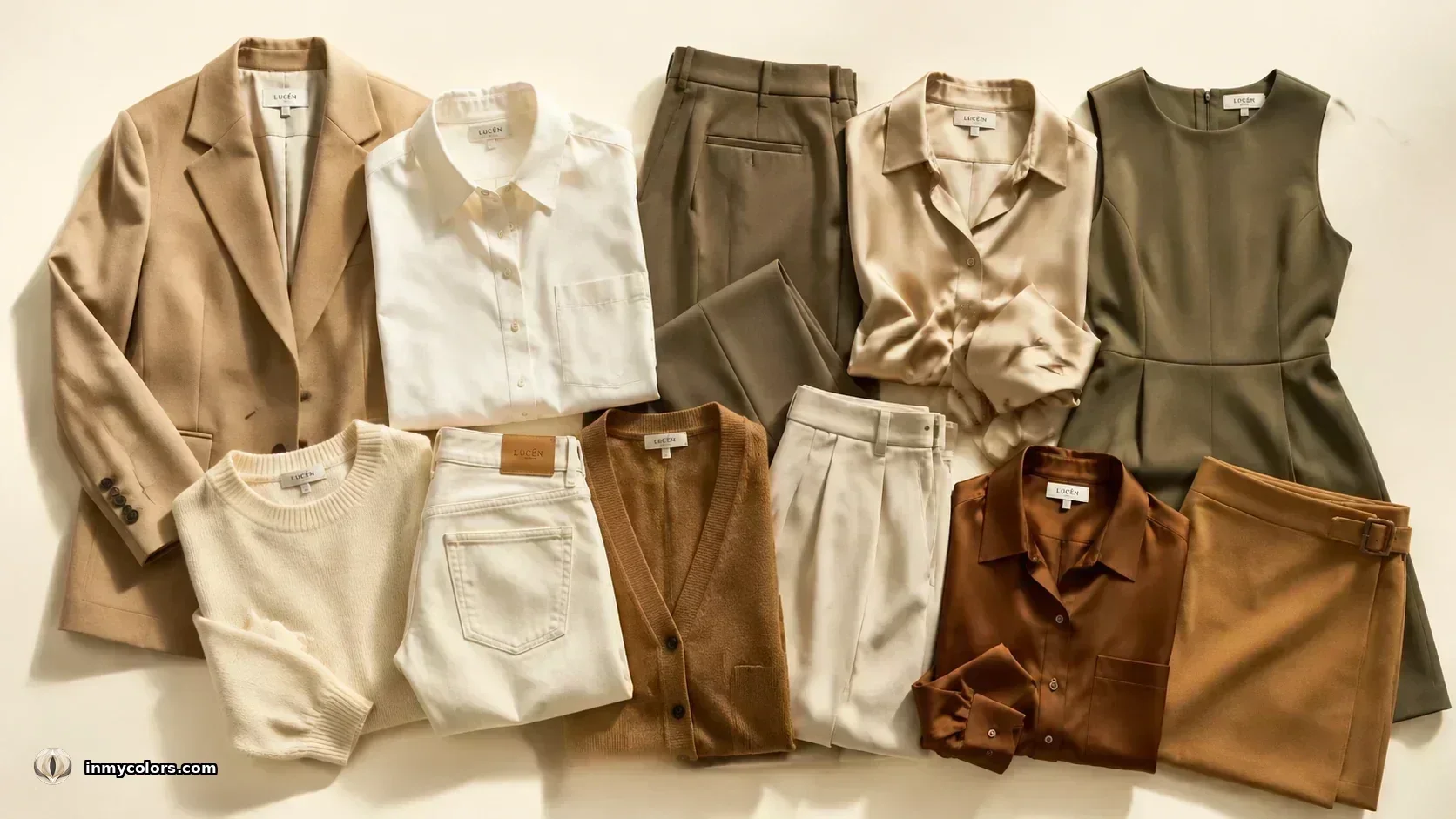
The foundation of a seasonal capsule wardrobe is four neutrals and three accents. The neutrals do the structural work — they form the base of every outfit. The accents provide variety and personality.
Your four season neutrals:
Spring neutrals: warm ivory or cream (replaces white), camel or warm tan, warm dark brown, warm khaki or olive. The camel and ivory form the base; the dark brown and olive provide depth.
Summer neutrals: cool white or soft white, cool grey or dove, soft navy, cool charcoal. The soft white and cool grey form the base; the navy and charcoal provide depth without the starkness of black.
Autumn neutrals: warm cream or golden ivory, camel, dark warm brown, dark warm olive or warm dark charcoal. The cream and camel form the base; the dark brown and olive go deep without going cool.
Winter neutrals: pure white, black or navy-black, cool charcoal, cool navy. The white and black form the base; the charcoal and navy add variety within the cool-depth range.
Notice that black does not appear in Spring or Autumn neutrals, and warm camel does not appear in Summer or Winter neutrals. This is the seasonal specificity that generic capsule guides miss — and it is the entire reason the guide fails when applied to the wrong person.
The Foundation Pieces
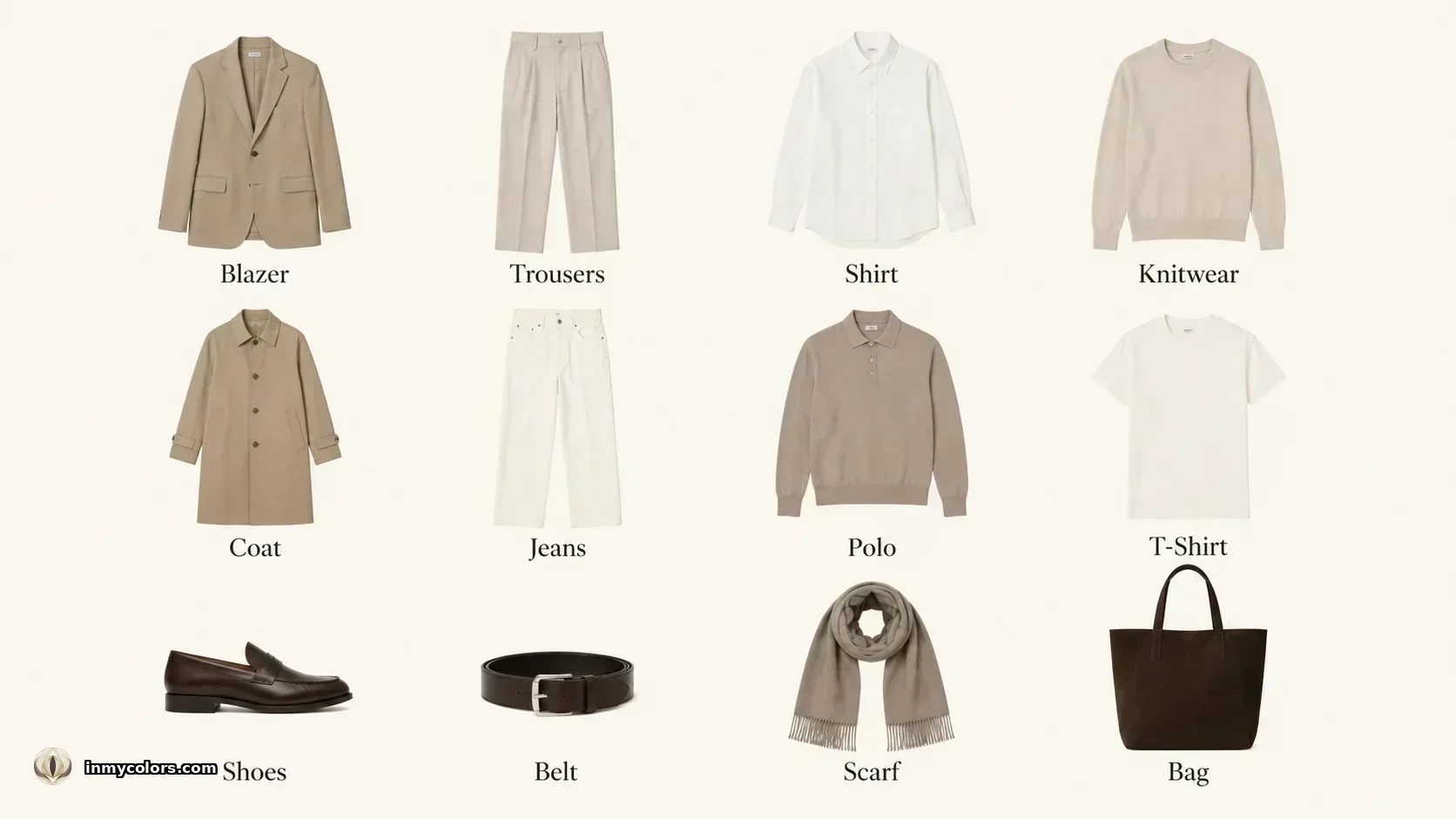
Building outward from the neutrals, the twelve foundation pieces for a seasonal capsule are:
- 1.A structured blazer in your primary neutral (camel for Spring/Autumn, navy or charcoal for Summer/Winter)
- 2.Tailored trousers in your secondary neutral (dark brown/olive for Spring/Autumn, cool charcoal for Summer/Winter)
- 3.A white/ivory shirt or blouse — warm ivory for Springs and Autumns, soft cool white for Summers and Winters
- 4.A lightweight knit or jumper in an accent colour from your season palette
- 5.A silk or flowing blouse in a season accent colour
- 6.A versatile dress that bridges casual and formal — in a neutral or key season colour
- 7.A second pair of trousers or a skirt in a coordinating neutral
- 8.A coat or jacket in your primary neutral
- 9.A casual top (T-shirt or simple knit) in neutral or soft accent
- 10.A casual or weekend trouser (denim or relaxed fit) — warm-wash denim for Springs and Autumns, cooler-wash denim for Summers and Winters
- 11.A statement piece — one item in your season's most vivid accent that anchors the personality of the wardrobe
- 12.A versatile shoe in your primary neutral — camel leather, warm nude, or dark warm brown for warm seasons; grey, cool nude, or black for cool seasons
These twelve pieces, all within the same temperature range, produce a wardrobe that is genuinely fully coordinating. Every blazer over every trouser. Every blouse under every knit. Every shoe with every outfit. The temperature unity is what makes it work.
Season Accents: Adding Colour Without Breaking Coordination
The four neutrals handle structure. The accents handle personality, mood, and seasonal variety. The rule for accents in a capsule wardrobe is simple: choose three to four accent colours from your season palette, and let them cluster at the warmer or cooler end of your palette depending on the season.
Spring accents: coral, warm peach, warm teal or aqua, golden yellow. These are the injection points of personality — a coral blouse over a camel trouser, a warm teal dress with an ivory blazer.
Summer accents: soft rose, lavender or lilac, cool dusty teal, muted berry. A soft rose blouse under a soft navy blazer; a lavender dress with cool grey shoes.
Autumn accents: terracotta or rust, warm olive, cognac, deep warm teal. A rust silk blouse under a dark olive blazer; a terracotta dress with camel boots.
Winter accents: true red, deep plum, cool royal blue, emerald or cool teal. A deep plum blouse under a black blazer; a red dress with cool charcoal accessories.
The accents sit at different price points across a wardrobe's lifespan: the neutrals justify investment and buy quality; the accents can be refreshed with seasons, trends, or as interests shift, without destabilising the foundation.
The Real Cost of the Wrong Colour
The financial argument for the seasonal capsule wardrobe is often understated.
The average wardrobe in the UK contains 57 items of clothing. The average wearer regularly uses 20 of them. The gap between 57 items and 20 used items — 37 items hanging unworn — represents, at typical retail prices, somewhere between £1,000 and £3,000 in clothes that were bought and never properly used.
The most common reason clothes go unworn is not that they are the wrong style, the wrong fit, or the wrong occasion. It is that they don't go with anything else. A garment that sits in isolation — beautiful on its own but unable to pair with the rest of the wardrobe — is a garment that stays on the hanger. And the reason it doesn't pair with the rest of the wardrobe is almost always temperature.
The warm camel blazer that seemed like a capsule essential when bought fights the cool grey wardrobe it was supposed to anchor. The cool lavender dress that looked perfect in the shop has nothing to wear it with among a wardrobe of warm earth tones. These garments were not mistakes of style or taste. They were mistakes of temperature. And each one was full price, bought with good intentions, and now unworn.
Building in season means building in a common temperature from the start. Every new addition, evaluated against the existing temperature, either coordinates or it doesn't. The evaluation is simple and largely pre-made: if it's in your season, it coordinates. If it's outside your season, it probably won't.
Sustainability and the Seasonal Approach
The environmental argument for a seasonal wardrobe approach is inseparable from the financial one.
The fashion industry is responsible for approximately 10% of global carbon emissions and is the second-largest consumer of water globally. These numbers are primarily driven by volume: the rate at which clothing is produced, purchased, and discarded. Fast fashion exists because disposability has become acceptable — buy inexpensively, wear a few times, replace.
The capsule wardrobe approach, built on season, inverts this model at the purchasing decision. Fewer, better items, chosen because they coordinate within a unified temperature system, last longer in the wardrobe — because they are used more often, and because they are chosen more deliberately.
A wardrobe that is used is a wardrobe that is not discarded. The most sustainable garment is the one that gets worn. Temperature coordination keeps garments in rotation. Out-of-temperature purchases are the primary driver of clothes that leave the wardrobe after three wearings.
Your season is not just a style preference. It is a tool for buying less and wearing more.
Building the Capsule: A Practical Process
The most effective process for building a seasonal capsule wardrobe is not buying twelve items simultaneously. It is auditing what you already have and identifying what is already in season.
Step 1: Audit with temperature in mind. Go through your current wardrobe and, for each item, ask: is this warm or cool? Does it sit within my season's range? Items that are clearly in season are keepers. Items that are clearly out of season — and that consistently go unworn or make you look flat when you wear them — are candidates for removal.
Step 2: Identify the gaps. Once the in-season items are identified, note where the coverage is thin. Missing a good neutral trouser in your season's depth? Missing a blazer that coordinates with your existing pieces? The gaps inform what to buy next.
Step 3: Fill gaps intentionally, not impulsively. Each new purchase evaluated against the season filter. Does this share the temperature of what I already own? Will it coordinate with at least three existing pieces? If yes, proceed. If no, consider whether the cost is worth the limited versatility.
Step 4: Refresh accents, not neutrals. As the wardrobe matures, the neutrals become permanent fixtures — the blazer, the trousers, the coat. Accents can be refreshed as interests, trends, or mood shifts. A new rust blouse or a deep teal knit injected into a stable Autumn foundation adds freshness without breaking the coordination architecture.
How Many Items Is Enough
The original capsule wardrobe concept, developed by Susie Faux in the 1970s and popularised by Donna Karan's "Seven Easy Pieces" in 1985, proposed a number that has been revised upward in every subsequent version.
The honest answer is: enough to get dressed on every occasion in your life without repetition during your normal cycle of laundry and wear. For most people, this is between 30 and 40 items — considerably fewer than the average of 57, considerably more than the minimalist fantasy of twelve.
The quality of the 30 matters infinitely more than its quantity. Thirty items in season, all coordinating, all used, all well-made, produce more outfit variety and more daily satisfaction than 57 items of mixed temperature and quality, a third of which will never be worn.
The season is the organising principle. The capsule is the implementation. Together, they produce a wardrobe that actually works.
Capsule wardrobe methodology draws on the work of Susie Faux (Wardrobe, 1976), Donna Karan's Seven Easy Pieces concept (1985), and Project 333 (Courtney Carver, 2010). Fashion industry sustainability statistics: Ellen MacArthur Foundation, A New Textiles Economy (2017).