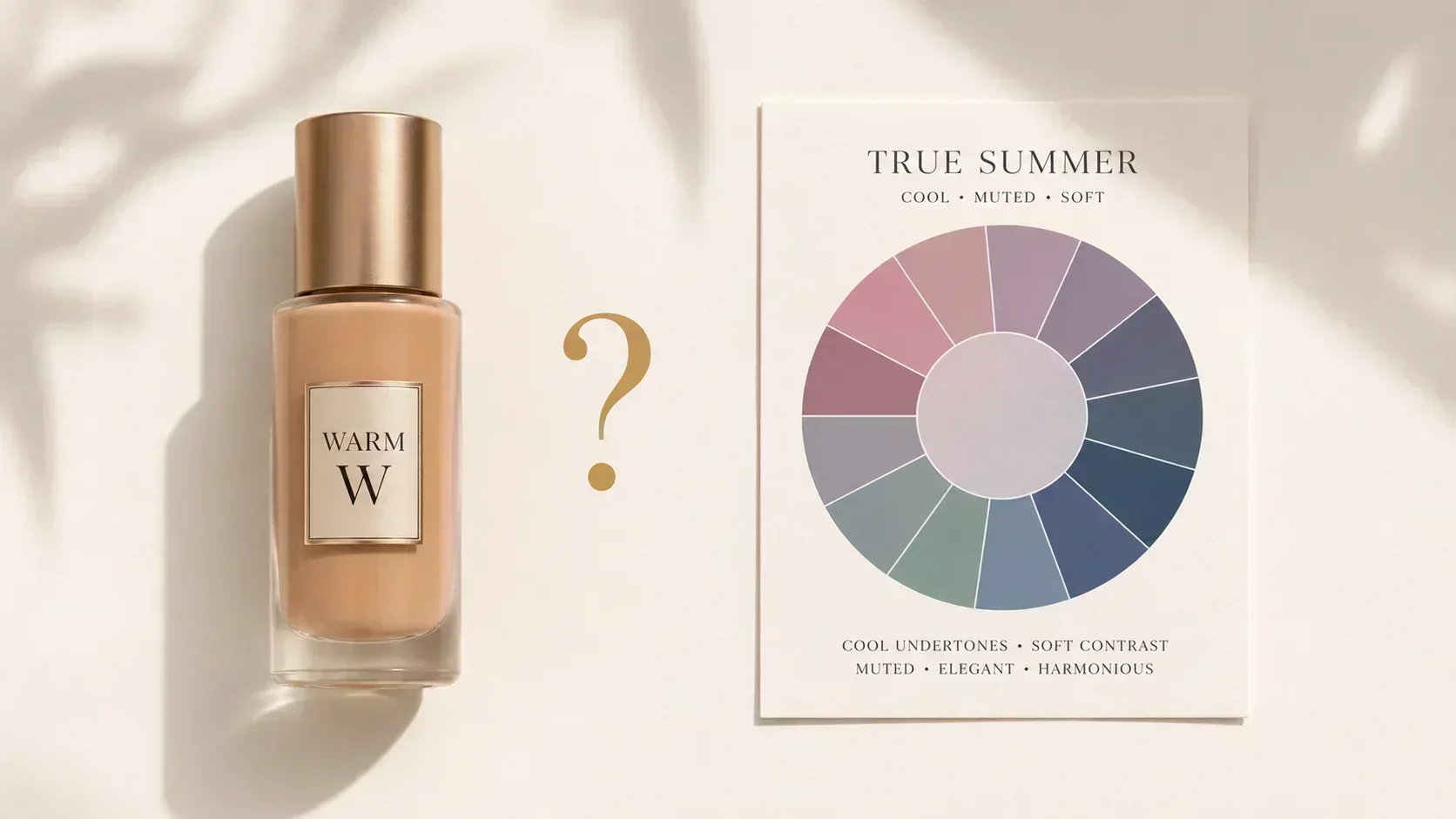
One of the most consistent points of confusion for people who have had a colour analysis and are applying it to makeup is this: the makeup counter tells you your foundation undertone is "warm" — but your season says you are a Summer, which is cool.
How can both be true?
They can both be true because "undertone" means different things in the two contexts. Makeup undertone labels (warm, cool, neutral) and season undertone are related but not identical. Understanding the difference lets you use both systems correctly — and stops you from choosing makeup that fights your season.
What Makeup Undertone Labels Mean
At a cosmetics counter or when reading a foundation description, undertone labels typically refer to the pigment balance in the formula itself:
"Warm" foundation: contains more yellow or peach pigment. Will read golden or peachy on the skin.
"Cool" foundation: contains more pink or rose pigment. Will read pink or rosy on the skin.
"Neutral" foundation: a balance of yellow and pink. Neither dominates.
The goal of foundation matching is to find a formula whose pigment balance matches the pigment balance of your skin, so the foundation disappears — reads as "skin" rather than as a visible product.
This is skin matching. It operates differently from season assignment.
What Season Undertone Means
In colour analysis, undertone refers to the underlying temperature of your natural colouring — specifically, whether the pigments in your skin, iris, hair, and overall appearance system produce a warm (golden/peachy/yellow) or cool (pink/rosy/blue-red) impression.
Season undertone is about the overall visual impression of the face, not just the skin pigment in isolation. It incorporates:
- ✦The warmth or coolness in the skin's undertone
- ✦The temperature of the iris colour
- ✦The temperature of the hair
- ✦How these elements interact as a system
A person can have medium pigmentation in their skin (reading as "neutral" in foundation matching terms) but a clearly cool season when all three axes are considered together.
Where the Confusion Comes From
The confusion typically arises in two specific scenarios:
Scenario 1: You are a warm season with "neutral" or "cool" foundation. Your skin pigmentation may read as fairly neutral in isolation — not strongly golden, not strongly pink. At the makeup counter, a "neutral" or slightly "cool" foundation matches your skin best. But your season is True Spring or True Autumn (warm). This seems contradictory.
The resolution: foundation matching targets the pigment balance of the skin surface to minimise visible formula. Season undertone is determined by the whole colouring system. The skin's pigment balance and the season's undertone can sit at different positions on the warm-cool axis. Your foundation can be neutral-to-warm while your season is clearly warm — because the season is based on the entire impression, not just the skin formula.
The practical test: in a warm versus cool foundation, which one disappears at the jaw? That is your foundation match. Separately, in warm versus cool colours near the face, which ones make you look more alive? That is your season undertone.
Scenario 2: You are a cool season with "warm" foundation. You've been classified as True Summer or True Winter — clearly cool. But at a makeup counter, you are matched to a "warm" foundation.
The resolution: many foundation formulas described as "warm" are warm in the sense that they contain yellow pigment — which neutralises pink or redness in the skin. Some cool-season people have visible redness (from haemoglobin visibility) that a slightly warm-toned formula corrects. The foundation is not "warm" in the way a warm seasonal palette is warm — it is warm in the narrower sense of containing yellow correction pigment.
The test is always visual: does the formula disappear at the jaw? If it does, it is your correct foundation regardless of whether its label says "warm" or "cool."
Foundation Undertone by Season: What to Look For
Despite the above complexity, there are patterns in foundation undertone labels that are useful as starting points:
Spring seasons (warm): generally suit "warm" or "neutral warm" foundations — formulas with a peach or golden quality that matches the warm undertone without sitting on the skin. Light Springs lean toward very light warm or neutral warm. Bright Springs may need a slightly warmer formula as their skin can read richer.
Summer seasons (cool): generally suit "cool" or "neutral" foundations — formulas with a pink or rosy quality, or a completely neutral balance. True Summers often suit "nude" or "neutral" formulas. The formula should have no golden quality.
Autumn seasons (warm): generally suit "warm" foundations, often with more depth than Spring formulas. True Autumns often need a noticeably warm, sometimes golden formula. Deep Autumns may need a warm formula in a deeper shade.
Winter seasons (cool): generally suit "cool" or "neutral" foundations. True Winters often need a formula with a slight cool or neutral quality. Deep Winters in a deep shade. The formula should not read warm at the jaw.
These are starting points, not guarantees. The foundation matching test — does it disappear at the jaw in natural light — is always the final arbiter.
Concealer and the Undertone Question
Concealer creates the same confusion, often more acutely because it is typically used in smaller areas where the temperature contrast with the skin is more visible.
Under-eye concealer: under-eye darkness is typically cool in tone — a blue-purple or grey-purple shadow. The instinct is to use a warm-toned concealer to cancel the coolness. This is correct colour correction logic (orange cancels blue). But the concealer applied over the correction should match the skin's undertone — warm over warm skin, cool over cool skin. A two-step process: cool-cancel corrector, then undertone-matched concealer.
Spot concealer: should match the skin temperature. A warm-undertone skin with a blemish needs a warm concealer that matches the skin, not a pink or cool formula that sits as a visibly different temperature from the surrounding skin.
The principle is consistent: the product should disappear into the skin. For that to happen, it must match the skin's temperature.
Colour Makeup: Where Season Takes Over
Foundation and concealer are about disappearing into the skin — matching, not contrasting. This is where the makeup-counter undertone label is most useful.
Colour makeup — blush, eyeshadow, lip colour, highlight — is about harmonising with the face. This is where the season is the primary reference, not the makeup-counter undertone label.
Blush: should harmonise with the face's overall temperature. See the blush-by-season guide for specific shades.
Eyeshadow: should harmonise with the eye colour and skin temperature. Warm seasons: warm neutrals (brown, camel, warm taupe, warm bronze, golden champagne). Cool seasons: cool neutrals (cool taupe, grey, soft plum, silvery nude).
Lip colour: the most expressive category. Should harmonise with the overall undertone. Warm seasons: coral, warm nude, warm berry, warm red. Cool seasons: cool red (blue-red), cool nude, cool rose, plum, berry.
Highlight: warm seasons: gold, peach-gold, warm champagne. Cool seasons: silver, cool pearl, icy champagne.
In all of these, the season undertone is the reference — not the formula label on a foundation bottle.
A Simple Decision Framework
For foundation and concealer: use the makeup-counter method. Match at the jaw in natural light. The label ("warm," "neutral," "cool") is a guide to the formula, not to your season. If the formula disappears at the jaw, it is correct.
For blush, eyeshadow, lip colour, highlight: use your season. The temperature of the colour should match the temperature of your season. Warm season → warm tones. Cool season → cool tones. The specific shades within the season are covered in season-specific makeup guides.
When the two systems seem to conflict — a cool-season person with a "warm" foundation — trust the visual test for foundation (does it disappear?) and trust the season for colour makeup (what makes the face look alive?). The two systems are answering different questions, and both answers can be correct simultaneously.
Contouring and Bronzing by Season
Contour and bronzer are warmth-based products — they simulate the warmth of shadow or sun on the skin. This makes them season-sensitive.
Warm seasons (Spring, Autumn): warm bronzer and contour in brown and golden-warm tones are generally harmonious. The warmth in the product matches the warmth in the skin. Many bronzers on the market are warm-toned and were designed with warm-season skin in mind.
Cool seasons (Summer, Winter): warm bronzer can make the face look muddy — the warm product on cool skin creates a temperature conflict. Cool-season people who want a contour effect should use a cool-toned shadow product (grey-brown, cool taupe) rather than a warm bronzer. "Blush draping" in a cool rose can achieve a similar luminosity effect without the temperature conflict.
For highlighting: warm-season highlight should have warmth in it (gold, warm champagne). Cool-season highlight should be silver, icy, or cool champagne. A warm-gold highlighter on a cool-season face can look slightly orange or incongruent.
The Practical Summary
If you are leaving a colour analysis with a season name and walking into a makeup shop:
- 1.Foundation: ignore the season; match at the jaw in natural light.
- 2.Blush: use the season. Look for warm (Spring/Autumn) or cool (Summer/Winter) in the correct saturation for your sub-season.
- 3.Eyeshadow neutrals: use the season. Warm neutrals for warm seasons; cool neutrals for cool seasons.
- 4.Lip colour: use the season. Warm lip for warm seasons; cool lip for cool seasons.
- 5.Highlight: use the season. Gold for warm; silver or cool champagne for cool.
- 6.Bronzer/contour: use the season. Warm for warm; cool-toned shadow for cool.
Two different questions, two different systems. Foundation asks "what matches my skin?" Season asks "what harmonises with my face?" Both questions have answers, and neither cancels the other.