Undertone is the single most important variable in personal colour analysis — more important than your skin colour, your hair colour, or your eye colour. It is the reason some colours make you look luminous and others make you look flat, regardless of how objectively beautiful the garment is.
And yet most people have never confirmed what their undertone actually is.
This guide covers seven reliable methods for finding yours — from the gold-silver test to the vein test to the white wall test. No professional analysis required, no special equipment, and no subjective guesswork. Just clear, repeatable methods with clear results.
What Undertone Actually Is
Before the tests: a clarification on what undertone means, because it is widely misunderstood.
Your skin has two layers of visible colour. The surface colour is what most people call "skin tone" — whether you are fair, medium, olive, or deep. This is your skin depth, and it is what most cosmetics counters use to match foundation.
Your undertone is the colour beneath the surface colour. It is caused by the pigmentation in the deeper layers of the skin — the combination of melanin, haemoglobin, and carotenoids that gives the skin its characteristic warmth or coolness. Unlike surface colour, undertone does not change with sun exposure, ageing, or seasonal variation. It is structural.
There are three undertone categories:
Warm: golden, peachy, or yellow cast beneath the surface. Associated with yellow-orange pigmentation. Springs and Autumns have warm undertones.
Cool: pink, rosy, or blue-red cast beneath the surface. Associated with pink-blue pigmentation. Summers and Winters have cool undertones.
Neutral: a balance of warm and cool with neither dominant. Very rare as a true category — most "neutral" people are slightly warm or slightly cool, and the methods below will reveal which.
The important distinction: surface colour and undertone are independent. A person with deep skin can have a cool undertone (think blue-black hair, vivid cool eyes — a Deep Winter). A person with very fair skin can have a warm undertone (light hair with golden highlights, green-hazel eyes — a Light Spring). Neither the depth of the skin nor its surface appearance reliably predicts the undertone.
Method 1: The Gold-Silver Test
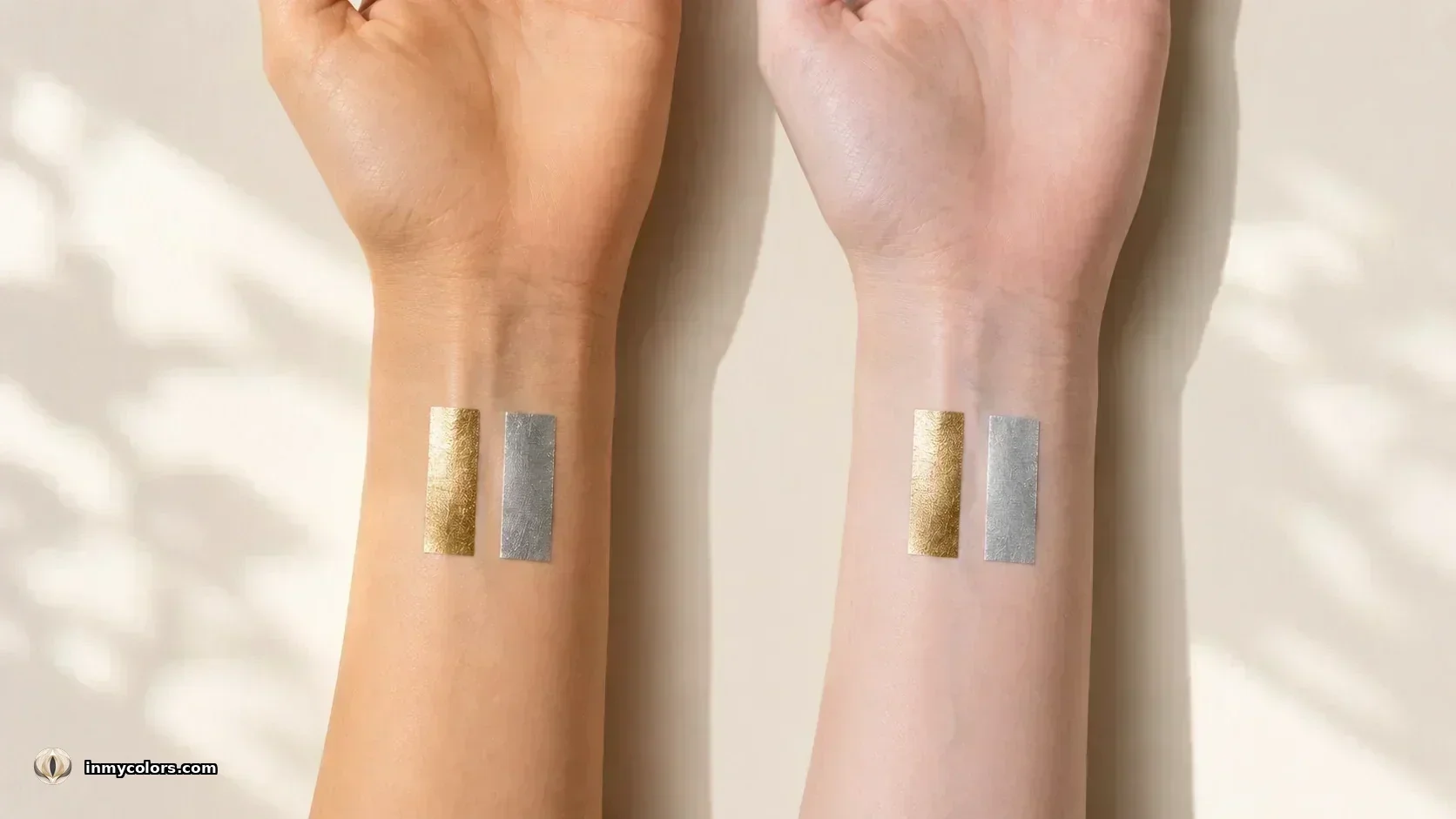
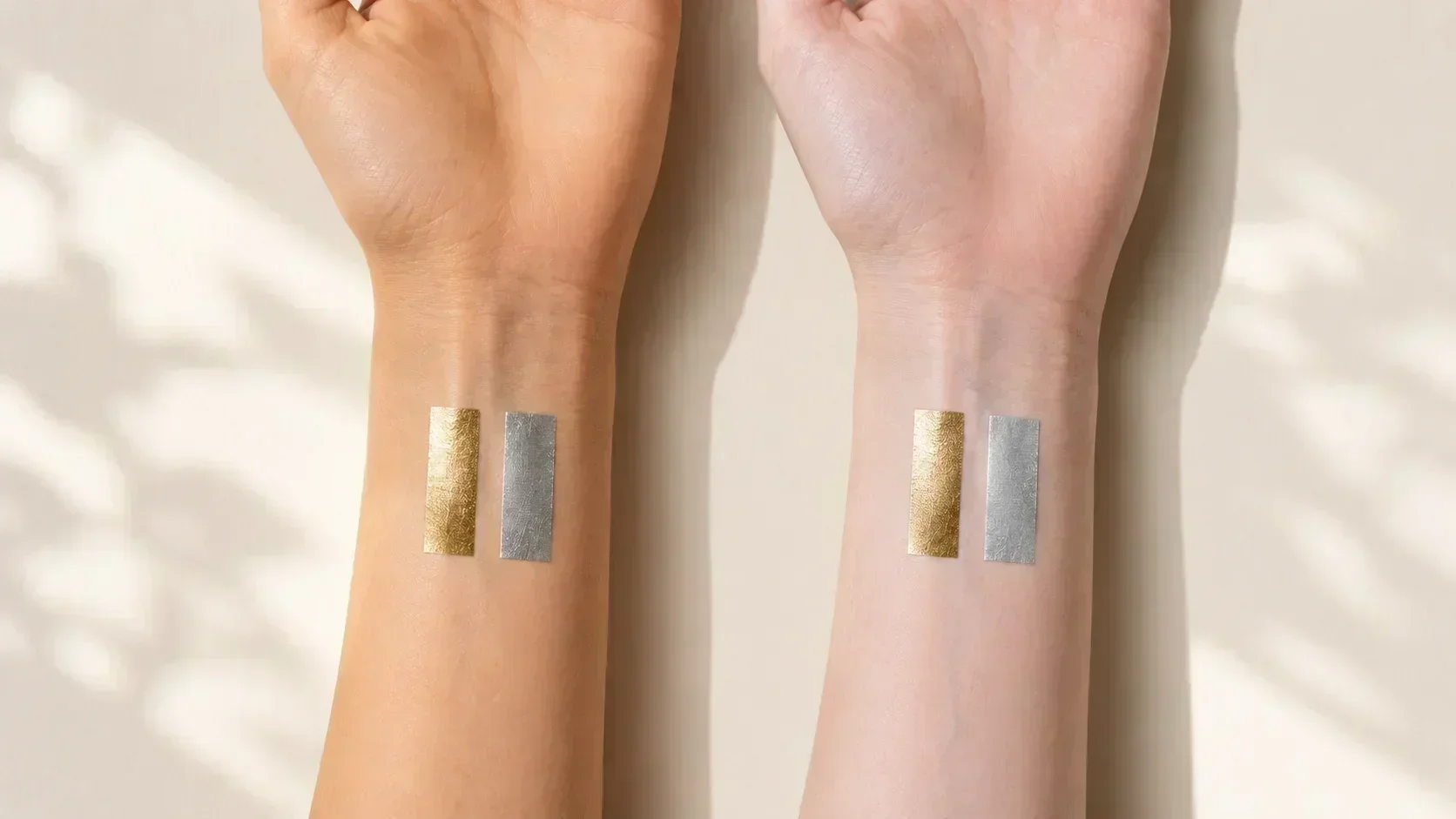
This is the most reliable single test, and the one most professional analysts use as a starting point.
You need: one piece of gold-toned fabric or card (warm yellow-gold) and one piece of silver-toned fabric or card (cool blue-silver). Not costume jewellery — fabric or paper in those colours works better than reflective metal.
The test: In natural light (not artificial), hold each swatch against your face — first the gold, then the silver — and look in a mirror.
What to look for: Against the swatch that matches your undertone, your skin looks brighter, more alive, and more luminous. Your face looks "awake." Against the wrong swatch, your skin looks slightly grey, flat, or washed out.
Interpreting the result:
- ✦Gold makes your face look more alive → warm undertone
- ✦Silver makes your face look more alive → cool undertone
- ✦Both look equally good or equally bad → neutral, or you need better light
Common mistake: Using costume jewellery rather than fabric swatches. Gold metal jewellery includes yellow tones but also reflects light differently from fabric. The swatch test is more reliable.
Method 2: The Vein Test
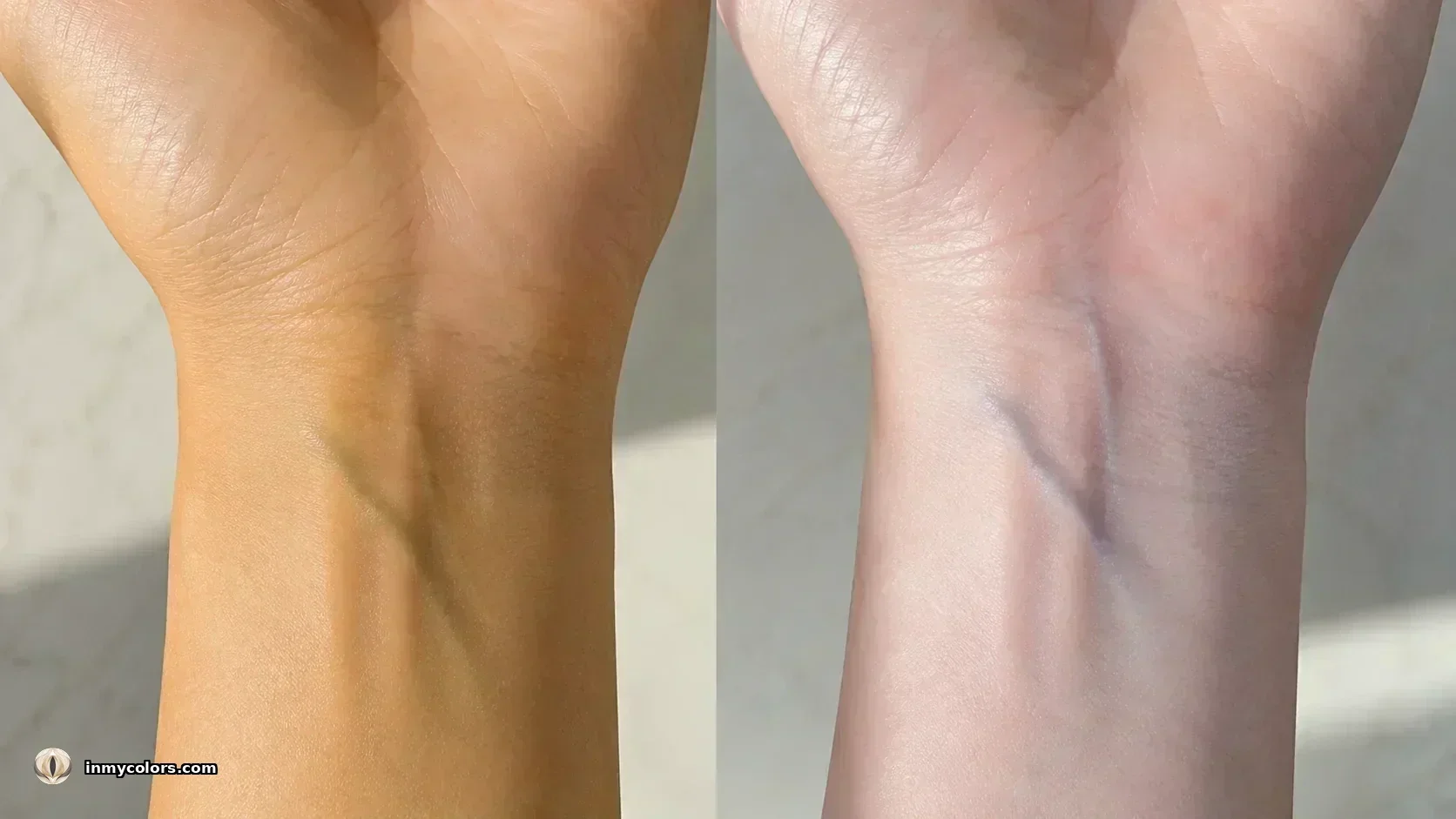
Look at the inside of your wrist in natural light.
What to look for:
- ✦Veins appear greenish or olive → warm undertone (the yellow in warm skin turns the blue blood vessels green)
- ✦Veins appear blue, purple, or blue-violet → cool undertone
- ✦Veins appear blue-green, neither clearly green nor clearly purple → neutral or boundary
Important caveat: The vein test is less reliable for very deep skin tones, where the veins may be harder to see clearly, and for very fair skin, where all veins can appear blue regardless of undertone. Use it as one data point, not a sole determinant.
Method 3: The White Wall Test
You need: a plain white wall or white piece of card, and natural window light.
The test: Stand in front of the white wall. Remove any clothing that might cast colour onto your face. Look in a mirror or have someone photograph you.
What to look for: Against pure white, the contrast between your undertone and the white becomes clear.
- ✦Skin looks slightly yellow, peachy, or golden against white → warm undertone
- ✦Skin looks slightly pink, rosy, or grey-cool against white → cool undertone
This test works on the same principle as the gold-silver test — the neutral reference (white) reveals the colour cast in the skin. It is particularly useful because most people have a white wall available.
Method 4: The Sun Effect Test
Think about how your skin responds to sun exposure.
Warm undertone indicators:
- ✦You tan easily and relatively evenly, with the tan being golden or bronze in tone
- ✦Your skin rarely burns as a first response — it tans before it burns
- ✦After sun, your skin looks golden or amber
Cool undertone indicators:
- ✦You burn before you tan, or burn and then return to your pale baseline
- ✦When you do tan, the tan has a pinkish or ruddy cast
- ✦You do not achieve golden or bronze tones easily
Important caveat: This test is not reliable for very deep skin tones (where burning is rare regardless of undertone) or in individuals whose sun response has been altered by medication or medical condition. It is most useful for fair to medium skin tones.
Method 5: The Colour That Always Looks Right
This is a retrospective observation rather than an active test — but it is often the most intuitively satisfying confirmation.
Think back across your life and identify: which one colour, when you wear it, consistently draws the most compliments? Not your favourite colour — the one that people respond to most reliably, that photographs best, that never seems to be "off."
- ✦A colour in the golden, camel, coral, or copper family → warm undertone
- ✦A colour in the rose, plum, soft blue, or navy family → cool undertone
- ✦A warm teal or olive → warm undertone
- ✦A cool teal, lavender, or icy blue → cool undertone
This method cannot determine undertone from scratch — but it often confirms what the other tests show. People who have found their best colour intuitively have almost always found a colour in their correct undertone family.
Method 6: Your Best Neutral
Most people own multiple versions of neutral — multiple shades of white, several greys, a range of browns. Looking at which neutrals work best is a reliable temperature indicator.
Warm undertone: ivory and cream work better than stark white; camel and warm tan work better than cool grey; warm brown works better than cool taupe.
Cool undertone: stark white works better than ivory; cool grey works better than camel; taupe or cool greige works better than warm tan.
If you have ever noticed that a particular white shirt photographs much better than another that looks identical in the shop — the difference is almost certainly warm white versus cool white, and your preference indicates your undertone.
Method 7: The Foundation Mismatch Test
If you wear foundation, think about what happens at the jaw.
A foundation in your correct undertone family should blend seamlessly from face to neck — there should be no visible line, no orange jaw, no grey pallor at the neck. If you consistently see:
- ✦An orange or peachy jaw → the foundation is too warm for a cool undertone, OR you are warm undertone and wearing too deep a shade
- ✦A grey or ashy jaw → the foundation is too cool for a warm undertone
- ✦The shade matches at the centre of the face but pulls warm at the jaw → the formula is too yellow for a cool undertone
This test is most reliable for people who have found a foundation that almost works but not quite — the direction of the mismatch reveals the undertone.
Undertone vs Season: What's the Difference
Undertone is one input into your season — specifically, it places you in either the warm family (Spring/Autumn) or the cool family (Summer/Winter). But undertone alone does not give you your season.
Within the warm family, Spring and Autumn are distinguished by value (light vs deep) and chroma (clear vs muted). A Light Spring and a Deep Autumn both have warm undertones — but the full colour palette that serves them is very different.
Within the cool family, Summer and Winter are distinguished by the same axes. A Light Summer and a Deep Winter both have cool undertones — but cold stark black serves the Winter and fights the Summer.
Knowing your undertone is the essential first step. It tells you your family. Your season tells you exactly which shades within that family are yours.
When You Get Conflicting Results
It is common for two or three of these tests to give conflicting signals — particularly for people whose undertone is genuinely neutral or sits at a boundary between warm and cool.
If this happens, weight the methods in the following order:
- 1.Gold-silver test in natural daylight — most reliable
- 2.Vein test — strong confirmation if results match test 1
- 3.White wall test — reliable secondary confirmation
- 4.Sun response and colour memory — useful corroboration but subject to variation
If after all seven tests you genuinely cannot determine warm or cool, you are likely a neutral undertone sitting closer to the warm or cool boundary. In this case, both warm and cool colours in the mid-range of the spectrum (warm teal, soft plum, warm olive, cool rose) will serve you reasonably. You will not have the striking temperature contrast that strongly warm or strongly cool undertones experience, but neither will you be dramatically wrong in either direction.
A full analysis — using all three axes (undertone, value, chroma) measured from skin, iris, hair, and sclera — will place you precisely even when visual tests give ambiguous results.
Undertone methodology draws on seasonal colour theory as developed through Carole Jackson, Color Me Beautiful (1980) and subsequent 12-season refinement. Physiological basis of undertone pigmentation: Fitzpatrick skin type research and dermatological colorimetry literature.