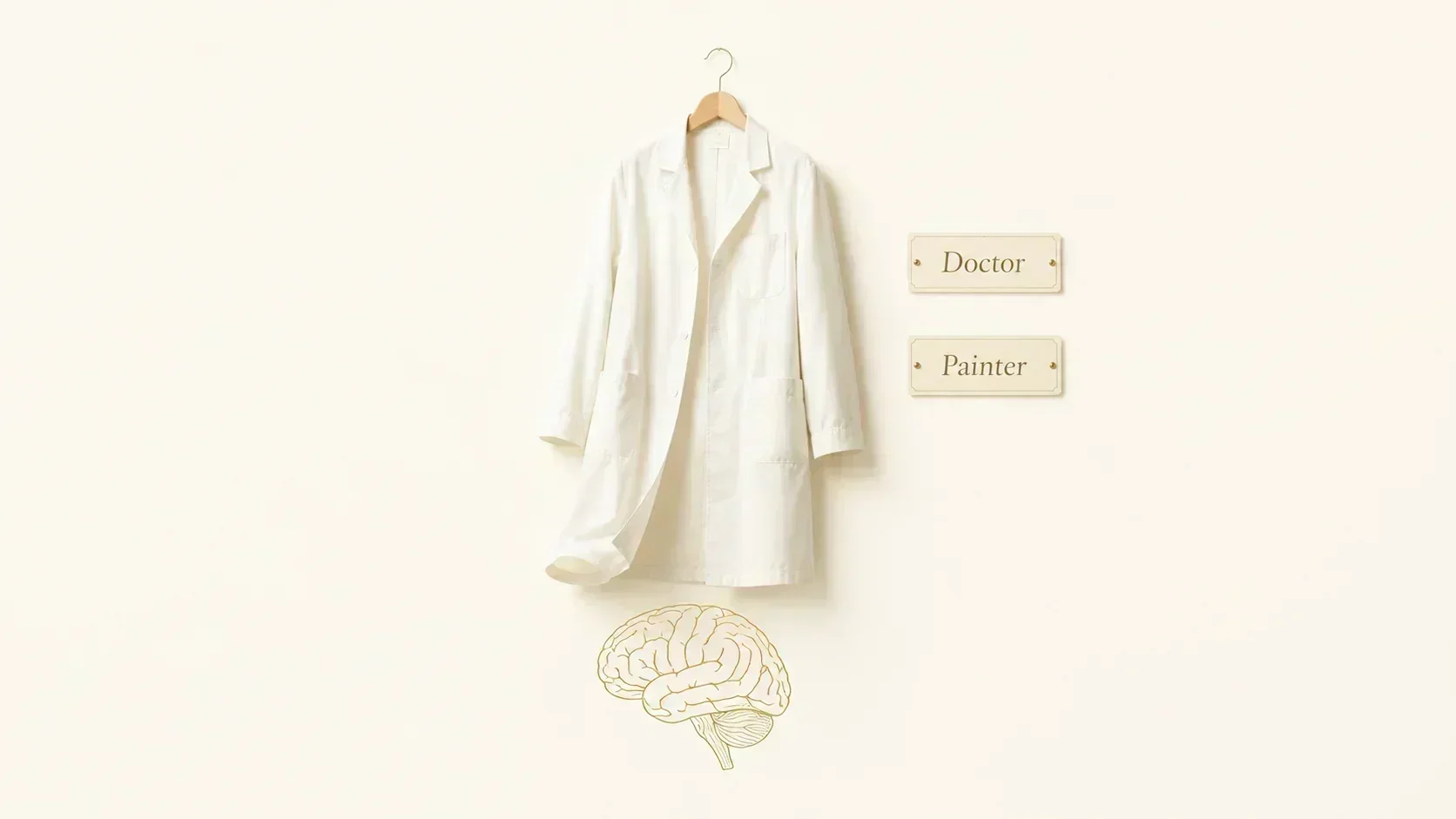
In 2012, two researchers at Northwestern University ran an experiment that produced one of the most counterintuitive findings in the psychology of dress.
They took a group of participants and divided them into three conditions. The first group wore a white lab coat that had been described to them as a doctor's coat. The second group wore an identical white lab coat described as a painter's coat. The third group looked at a doctor's coat without wearing it.
All three groups then completed a sustained attention task — a test designed to measure focused concentration and error rate.
The doctor-coat group made half as many errors as the painter-coat group.
Same coat. Different label. Different brain.
What Enclothed Cognition Is
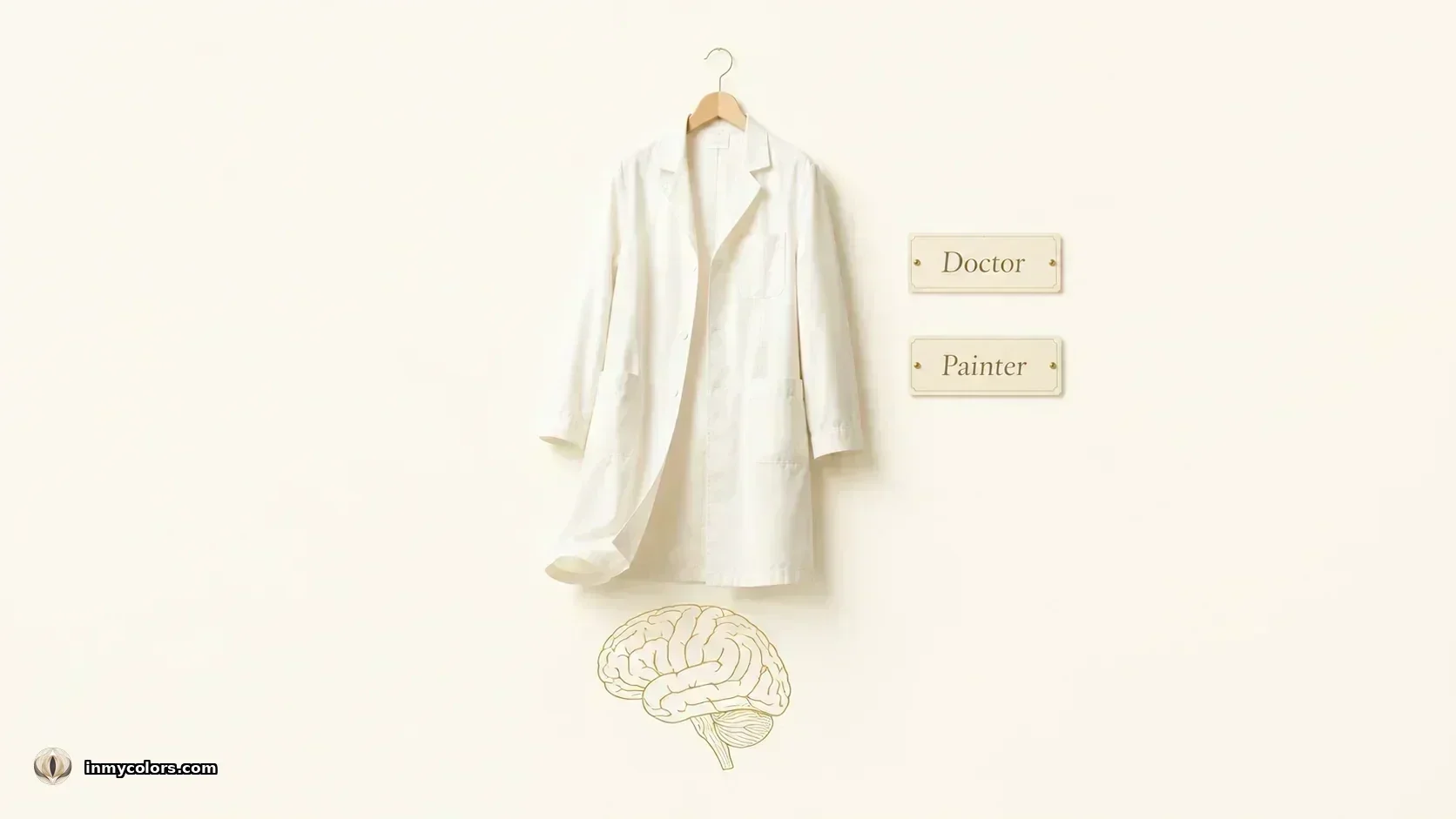
Adam and Galinsky called this effect enclothed cognition — the systematic influence that clothing has on the psychological processes of the wearer. Their 2012 paper in the Journal of Experimental Social Psychology established two necessary conditions for the effect to occur:
The symbolic meaning of the clothing. The white coat, to most people, carries the associations of the medical profession: precision, careful attention, expertise, authority. These associations are activated when you put the coat on.
The physical act of wearing the garment. Not just seeing it. Not just knowing what it represents. The act of wearing it — having it on your body — is required for the cognitive effect to manifest. In the experiment, participants who simply looked at the doctor's coat showed no significant improvement.
Both conditions together activate what the researchers called the "enclothed" mental state: the symbolic associations of the garment are literally incorporated into the wearer's cognitive processing.
The implications are substantial.
What You Wear Changes How You Think
The most important implication of enclothed cognition is the one most people overlook: clothing does not just change how others perceive you. It changes how you perceive yourself — and by extension, how you think.
The doctor-coat participants were not performing better because they felt they looked more professional. They were performing better because wearing the coat activated the cognitive schema associated with medical expertise — focus, precision, careful attention — and that schema influenced their actual cognitive performance.
This is not metaphor. It is a measurable effect on attention and error rates.
The practical extension is straightforward: every garment in your wardrobe carries associations. Some of those associations are personal — the dress you wore when you got the job, the jacket you wore when you gave your best presentation. Some are cultural — a well-cut suit signals authority across most professional contexts. When you wear these garments, you activate those associations, and those activated associations shape the cognitive mode you inhabit.
Getting dressed is, in this framework, not an aesthetic act. It is a cognitive act. You are choosing the mental state you will inhabit for the day.
The Creativity Paradox
A follow-up study by Van Stockum and DeCaro (2014) at the University of Louisville added a significant complication to the enclothed cognition framework.
Using the same white lab coat paradigm, they found that wearing the formal professional garment did increase controlled, focused attention — replicating Adam and Galinsky's finding. But it also decreased performance on insight problem-solving tasks: problems that require the kind of diffuse, associative thinking that produces unexpected connections and creative breakthroughs.
The same clothing that makes you more focused makes you less creative.
The mechanism is consistent with the enclothed cognition model: the formal coat activates authority and precision, which activates controlled analytical processing, which suppresses the unfocused, wandering mental mode from which insight emerges. The coat is doing what it is supposed to do — the problem is that "what it is supposed to do" is antagonistic to creative thinking.
This is the creativity paradox: the wardrobe that helps you win a negotiation will limit you in a brainstorming session. The cognitive demands of the two tasks are different — and the clothing that serves one actively undermines the other.
Dressing for the Cognitive Task
The practical implication of both studies combined is that intentional dressing should be calibrated not just to how you want to appear to others — but to the cognitive work the day requires.
For analytical, focused, high-stakes tasks — negotiations, important presentations, interviews, critical assessments — structured, formal, authority-associated clothing supports the controlled attention those tasks require. Dark, structured, season-appropriate authority colours. The wardrobe that activates precision and control.
For creative, generative, exploratory work — brainstorming, writing, design, open-ended problem-solving — softer, less structured, less formal clothing supports the diffuse mental state that produces insight. The wardrobe that allows the mind to wander.
For routine and maintenance work — the cognitive demand is lower, the wardrobe choice matters less. The risk is choosing formal clothing out of habit and inadvertently activating a controlled processing mode that makes routine tasks feel more effortful than they need to be.
This is not an argument for casual dress as a universal default. It is an argument for matching the wardrobe to the actual cognitive demand — and for recognising that "dress professionally" is too blunt an instruction to serve the full range of mental work most people do in a given week.
Clothing and Self-Perception: The Invisible Audience
One of the most practically useful aspects of enclothed cognition research is its implication for how you relate to yourself in the mirror.
The clothing activates associations regardless of whether anyone else is present. The cognitive effect does not require an audience. The doctor-coat participants were not performing for external observers — they were alone in a test environment. The coat changed their cognition in the absence of any social function.
This means that how you dress at home — when you are working alone, when no one else will see you — still affects how you think. The informal, comfort-first wardrobe choice for a day of solitary work activates the associations of informal comfort: relaxed, exploratory, off-duty. This may be ideal for a creative day. It may be counterproductive for a day requiring focused analytical output.
The wardrobe serves you even when there is no external audience. The activation is internal.
The Colour Dimension
Enclothed cognition research has focused primarily on garment type and symbolic meaning rather than colour. But the colour psychology literature — Birren, Labrecque and Milne, and others — establishes an independent colour-cognition pathway: colour affects physiological arousal and cognitive tone before any symbolic associations are processed.
The intersection of the two frameworks suggests that the most effective wardrobe choice for any given cognitive demand works on both levels simultaneously: colour that creates the appropriate physiological state (red for arousal, blue for calm, warm colours for energy, cool colours for precision) and clothing whose symbolic meaning activates the appropriate cognitive schema (formal for controlled attention, casual for open thinking).
A deep navy structured jacket, for a Summer season person facing an important presentation, works on three levels: the temperature is in season (luminosity and harmony), the blue activates the competence and trust association, and the structure activates controlled analytical attention. Three independent mechanisms pointing in the same direction.
This is what intentional dressing looks like at its most precise.
Getting Dressed on Purpose
The practical takeaway from enclothed cognition is not a set of rigid rules but a shift in orientation: from getting dressed as a morning routine to getting dressed as a deliberate decision about the cognitive and psychological state you want to inhabit.
What does the day require? What associations does the wardrobe need to activate? What colour signal serves the context?
The answers to these questions are not complicated. But asking them — rather than reaching for the first item on the pile — is the difference between a wardrobe that works for you and one that happens to you.
Sources: Adam, H. & Galinsky, A. D. (2012). Enclothed cognition. Journal of Experimental Social Psychology, 48(4), 918–925. Van Stockum, C. A. & DeCaro, M. S. (2014). Enclothed cognition and controlled attention during insight problem-solving. Journal of Problem Solving, 6(1).