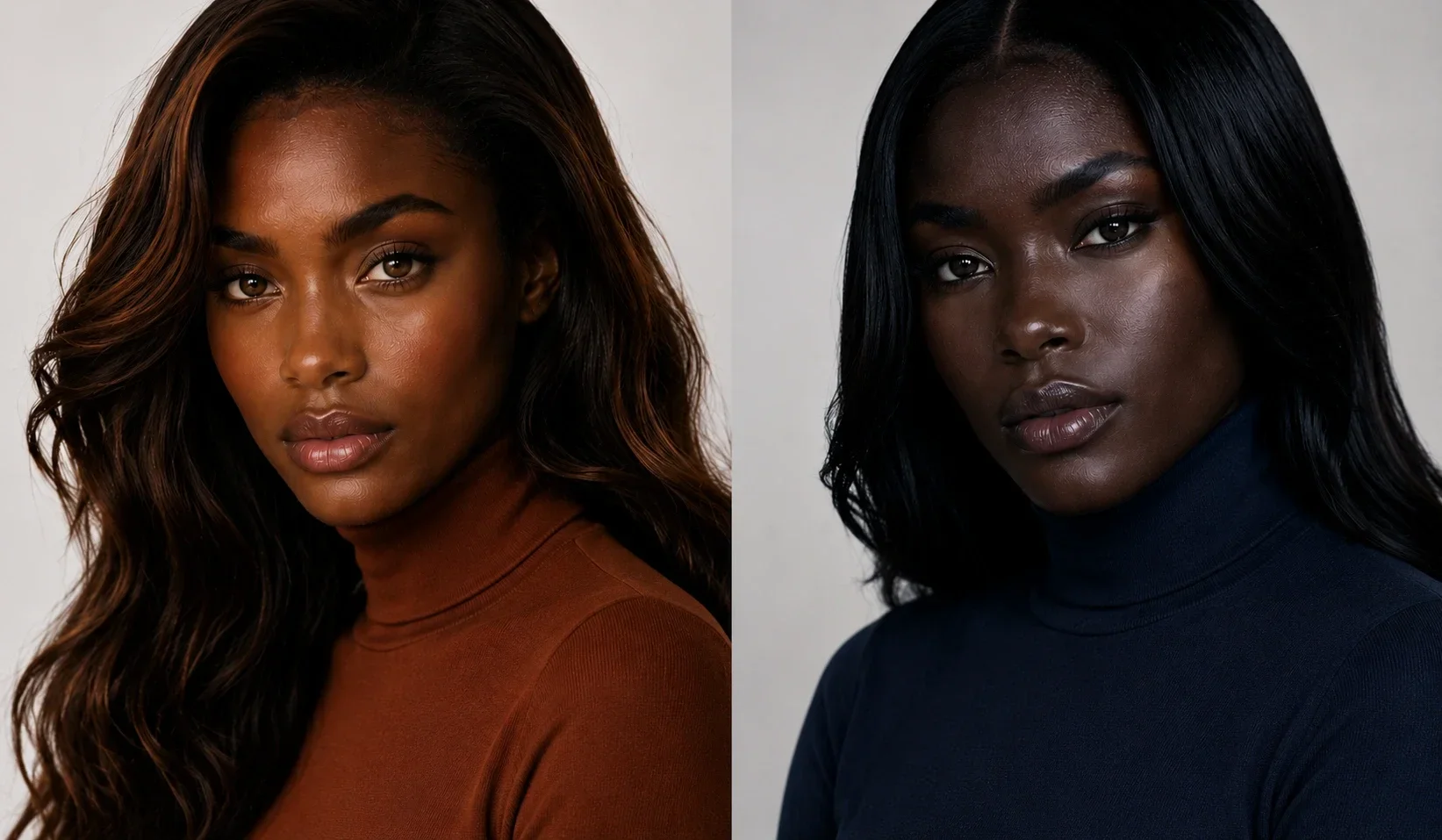
The most widespread myth in colour analysis is also the most specific: if you have deep skin, you are a Winter.
This assumption travels through the internet in countless forms. Blog posts about Winter season aesthetics feature predominantly dark-skinned faces. Celebrity analyses of deep-complexioned women almost universally arrive at Dark Winter or True Winter. Online communities discussing colour analysis often operate with "deep skin = high contrast = Winter" as an unexamined premise. The conclusion feels logical, so it goes unchallenged.
It is wrong. Demonstrably, technically, consequentially wrong.
Why the Myth Exists
The reasoning behind "deep skin = Winter" goes like this: Winter is defined by high contrast. Deep skin against features creates strong contrast. Therefore, deep skin = Winter.
The error is that this reasoning conflates two completely different characteristics: contrast and temperature.
Contrast — the degree of difference between skin, hair, and eye colour — is a real dimension of colour analysis. Winter often has high contrast. But contrast is not the only Winter characteristic, and it is not a characteristic that belongs only to Winter. Some Autumns have very high contrast. Some Winters have lower contrast. Contrast is one variable among several.
Temperature — whether the undertone of the skin pulls warm or cool — is the foundational variable in colour analysis. A skin tone can be deep and warm. It can also be deep and cool. Depth and temperature are independent axes. The same depth value on two different people can sit at completely different places on the warm-cool spectrum.
When colour analysis correctly identifies a person's season, it is reading both dimensions. When it shortcuts to "deep = Winter," it is only reading one dimension — and it is getting roughly half the deep-complexioned population wrong.
The Six Seasons Where Deep Colouring Appears
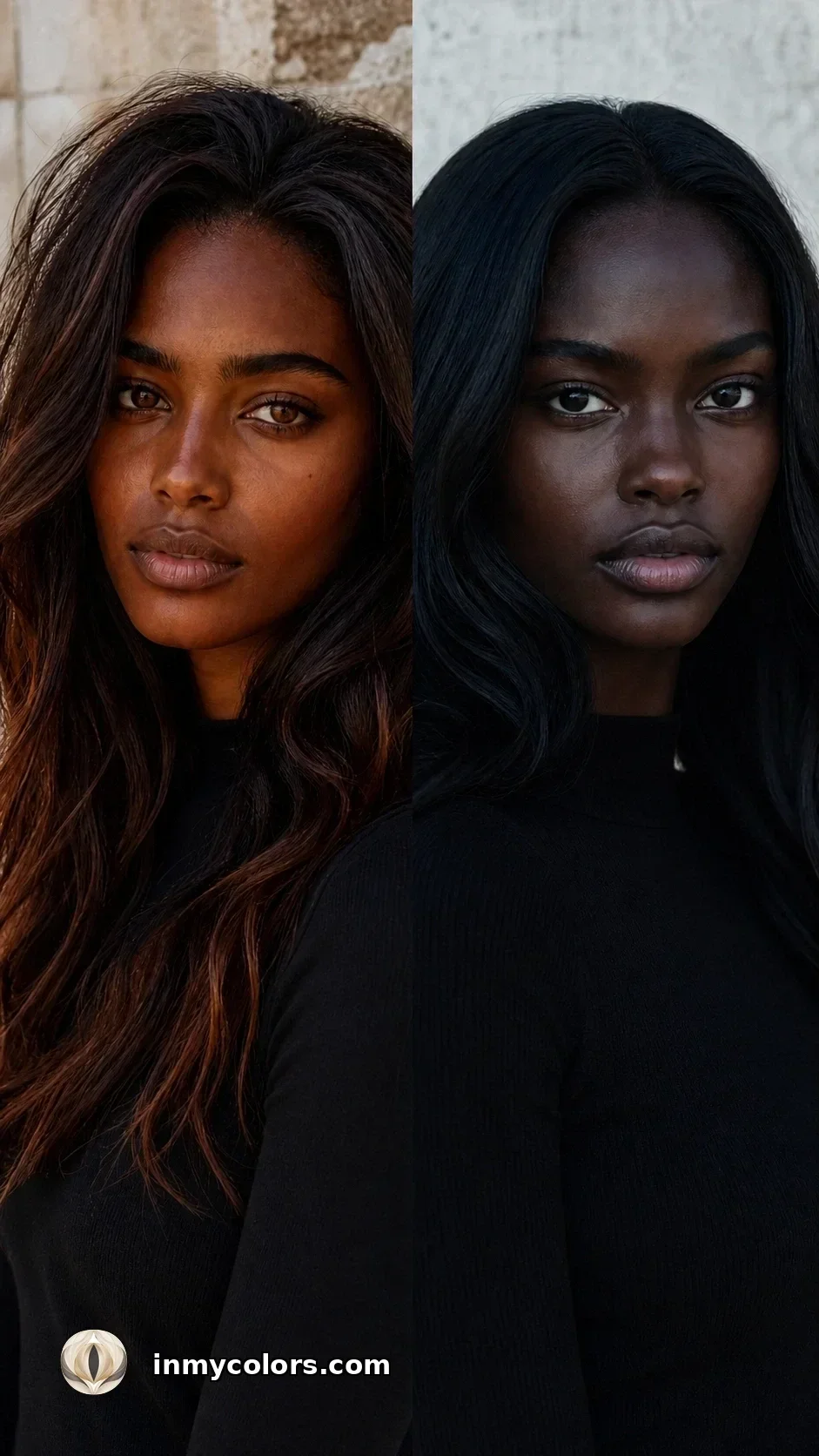
Deep colouring is not exclusive to any season family. It appears across both warm and cool seasons:
Warm deep seasons:
- ✦True Autumn: Deep, rich, golden-mahogany undertone. Medium-to-deep complexion. The warmth is unmistakeable in good light.
- ✦Dark Autumn: The deepest Autumn sub-season. Very dark complexion with a golden, brown, or mahogany undertone. The warm quality runs through the skin even at great depth.
- ✦True Spring: Some True Spring individuals have medium-deep complexions with warm, golden-peachy undertones. Less common at the deepest end, but present.
Cool deep seasons:
- ✦True Winter: Deep to very deep complexion with a distinctly cool, blue-toned undertone.
- ✦Dark Winter: The deepest Winter sub-season. Very deep colouring with blue-black or cool ebony undertone.
- ✦True Summer: Some Summer individuals have medium-deep complexions. Less common at the deepest end, but the cool undertone distinguishes them clearly from Autumn.
The population of deep-complexioned individuals is distributed across both warm and cool seasons in roughly equal measure. Assigning all of them to Winter would misclassify approximately half.
The Diagnostic Question: Is the Undertone Golden-Mahogany or Blue-Ebony?
The question that separates warm deep seasons from cool deep seasons is simple to state, though it requires careful observation: does the undertone pull toward golden-mahogany, or toward blue-ebony?
Golden-mahogany: A warm quality in the skin — the kind of depth that reads bronze, golden-brown, or reddish-warm. When this person stands in sunlight, the skin glows warm. When they wear gold jewellery, it connects with the skin. When they wear cool colours, the skin can look slightly grey or ashen. This is warm: Autumn territory.
Blue-ebony: A cool quality in the skin — the kind of depth that reads blue-black, cool brown, or ash. When this person stands in sunlight, the skin does not add warmth. When they wear silver jewellery, it connects with the skin. When they wear warm colours, the face can look muddy. This is cool: Winter territory.
At the deepest complexion depths, reading this distinction takes practice. The contrast between the two is less immediately visible than at lighter complexion depths. But it is there, and it is readable — through undertone testing, draping, or careful observation of whether gold or silver metal looks more harmonious against the skin.
The Vein Test at Deeper Skin Depths
The vein test — looking at the inside of the wrist to read whether veins read green-warm or blue-cool — works at all complexion depths, though the contrast between green and blue can be harder to read on very deep skin where the pigmentation is high throughout.
For individuals with very deep complexions, the vein test should be done in very strong natural light and compared against a white background. The undertone quality of the veins — whether they push toward warm olive-green or distinctly blue-purple — is still present even if less immediately obvious.
If the vein test is genuinely inconclusive, the more reliable test is draping: holding distinctly warm fabrics (golden yellow, warm rust, terracotta) and distinctly cool fabrics (cool blue, lavender, pure cool grey) near the face and observing which makes the complexion look more alive, more even, and more vibrant. This test works consistently across all complexion depths.
The Lupita Example: Why Celebrity Analyses Get This Wrong

Lupita Nyong'o is one of the most frequently discussed celebrity colour analyses online. The near-unanimous consensus from blogs, forums, YouTube analyses, and beauty discussions is that she is a Dark Winter — cool, deep, high-contrast.
An actual analysis of her skin in multiple photographic contexts tells a different story. The undertone in her skin — visible in natural light, particularly in warm-light photography — has a golden-mahogany quality. It does not read as the cool blue-ebony undertone of a Dark Winter. It reads warm.
A careful pixel-level analysis of her colouring — looking at the skin tone independently, without the name attached — arrives at Deep Autumn: warm, golden-mahogany undertone, deep and muted rather than cool and vivid.
This is not a definitive diagnosis made from photographs. It is an illustration of the gap between what careful analysis shows and what internet consensus asserts. The internet says Dark Winter. The analysis says Deep Autumn. These are opposite sides of the temperature divide.
Why AI Assistants Compound the Problem
If you ask an AI chatbot what colour season Lupita Nyong'o is, it will almost certainly say Winter. It may say Dark Winter or True Winter. It will give you a confident explanation citing her high contrast and deep colouring.
It will not be doing colour analysis. It will be doing a literature review — synthesising the consensus from thousands of blog posts, forum discussions, YouTube comments, and colour analysis articles that have accumulated on the internet. Those sources converge on Winter because "deep = Winter" is the dominant assumption in the popular discourse, and the AI is summarising that discourse.
This is a structural problem. An AI trained on text cannot look at a face. It cannot read a pixel. It reads what people wrote about a face, and what people wrote is shaped by the same myth this article is addressing.
What Actually Happens When a Deep Autumn Wears Winter Colours
The test that settles any season question is observation: what happens when the person wears the colours from both candidate seasons?
A person with deep, golden-mahogany colouring who wears Winter colours — cool grey, cool blue, cool charcoal — often experiences the following: the face looks slightly grey or ashen. The warm quality of the skin seems to disappear. The overall impression is slightly flat.
The same person in Autumn colours — warm gold, terracotta, deep cognac, warm forest green — experiences something different: the face becomes animated. The warmth in the skin becomes visible. The overall impression is vibrant.
This is the diagnostic. It works more reliably than any other test, and it works consistently across complexion depths.
The Practical Consequence
If you have deep colouring and you have been told you are a Winter, try a test before accepting the answer:
- 1.Find fabrics in warm, earthy, golden tones — terracotta, warm rust, deep cognac, warm olive.
- 2.Find fabrics in cool, clear tones — cool blue-grey, cool charcoal, cool royal blue.
- 3.Hold each near your face in natural light without makeup.
- 4.Look for which makes the skin look more alive, which makes the whites of the eyes look brighter, which makes any unevenness in the skin less visible.
If the warm fabrics win, you are not a Winter. You are somewhere in the warm family — likely Autumn.
The correct season matters. Wearing the wrong season's palette is not neutral; it actively works against the colouring rather than supporting it.
Find Your Season
Depth is not a proxy for Winter. Temperature is the diagnostic — and temperature is readable, testable, and consistently present regardless of how deep the complexion is. Get a genuine, pixel-level reading of your undertone rather than relying on the dominant assumption. Find your season at inmycolors.com.