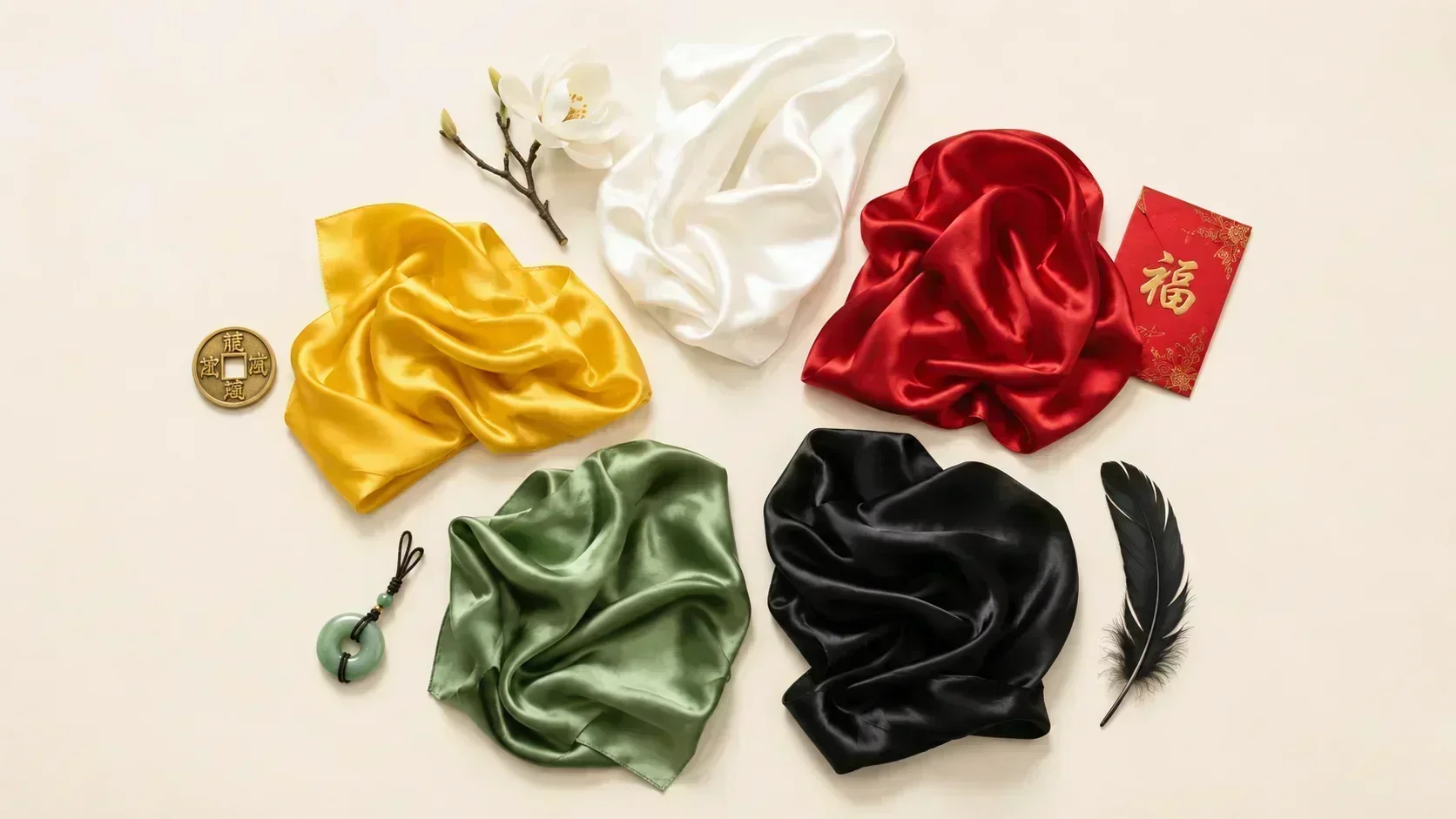
Colour does not carry meaning the same way across every culture. White is the colour of mourning in China and the colour of weddings in the West. Red is the colour of luck in India and the colour of danger in Western traffic signals. Green means money in the United States and means fertility and new beginnings in many Islamic contexts. The same colour, worn in different parts of the world, signals different things.
This is widely understood in the abstract. What is less clearly articulated is the specific pattern of variation — which colours vary most across cultures, which associations are near-universal, and what this means for how you dress across cultural contexts.
The Two Categories of Colour Meaning
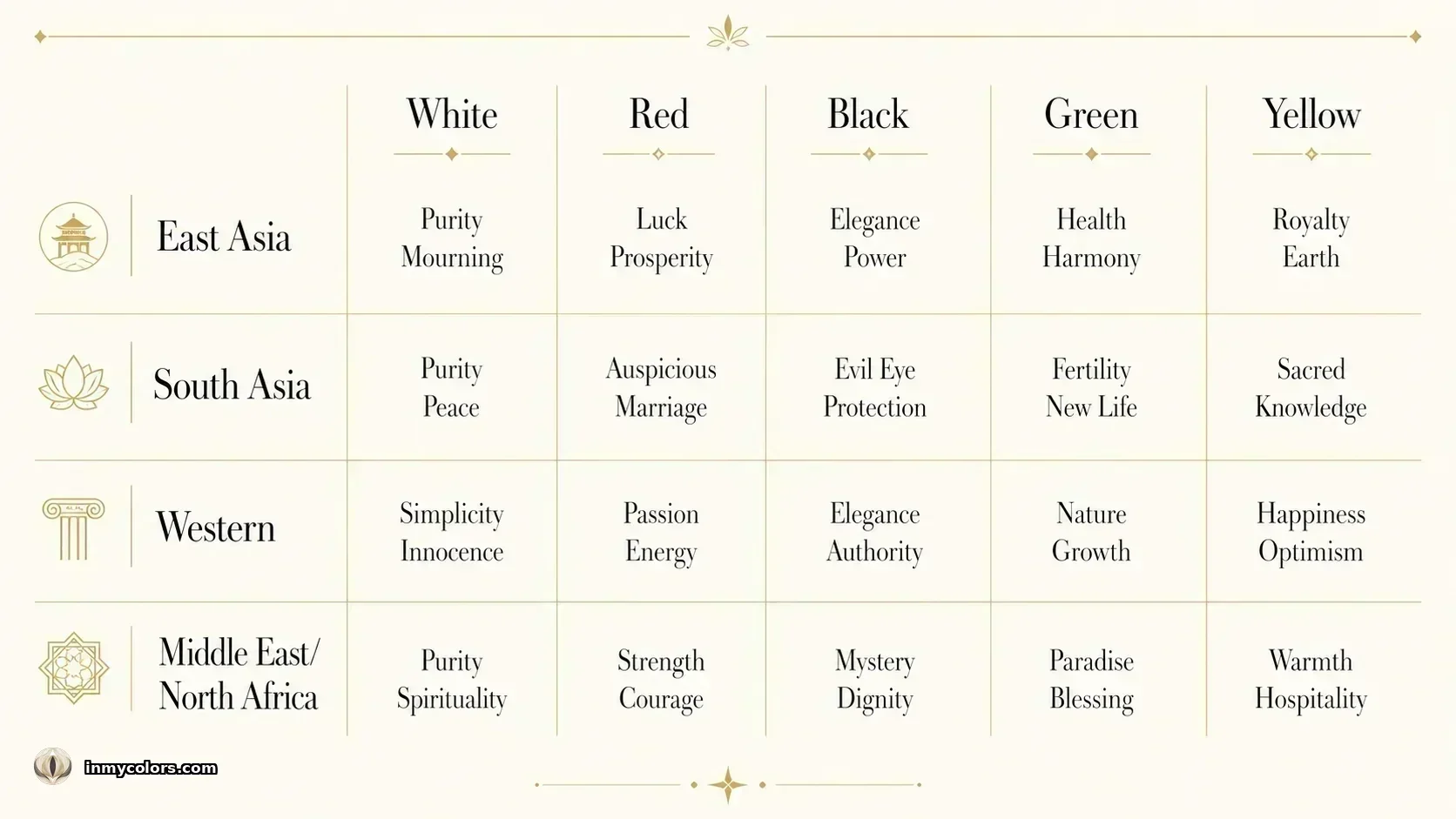
Colour psychology research distinguishes between two types of colour associations:
Physiological associations, which are consistent across cultures because they arise from biological response rather than learned cultural meaning. Red raises pulse rate whether you are in Tokyo, Lagos, or London — the body responds to the wavelength before the mind processes its symbolic meaning. Blue lowers arousal. Yellow is fastest to process in peripheral vision. These effects are universal because they operate below the level of cultural learning.
Cultural associations, which are learned, vary significantly across regions and historical periods, and can directly contradict each other. White as mourning and white as celebration are both cultural associations — neither is wrong, neither is universal, and both are deeply meaningful within their context.
Understanding which type of association you are dealing with is the first step in navigating colour across cultural contexts.
White
In most Western European and North American contexts, white is the canonical colour of weddings, purity, and new beginnings. The white wedding dress, codified by Queen Victoria in 1840, has become so embedded in the Western imagination that it is often assumed to be universal.
It is not.
In China, Japan, Korea, and across much of East Asia, white is the traditional colour of mourning and funerals. The white funeral robe and white-draped mourning ceremony are deeply established traditions. A wedding guest wearing white in this context is making a significant cultural error.
In India, white has historically been associated with widowhood and renunciation — the white sari worn by widows in traditional contexts. Contemporary Indian weddings are colour-saturated events; white is notably absent. Brides wear red or warm colour; guests wear vivid jewel tones. A guest arriving in white is signalling the wrong thing.
In many Islamic contexts, white has no strong mourning association and is perfectly appropriate for celebration. The qandura or thobe worn by men in Gulf countries is typically white — a sign of cleanliness and dignity.
The same single colour, across three cultural contexts, carries meanings that are contradictory: celebration in one, mourning in another, dignity in a third.
Red
Red is the most cross-culturally studied colour, partly because its associations are the most dramatic in their variation.
In China, red is the colour of luck, prosperity, celebration, and joy. Red envelopes (hongbao) are given at New Year and weddings. Brides wear red. The colour is used at every festive occasion as a positive, life-affirming signal. Red in Chinese cultural contexts is unambiguously positive — the most powerful good-luck colour in the system.
In India, red carries similar associations: prosperity, fertility, and celebration. The traditional bridal sari is deep red or red-orange. Sindoor — the red powder applied to the hair parting of married Hindu women — marks marital status. Red is the colour of auspicious beginnings.
In Western contexts, red carries contradictory associations simultaneously. In romance, red means passion and desire. In professional contexts, red means authority, energy, and urgency. In traffic signals, red means danger and stop. The same colour operating in completely different registers within the same culture.
In some West African contexts, red carries associations with aggression or danger. In mourning traditions in parts of Ghana and Ethiopia, red is worn to signal warrior death or honour in battle.
Red is also the most physiologically potent colour — it raises pulse rate and blood pressure regardless of cultural context. The physiological effect is consistent; the symbolic overlay varies.
Black
Black in Western fashion is neutral, sophisticated, and authoritative — the universal default for formal occasions, professional settings, and understated elegance. "Little black dress" is a concept with no equivalent in most non-Western fashion traditions because the colour does not carry the same neutral authority.
In most East Asian mourning traditions, white is the mourning colour; black plays a secondary role. In contemporary urban fashion in China, Japan, and Korea, black has adopted Western fashion associations and is widely worn. But the traditional association is primarily Western.
In many West African traditions, black is not a primary mourning colour. Red, white, and black combined have ceremonial significance in various traditions, but black alone does not carry the same universal mourning signal.
In Morocco and across North Africa and the Middle East, black carries connotations of formality and modesty, often worn by women as a sign of conservative dress rather than mourning. The association is respectability rather than death.
The Western fashion industry's use of black as the universal neutral — the default for everything from job interviews to formal dinners — reflects a highly culturally specific convention, not a universal truth.
Green
Green has unusually consistent positive associations across many of the world's major cultural traditions.
In Islamic cultures, green is the most sacred colour — the colour of Paradise, the colour of the Prophet's banner, and the colour associated with spiritual life. This is the basis for the prevalence of green in the flags and decorative traditions of many Islamic-majority countries: Saudi Arabia, Libya, Pakistan, Bangladesh, Iran.
In Western contexts, green has strong nature, growth, and environmental associations — money (particularly US currency), growth, and now specifically ecological consciousness.
In East Asian contexts, green jade is one of the most prized and symbolically rich materials — associated with virtue, luck, and high status. Green as a colour carries the associations of jade.
The exception: in France, green was historically associated with poison (arsenic-based green dyes were used in 18th and 19th century wallpapers and clothing, and caused deaths). The association lingered, and green retained residual negative associations in French tradition longer than elsewhere in Europe.
Yellow and Gold
In many Asian contexts, yellow and gold are the colours of royalty, imperial power, and the highest social status. In Imperial China, yellow was reserved for the Emperor — it was literally illegal for commoners to wear it. Gold in its many forms carries the same imperial and divine associations across South and East Asian traditions.
In Western contexts, yellow is associated with optimism, warmth, and energy at its most vivid — but can also carry associations of cowardice or caution (yellow as warning signal). Gold in Western fashion is a premium accent colour, associated with luxury rather than divine status.
In some contexts, yellow carries negative associations: in some Latin American traditions, yellow flowers are funeral flowers and should not be given as gifts. In Russia, yellow flowers traditionally signal jealousy or infidelity and are similarly inappropriate as gifts in romantic contexts.
What Stays Constant: The Physiological Floor
Underneath all the cultural variation, a consistent physiological layer operates.
Warm colours (reds, oranges, yellows) produce higher arousal across all cultures — faster pulse, more attention, more energy. Cool colours (blues, greens, grey-blues) produce lower arousal — calmer response, reduced urgency. This is not cultural learning; it is the body responding to wavelength.
This means that the advice to wear warm colours for energy and visibility, and cool colours for calm and reliability, holds across cultural contexts — even when the symbolic meanings layered on top of those physiological effects differ dramatically.
Similarly, the principles of simultaneous contrast — that the same colour looks different against different backgrounds — operate physiologically and are not culturally modified. Your skin's undertone responds to colour adjacency the same way in every culture.
The Personal Colour Analysis Dimension
Personal colour analysis operates primarily on the physiological level, not the cultural one. The warm-cool axis, the value axis, the chroma axis — these are properties of light and colour interaction with skin pigmentation that apply consistently regardless of cultural context.
The recommendation that a True Autumn avoid stark cool navy is not a Western fashion prescription. It is an observation about how a warm-undertone skin responds to a cool-temperature colour — the undertone cancels, the skin reads flat, the harmony is lost. This effect is the same in Tokyo, Lagos, and São Paulo.
What varies across cultures is the social meaning of particular colours — the occasions they are appropriate for, the signals they send, the messages they carry. Personal colour analysis identifies which shades of which colours harmonise with your individual colouring. Cultural context identifies which of those harmonising shades are appropriate for a given occasion.
Both layers matter. Neither cancels the other.
A Summary of Key Cross-Cultural Meanings
White: Weddings/celebration (Western); mourning/funerals (East Asian); widowhood (traditional India); dignity/cleanliness (Islamic, Gulf contexts)
Red: Danger/passion (Western); luck/prosperity/celebration (Chinese, Indian); warrior honour (some West African)
Black: Sophistication/authority/mourning (Western); modesty/formality (North African/Middle Eastern); secondary mourning (East Asian)
Green: Growth/environment (Western); sacred/paradise (Islamic); imperial/jade virtue (East Asian)
Yellow/Gold: Warning/optimism (Western); imperial/divine status (Chinese, South Asian); funeral/jealousy (parts of Latin America, Russia)
Dressing Across Cultural Contexts
For someone who moves across cultural contexts — international travel, multicultural professional environments, cross-cultural social occasions — the practical implications are straightforward.
Research the specific occasion, not just the country. Colour meanings vary not just by country but by occasion type (wedding, funeral, business meeting, celebration), by generation, and by degree of traditionalism. A contemporary urban wedding in Beijing may have completely different colour conventions than a traditional village wedding in the same country.
The safest universal approach for uncertainty: mid-depth, mid-temperature colours that are neither strongly associated with mourning nor with extreme cultural salience. A soft teal, a warm dusty rose, a mid-depth olive — these colours carry fewer strong cultural associations than red, white, black, or yellow, and are appropriate as a default when cultural context is genuinely unknown.
The safest approach for known occasions: ask. A colleague, a local contact, or a brief cultural research note will resolve most colour questions before the occasion. The risk of getting a culturally significant occasion wrong is always higher than the effort of checking.
Your palette, selected by season, gives you colours that harmonise with your individual colouring. Which of those harmonising colours are appropriate for a given cultural context is a separate — and always resolvable — question.
Cross-cultural colour associations draw on Faber Birren, Color and Human Response (1978); David Batchelor, Chromophobia (2000); Kassia St Clair, The Secret Lives of Colour (2016); and academic literature on cross-cultural colour symbolism including Aslam, M. M. (2006), Are you selling the right colour? Journal of Marketing Communications, 12(1).