"Olive skin" is one of the most frequently misused terms in colour and beauty advice — and the misuse leads to systematic misclassification in colour analysis.
Olive skin is not a season. It is a description of a specific skin quality: medium to medium-deep skin with a green or greyish-yellow cast, caused by a combination of higher melanin and the visible effect of yellow (carotenoid) and sometimes green-grey pigmentation. It appears across multiple ethnic backgrounds — Mediterranean, Middle Eastern, South and Southeast Asian, Latin American, East Asian, and others — and, critically, it appears in both warm and cool undertone versions.
Most colour advice treats olive skin as synonymous with warm undertone. This is a strong tendency, not a universal rule. Cool olive exists. And a cool olive person in a warm season palette will experience exactly the same temperature mismatch as any other cool-undertone person in the wrong temperature.
What Makes Skin "Olive"
Olive skin gets its characteristic grey-green or yellowish-grey quality from a specific combination:
Higher eumelanin (dark pigment): produces a brown-grey quality in the skin rather than a pink or golden one.
Carotenoid pigmentation: the yellow-orange pigment that produces a golden cast. When carotenoid is high against a melanin-rich background, the result is warm olive — golden-brown, amber, warm yellow-brown.
Lower haemoglobin visibility: less visible pink-red, which means the skin lacks the rosy or flushed quality of cooler, fairer skin types.
The green or grey quality of olive skin comes from the combination of yellow and blue-brown pigments, which optically read as olive-grey — the colour you get when you mix yellow and grey-brown together.
Warm Olive vs Cool Olive: The Critical Distinction
Warm olive is the more common form — golden, amber, or warm-brown olive with a distinct warmth in the skin. Warm olive skin looks alive in gold jewellery, harmonises with camel and warm tones, and has a honey or amber quality in sunlight.
Warm olive appears in: True Autumn, Soft Autumn, True Spring, Deep Autumn — warm season families.
Cool olive is less commonly discussed but real. Cool olive skin has the grey quality without the golden warmth — a cooler, more neutral or slightly grey-green quality. Silver jewellery sits better than gold. Cool colours (soft navy, plum, muted teal) harmonise better than warm ones.
Cool olive appears in: True Summer, Soft Summer, True Winter — cool season families.
The distinction is important because most olive-skin colour advice defaults to warm: "olive skin → Autumn palette." A cool olive person given an Autumn palette will wear warm camel and rust and find them consistently flat and slightly wrong, without being able to identify why.
Testing Temperature With Olive Skin
The same tests that work for all skin tones work for olive, though the results may require careful observation.
The gold-silver test: hold warm gold and cool silver swatches near the face in natural light. Warm olive skin typically shows a more pronounced effect than cool olive — the gold makes the skin glow visibly more than the silver. For cool olive, the silver produces a cleaner impression while the gold can make the skin look slightly yellow or sallow.
The vein test: look at the inside of the wrist.
- ✦Greenish or olive veins → warm undertone (this is particularly common in warm olive skin, where the yellow pigment turns the blue veins green)
- ✦Blue or purple veins → cool undertone
- ✦Difficult to read clearly → the melanin level may make veins harder to assess; rely more on the draping test
The camel test: hold a warm camel fabric near the face.
- ✦Skin glows or looks harmonious → warm olive
- ✦Skin looks slightly grey, flat, or sallow → cool olive
The white test: hold stark white near the face.
- ✦Skin looks yellow or olive-highlighted → typically cool olive (the cool white creates a cool reference that reveals the yellow or grey quality as a discordance)
- ✦Skin looks clear and luminous → likely cool undertone (Winter or Summer) where stark white harmonises
- ✦Skin looks harsh or slightly cold → typically warm olive, where the cool white fights the warm undertone
Olive Skin Across the Seasons
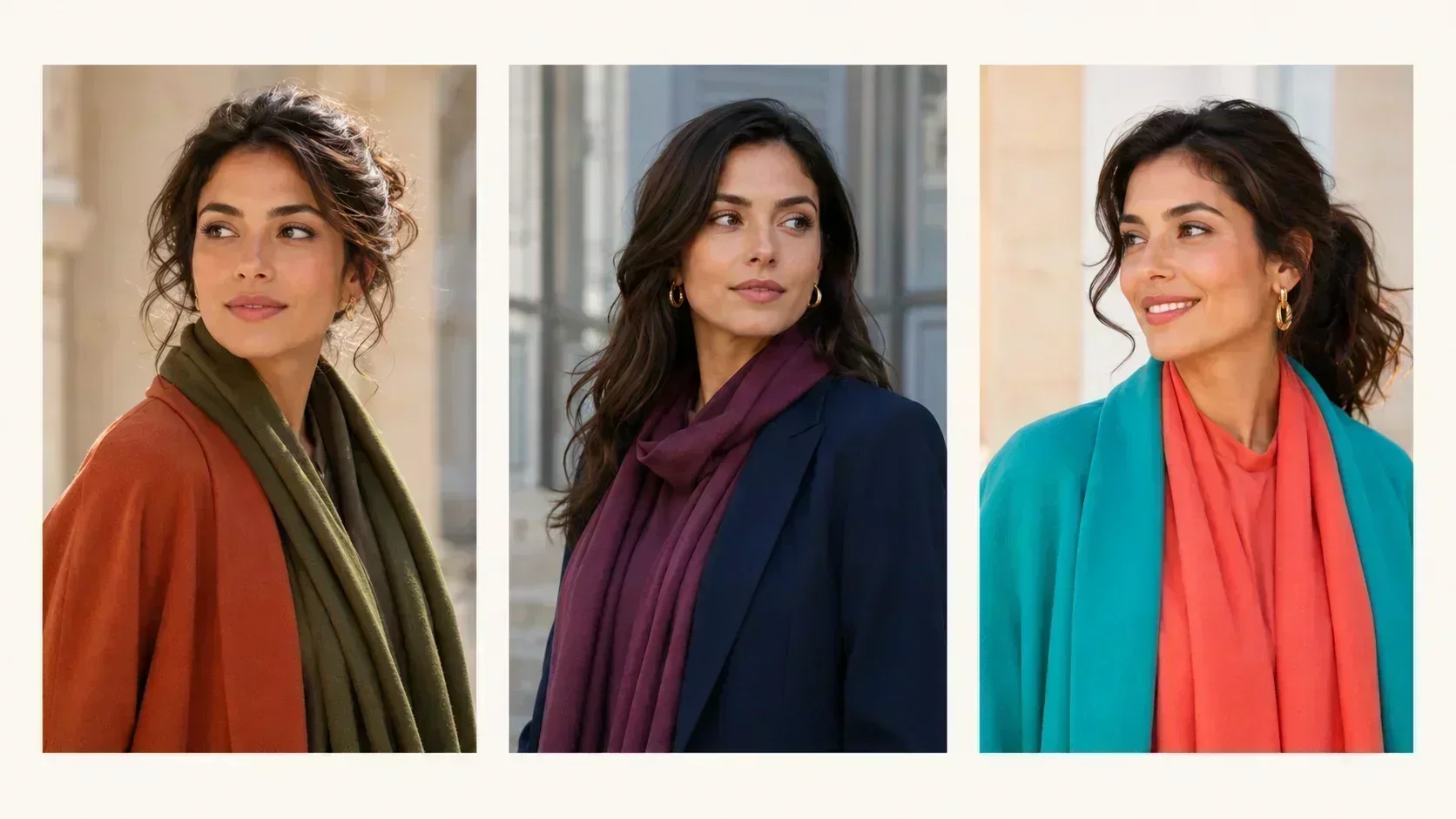
True Autumn (warm olive, muted): the most classically "olive skin" season. Medium to medium-deep warm olive skin, dark warm-brown or auburn hair, dark or hazel eyes. The Autumn palette — rust, terracotta, olive green, cognac, warm burgundy, warm dark teal — is the range that best harmonises with this colouring. The warmth in the palette matches the warmth in the skin; the muted chroma matches the subtle chroma of the olive quality.
Soft Autumn (warm olive, soft): slightly lighter and softer than True Autumn. The same warm olive quality in a lighter, more muted form. The palette is the gentlest Autumn range — warm greige, muted camel, dusty terracotta, warm soft sage.
Deep Autumn (warm olive, deep): the deepest warm olive — medium-deep to deep skin with the rich warm olive quality, very dark warm hair, dark eyes. The deepest Autumn palette: dark warm brown, forest green, warm dark teal, rich cognac, deep amber.
True Spring (warm olive, clear): less commonly discussed — warm olive with higher chroma and lighter value. The warm green-golden quality in the skin sits within the Spring range when paired with lighter, clearer eyes and lighter warm hair. The Spring palette serves this colouring in its warmer, clearer versions: warm teal, golden yellow, clear coral.
True Summer (cool olive, muted): this is the least discussed combination. Cool olive skin — the grey-green, slightly flat quality with no golden warmth — within a cool, muted, medium-depth frame. Soft navy, dusty mauve, cool sage, muted teal. The season is defined by cool temperature and muted chroma; the olive quality reads as a cool-grey-green rather than a warm-golden-green.
True Winter (cool olive, clear): cool olive at higher contrast. Dark hair, deeper or more vivid features, and the cool grey-green olive skin quality. The Winter palette — black, navy, cool white, deep plum, cool teal — sits in a different relationship to the skin than the Summer palette: sharper and more vivid rather than soft.
The Myth That Olive Skin Can't Wear Warm Tones
A persistent piece of advice is that warm yellow or orange tones "clash" with olive skin — that the yellow in the skin and the yellow in warm colours create a sallow, yellow-on-yellow effect.
This is true for cool olive skin, where a warm olive or golden yellow in the clothing emphasises the yellow quality of the skin and makes it look sallow.
It is not true for warm olive skin, where the warmth in the clothing harmonises with the warmth in the skin and produces a luminous, alive impression. A warm True Autumn in terracotta looks rich and grounded. The same True Autumn in cool grey looks flat and somewhat ashen. The temperature match is working correctly.
The confusion arises from applying cool-olive advice to warm-olive skin. The advice is correct for the wrong population.
Foundation Matching for Olive Skin
Olive skin is the most commonly mismatch in foundation — across all skin tones, olive skin has the most difficulty finding foundations that work.
The problem: most foundation ranges are calibrated for pink undertones (cool, non-olive) or warm golden undertones (warm, non-olive). Olive skin — with its yellow-grey-green quality — sits outside both calibrations.
For warm olive skin: look for foundations described as "warm" with a golden-yellow base and no pink. "Neutral warm" often works. Avoid anything with pink. The warm yellow in the formula should harmonise with the warm yellow in the skin without emphasising it.
For cool olive skin: look for foundations described as "neutral" with a slight grey-beige quality. A foundation that is too warm will make cool olive skin look sallow (yellow-on-grey-yellow). A foundation that is too pink will fight the olive quality. Neutral, with very slight grey-beige character, tends to be the most harmonious.
The test for both: the correctly matched foundation should disappear at the jaw. No orange line, no grey line, no visible warmth or coolness at the neck. It simply blends.
Metals for Olive Skin
Warm olive: gold. Antique gold, bronze, warm champagne gold. Yellow gold sits harmoniously against the warm yellow-brown skin. Silver can look slightly cold.
Cool olive: silver, white gold, or platinum. Cooler metals harmonise with the cool grey-olive quality. Yellow gold can make cool olive skin look sallow or yellow.
A Summary: Which Season Is Your Olive?
If you have olive skin and are trying to determine your season:
- 1.Do the gold-silver test. Gold makes your skin glow? Warm olive — Spring or Autumn family. Silver looks cleaner? Cool olive — Summer or Winter family.
- 1.Assess your depth. Lighter medium skin? Spring or Summer family. Deeper medium or deep skin? Autumn or Winter family.
- 1.Assess your chroma. Vivid, striking eyes or features? Leaning toward clearer seasons (Spring, Winter). Softer, blended features? Leaning toward muted seasons (Autumn, Summer).
- 1.Drape three colours: warm terracotta, cool soft navy, and warm camel. The one that makes your face look most alive tells you your temperature and confirms the family.
Olive skin does not have one season. It has several — across both warm and cool families. The depth and temperature together tell you which one is yours.