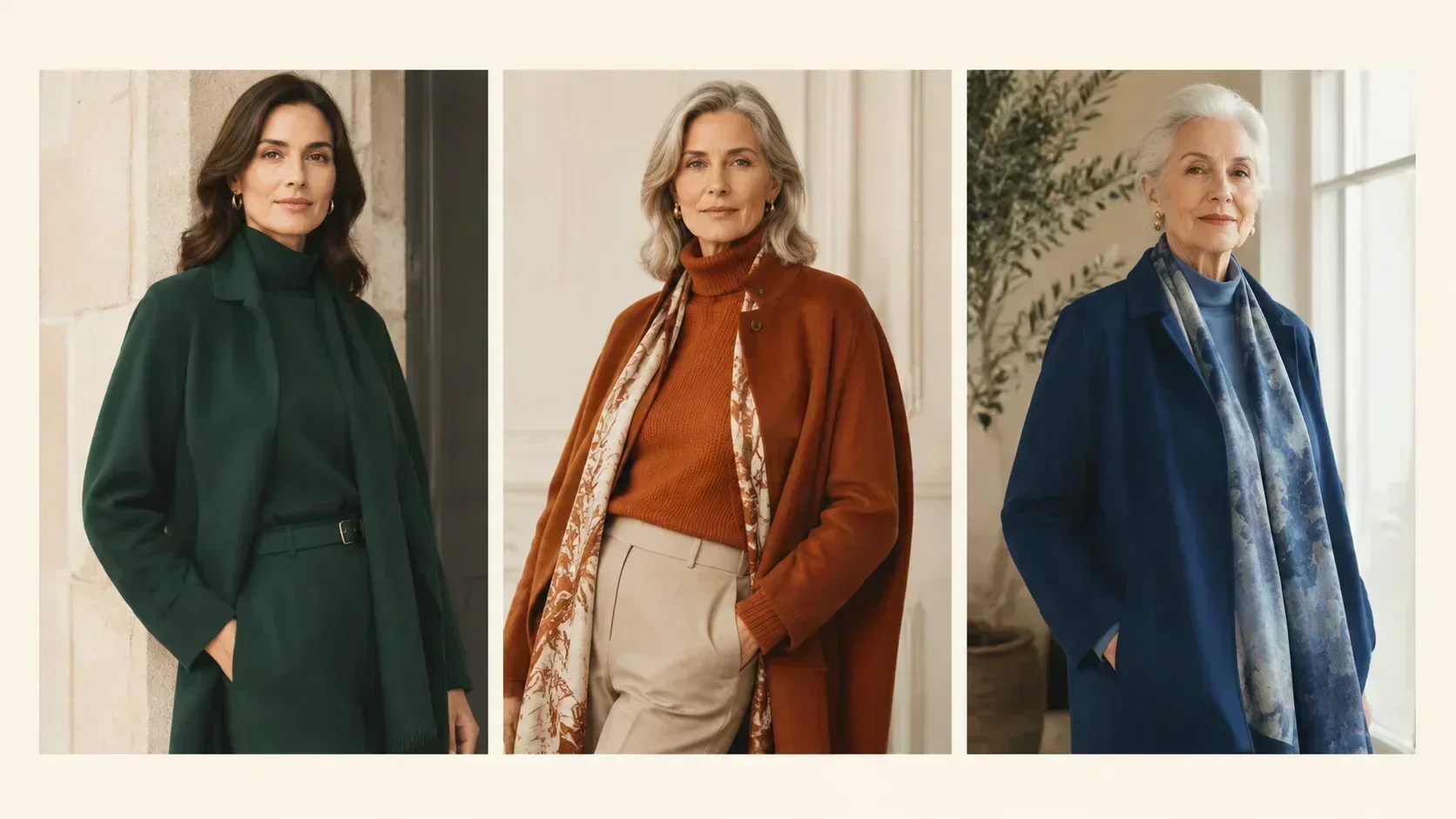
The question most people have when they first encounter seasonal colour analysis is: does my season change as I get older?
The answer requires two parts.
Your underlying season — the classification determined by the temperature, value, and chroma of your natural colouring — does not change. The perceptual system that assigns you to a season is based on structural features of your colouring that are determined by your genetics, not your age. A True Autumn at 30 is a True Autumn at 60. The category itself is stable.
What changes is what the season looks like expressed at your current age. The shades that best serve you within your season shift as your colouring shifts. The contrast levels that work most effectively adapt. The application — how you use the season in makeup, hair colour, and clothing — requires recalibration at each life stage.
Understanding both the stability and the evolution is what allows the season to serve you across decades rather than being discarded as your appearance changes.
What Changes With Age — and Why
Colouring typically evolves through several consistent patterns as the decades pass.
Value lightens. Skin generally lightens slightly over time. The melanin production that produces pigmentation declines, and the skin reflects more light. Hair, particularly, moves toward grey and white — a dramatic increase in value. The face overall typically becomes higher in value (lighter) with age.
Contrast softens. The high contrast between dark hair and pale skin that characterises many young people's colouring softens as hair loses its pigment. The dark-haired twenty-year-old becomes the salt-and-pepper forty-year-old and the silver-haired sixty-year-old. The contrast that may have pushed toward Winter or Bright Spring in youth softens toward something closer to Summer or Light Spring in later decades.
Chroma softens. The vivid, saturated colouring of youth — flushed cheeks, vivid lip pigmentation, bright iris colour — softens with age. The natural chroma of skin reduces. Makeup that replaces this chroma becomes more relevant.
The season family stays constant. Importantly, temperature does not change with age. A warm undertone remains warm. A cool undertone remains cool. The temperature axis — the axis that determines which season family you sit in — is structural and does not shift across decades. A Spring remains a Spring. A Winter remains a Winter.
The practical implication: the season family is lifetime guidance. The specific shades within that family require gentle recalibration.
The Twenties and Thirties: Working With What You Have
In the early adult decades, colouring is typically at its most vivid and clearly defined. The natural chroma is relatively high, the contrast is clear, and the skin reflects light effectively. The season classification made at this stage is likely to be the most accurate and the most clearly supported by the colouring.
The practical work in these decades is simply learning to use the season. Understanding which shades within the family harmonise, identifying the neutrals that form the foundation of a wardrobe, and beginning to build a colour intuition that will serve for decades.
One common error in these decades: applying too much makeup of the wrong temperature because the natural chroma is high enough to "carry" it. A Spring who can wear a cool berry lip doesn't look terrible — the youth and vitality compensate. The same Spring at 50, with slightly reduced natural chroma, will find the same cool berry significantly more problematic. Building good temperature habits in the early decades pays later.
Another common error: treating the season as a rigid constraint rather than a filter. The season specifies shades within families, not bans on colour families. A True Winter at 25 who avoids warm camel because it "isn't in her season" but wears warm gold because she likes it has misunderstood the system. The gold is wrong temperature; the camel may be achievable in a cool, dark version (cool dark camel reads as grey-brown for Winter). Learning the flexibility within the system matters.
The Forties: When Chroma Softens
The forties are typically the decade when most people notice their colouring has softened slightly. The very vivid colours that looked magnificent at 25 can start to feel overwhelming. The high-contrast looks that felt electric start to feel slightly harsh.
This is not the season changing. It is the natural chroma level softening, which shifts the optimal position within the season toward softer shades.
The practical adjustment: move toward the middle and softer edge of your season palette rather than the most vivid versions. A Bright Spring at 45 may find that pure coral-red looks slightly overwhelming and that a slightly softer warm red serves better. She is still Bright Spring — the shade has moved within the family, not outside it.
Skin-near colour matters more. As natural chroma softens, the colours immediately adjacent to the face have more impact. A strong, harmonious colour near the face — a blouse, a scarf, a neckline in the right shade — provides the luminosity that the skin provided more effortlessly at 25. Getting the face-adjacent colours right matters more in the forties than it did in the twenties.
Foundation and blush recalibration. The warm peachy-nude foundation that worked at 30 may read as slightly heavy or orange at 45 on skin that has lightened slightly. A slightly lighter, slightly more neutral-within-warm version usually serves better. Blush becomes more structurally important as natural flush reduces.
The Fifties: Contrast and the Great Grey Question
The fifties are, for many people, the decade of the most significant colouring shift: the arrival of grey hair. What was dark becomes salt-and-pepper, and then silver, and then — for those who choose not to colour — white.
This changes contrast dramatically. And contrast is one of the axes on which seasonal classification is partly based.
The important thing to understand is that the grey itself has a temperature. Silver-grey hair is cool. Champagne-grey hair is warm. And the temperature of the grey is consistent with the underlying season.
Warm-season people (Springs and Autumns) who go grey typically produce a warm grey — champagne, golden-grey, warm cream-white. The grey has warmth in it. It works within the season.
Cool-season people (Summers and Winters) who go grey typically produce a cool silver or pure white. The grey has no warmth. It works within the season.
This means that going grey — while it dramatically changes contrast — does not change the season. It changes the palette application.
The reduced contrast shift. For people whose high contrast level pushed their classification toward Winter or Bright Spring, the softening of contrast with grey hair may reveal that the underlying season was always slightly softer — Soft Summer, True Summer, True Autumn — and the hair provided the high contrast element. With grey hair, the colour palette may shift slightly toward softer versions of the same family.
The counter-intuitive Winter case. True Winters with stark white or silver-grey hair often experience an increase in effective contrast: white hair against the naturally cool, vivid skin of the Winter creates a high-contrast framework that is entirely in season. Many Winters look most striking with fully silver or white hair.
When Hair Goes Grey: A Complete Seasonal Guide
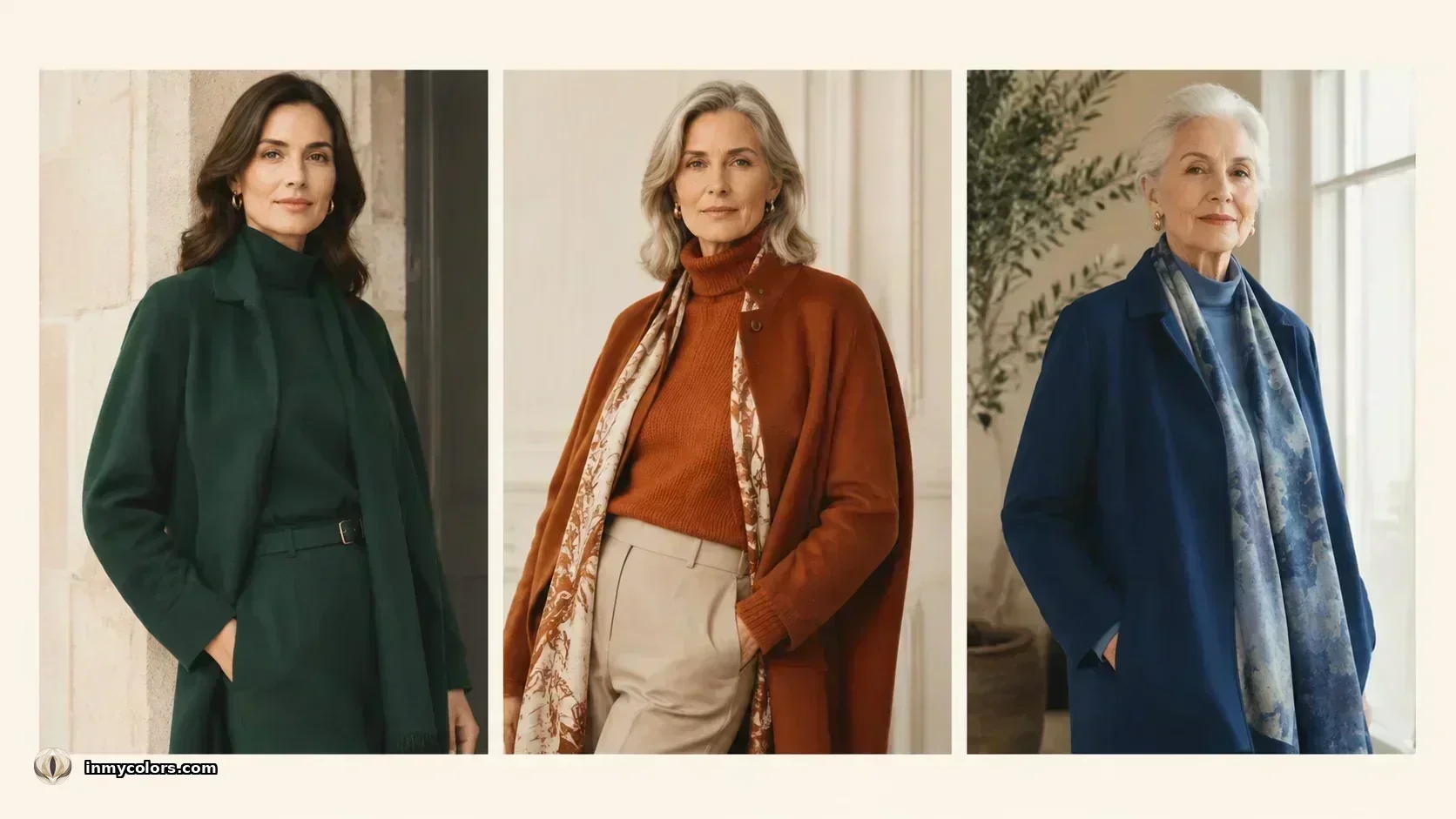
The most common question about colour analysis and ageing is not about clothing — it is about hair. Should I colour my grey? If I do, what colour? If I don't, how do I make the grey work?
The answer is season-specific.
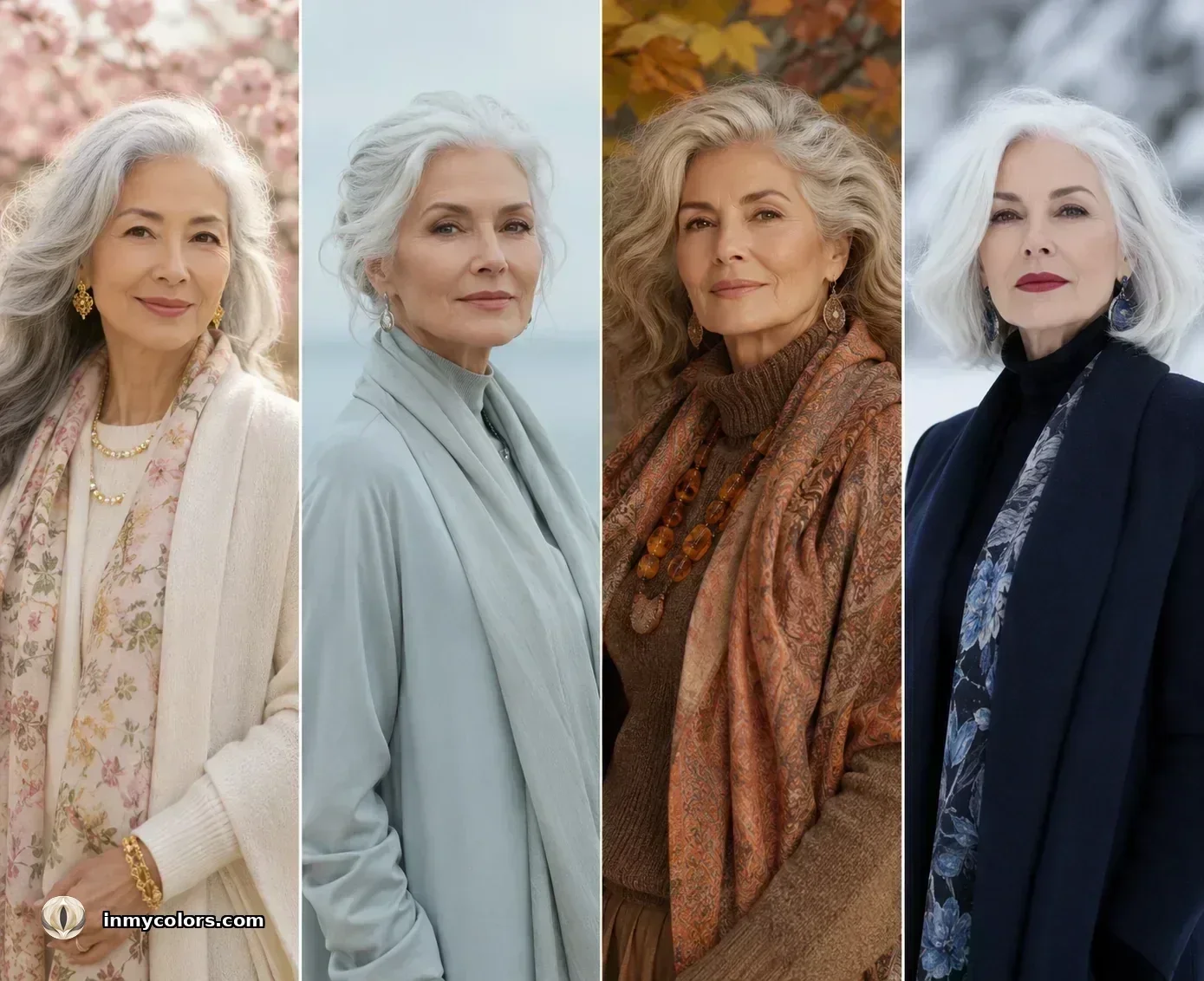
Springs with grey hair. Natural Spring grey tends toward warm champagne or warm silver. The challenge is that grey reduces the warmth that defines the Spring season. Two approaches work: (1) embrace the warm grey with hair colours in golden champagne, honey, or warm blonde highlights that blend with the grey and maintain warmth near the face; (2) if going fully grey, ensure the colour palette near the face skews toward the lighter, warmer end of the Spring palette — soft peach, warm ivory, light coral — to compensate for the reduced hair warmth.
Summers with grey hair. Natural Summer grey is cool — ash, silver, or pale blue-grey. This is perfectly in season for Summer. Light Summers in particular may find that their grey hair is simply the lightest version of a consistently cool, soft palette. True and Soft Summers can embrace the silver without adjustment. The palette remains as is; if anything, the cool silver intensifies the Summer's natural palette resonance. This is the season for which going grey is most straightforwardly beautiful.
Autumns with grey hair. Natural Autumn grey tends toward warm or champagne grey, but the depth of the original Autumn colouring means the reduction in contrast can be significant. For Autumns who wish to colour: warm golden, copper, or warm auburn tones maintain the temperature. Avoid ash. For those going natural: the palette should be anchored by warm earth tones near the face — camel, rust, cognac — to maintain the warmth the season depends on. Soft Autumns may find that warm champagne grey is actually a beautiful natural evolution.
Winters with grey hair. The Deep Winter who goes pure white or stark silver with their naturally cool, deep skin and eyes may have one of the most striking natural looks of any season. The contrast is dramatic and entirely in season. True Winters can go grey-to-white without adjustment. Bright Winters may want to maintain depth in the hair (deep cool brown, off-black) to preserve the high contrast that characterises their season. For Winters who choose to colour: cool dark brown or off-black are the only temperature-appropriate options. Never warm brown.
The Sixties and Beyond: Softening and Authority
In the sixth decade and beyond, the colouring has typically reached a stable state — whether naturally grey, coloured, or white. The colour analysis principles remain the same. What shifts is emphasis.
Luminosity near the face becomes the primary priority. As the skin becomes slightly thinner, and natural flush further reduces, the colours immediately adjacent to the face do the work that the skin's own luminosity once did. This is not a counsel of anxiety — it is a practical observation about where to invest most carefully. The right shade at the neckline, in the right temperature, does more for the overall impression at 65 than any other single choice.
The authority of understatement. There is a well-documented phenomenon in professional and social contexts: the most assured dressers at 60 and beyond typically wear fewer colours, not more. The palette compresses toward the deep neutrals and one or two signature accent colours. The confidence to wear less — less contrast, less variety, less novelty — is itself a signal of ease and authority. A perfectly chosen three-colour outfit at 65 often reads as more assured than a maximalist wardrobe at 35.
Texture and fabric quality matter more. As the eye travels less (fewer colours, less contrast), the quality of what remains becomes more visible. A well-cut blazer in a beautiful fabric at the right temperature does more work than a high-volume wardrobe of average items. The decade-by-decade investment in quality over quantity pays most clearly here.
The Constant: Temperature Is Structural
Across all of this evolution — the softening of chroma, the arrival of grey, the compression toward a mature palette — one thing remains unchanged.
Your temperature is structural. Warm undertone is warm at 25 and warm at 75. Cool undertone is cool at 25 and cool at 75. The season family you were classified in at your most vividly coloured does not change because your hair has gone silver or your skin has lightened.
The practical consequence: the most important thing you learned from your season classification — which temperature of neutrals, which temperature of accent colours, which temperature of foundation and blush — remains correct at every age. The shades within that temperature may shift. The temperature itself does not.
This is the reason a good season analysis, done once, provides a framework for a lifetime of dressing — not a static prescription that becomes obsolete, but a set of principles that adapt to every colouring shift while remaining fundamentally stable.
Your season grows with you.
Colour evolution across life stages draws on seasonal colour application research in Jan Spillane's Colour Me Confident (2008) and Veronique Henderson and Pat Henshaw's Color Me Beautiful Book of Style (1995). Hair-greying temperature patterns draw on colorimetric research in natural hair pigmentation loss.