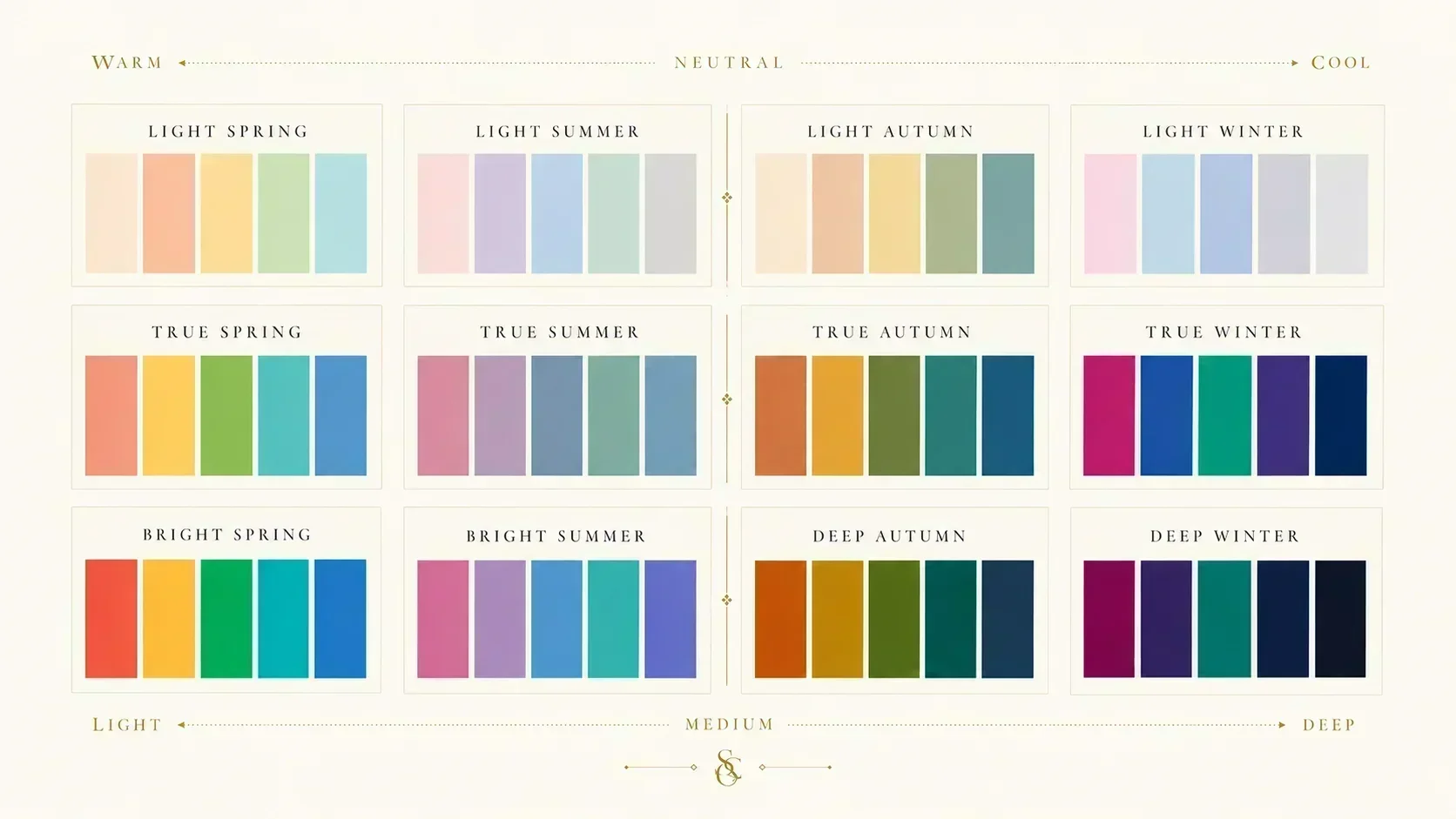
In 1980, Carole Jackson published Color Me Beautiful. The book proposed four seasons — Spring, Summer, Autumn, Winter — each corresponding to a colour palette. It was a publishing phenomenon, selling millions of copies and creating an entirely new category of professional advice.
The four-season system worked. It was also, for a significant portion of the population, not precise enough.
The problem was at the boundaries. A person who was clearly Spring in temperature but higher in chroma than most Spring palettes. A person who was Winter in coolness and depth but not vivid enough for the classic Winter palette. People who fell between the seasons — not wrong for one category but not perfectly served by it either.
The 12-season system emerged from practitioners who observed these boundary cases over thousands of consultations. The refinement added three sub-seasons within each of the four families, producing 12 precisely defined colour ranges that together cover the full spectrum of human colouring with significantly less ambiguity at the edges.
The Three Axes That Define Your Season
Every season in the 12-season system is defined by three measurements:
Temperature: whether the skin undertone is warm (golden/peachy/yellow) or cool (pink/rosy/blue-red). This is the most fundamental axis — it places you in either the warm family (Spring/Autumn) or the cool family (Summer/Winter).
Value: whether the overall colouring is light or deep. Light colouring (fair skin, lighter hair) sits toward the lighter end of the value scale. Deep colouring (darker skin, very dark hair) sits toward the deeper end. This axis distinguishes within the temperature families — Spring vs Autumn within warm, Summer vs Winter within cool.
Chroma: whether the colouring is clear/vivid or muted/soft. Clear colouring has vivid iris colours, well-defined features, relatively high saturation in the natural colouring. Muted colouring is softer, blended, with less saturation in the features. This axis creates the third subdivision — the three types within each family.
Every person sits at a specific position on all three axes simultaneously. The season is simply the label for that position.
The Four Families and Their Twelve Seasons
Spring Family — warm, clear
All Springs have warm undertone and relatively clear chroma. They are distinguished by value.
Light Spring: the lightest of the Springs — fair skin, light golden or strawberry-blonde hair, light eyes. The palette is warm and clear but stays in the lighter value range. Delicate golden tones, apricot, soft warm ivory, warm pastels. Too-dark colours can overwhelm; too-cool colours fight the warm undertone.
True Spring (also called Warm Spring): the archetypal warm, clear Spring. Medium-fair skin, golden or warm medium-brown hair, green or hazel eyes often. The palette is warm and clear across a moderate value range — coral, warm teal, golden camel, clear warm amber. The most classically "Spring" appearance.
Bright Spring: the Spring with the highest chroma — the clearest, most vivid end of the Spring spectrum. Can border on Winter in their clarity and contrast but has a definitively warm undertone. Can carry higher-saturation colours than True Spring — clear warm aqua, vivid coral, bright warm yellow. The Spring that can almost wear Winter colours, but will always need the warm version.
Summer Family — cool, soft
All Summers have cool undertone and relatively muted chroma. They are distinguished by value.
Light Summer: the lightest Summer — fair to medium skin, ash blonde or light ash brown hair, light blue or grey eyes. Very low contrast colouring. The palette is cool, muted, and light — powder blue, soft rose, lavender, misty teal, cool soft ivory. The lightest Summer is among the lowest-contrast people in the system.
True Summer (also called Cool Summer): the archetypal cool, muted Summer. Medium skin, ash or cool medium-brown hair, blue-grey or grey-green eyes. The palette covers the full muted cool range — soft navy, dusty rose, mauve, cool grey. The most classically "Summer" appearance.
Soft Summer: the most muted Summer — the closest to Autumn in chroma level, but definitively cool in undertone. Slightly deeper and more muted than True Summer. The palette is the coolest version of earth-ish tones — cool greige, dusty mauve, muted blue-grey, soft plum. Can sometimes be confused with Soft Autumn; the diagnostic is always temperature.
Autumn Family — warm, muted
All Autumns have warm undertone and relatively muted chroma. They are distinguished by value.
Soft Autumn: the lightest and most muted Autumn — medium-fair skin, light warm or golden-brown hair, hazel or light brown eyes. The most delicate Autumn. The palette is warm but very soft — warm greige, muted camel, dusty terracotta, warm dusty sage. Strong Autumn colours (deep rust, intense copper) can overwhelm.
True Autumn (also called Warm Autumn): the archetypal warm, muted Autumn. Medium to medium-deep skin, golden brown or auburn hair, brown, hazel, or warm green eyes. The full, rich Autumn palette — terracotta, rust, olive, deep teal, cognac, warm burgundy. The most classically "Autumn" appearance.
Deep Autumn: the deepest Autumn — deeper skin (often medium-deep to deep), very dark warm-brown or near-black hair with warm cast, dark eyes. The palette goes darkest within the Autumn range — deep chocolate, forest green, warm dark teal, rich cognac, deep amber. Can sometimes be confused with Deep Winter; the diagnostic is always the warm undertone.
Winter Family — cool, clear or deep
All Winters have cool undertone and relatively clear chroma. They are distinguished by value and chroma intensity.
True Winter (also called Cool Winter): the archetypal cool, clear Winter. Medium to medium-deep skin, dark cool-brown hair, dark or vivid cool eyes. The classic Winter palette — black, white, navy, cool red, deep burgundy, cool teal, royal blue. High contrast, cool temperature throughout.
Bright Winter: the highest-chroma Winter — the clearest and most vivid end of the Winter spectrum. Can border on Spring in their clarity but has a definitively cool undertone. Vivid, electric colours work — electric blue, vivid fuchsia, clear emerald, bright cool aqua. The Winter that can almost wear Spring clarity, but will always need the cool version.
Deep Winter: the deepest Winter — very deep skin with cool or neutral undertone, very dark hair (near-black or blue-black), dark deep eyes. The palette goes to the deepest ends of the cool spectrum — near-black, deep espresso-cool, deep teal-almost-black, intense deep plum. The Winter that can wear depth that would overwhelm every other season.
Why the 4-Season System Was Not Enough
The original 4-season system placed every person in one of four categories. For some people — those whose colouring falls clearly at the centre of a season — this was entirely sufficient. A True Spring who is warm, moderately clear, and moderate in value is well served by the Spring palette.
The problems emerged at the edges:
The Bright Spring problem: a person with warm undertone, very high chroma, and the vivid clarity of a Winter. The Spring palette felt too soft; the Winter palette felt too cool. Neither was quite right. The 12-season system resolves this: Bright Spring is its own season, occupying the vivid, clear end of the warm spectrum.
The Soft Summer problem: a person with cool undertone but very muted chroma — so muted that they looked washed out in the Summer palette's softer colours but completely wrong in the cool-vivid Winter colours. The 12-season system resolves this: Soft Summer sits at the most muted end of the cool spectrum, with its own distinct palette.
The Deep Autumn / Deep Winter confusion: a person with very deep colouring (dark hair, deep skin) and a warm undertone. The Winter palette is cool; the Autumn palette is warm. But both have the depth their colouring needs. The 4-season system left them under-served. The 12-season system resolves this: Deep Autumn and Deep Winter have distinct palettes that differ primarily in temperature.
How the 12-Season System Is Structured
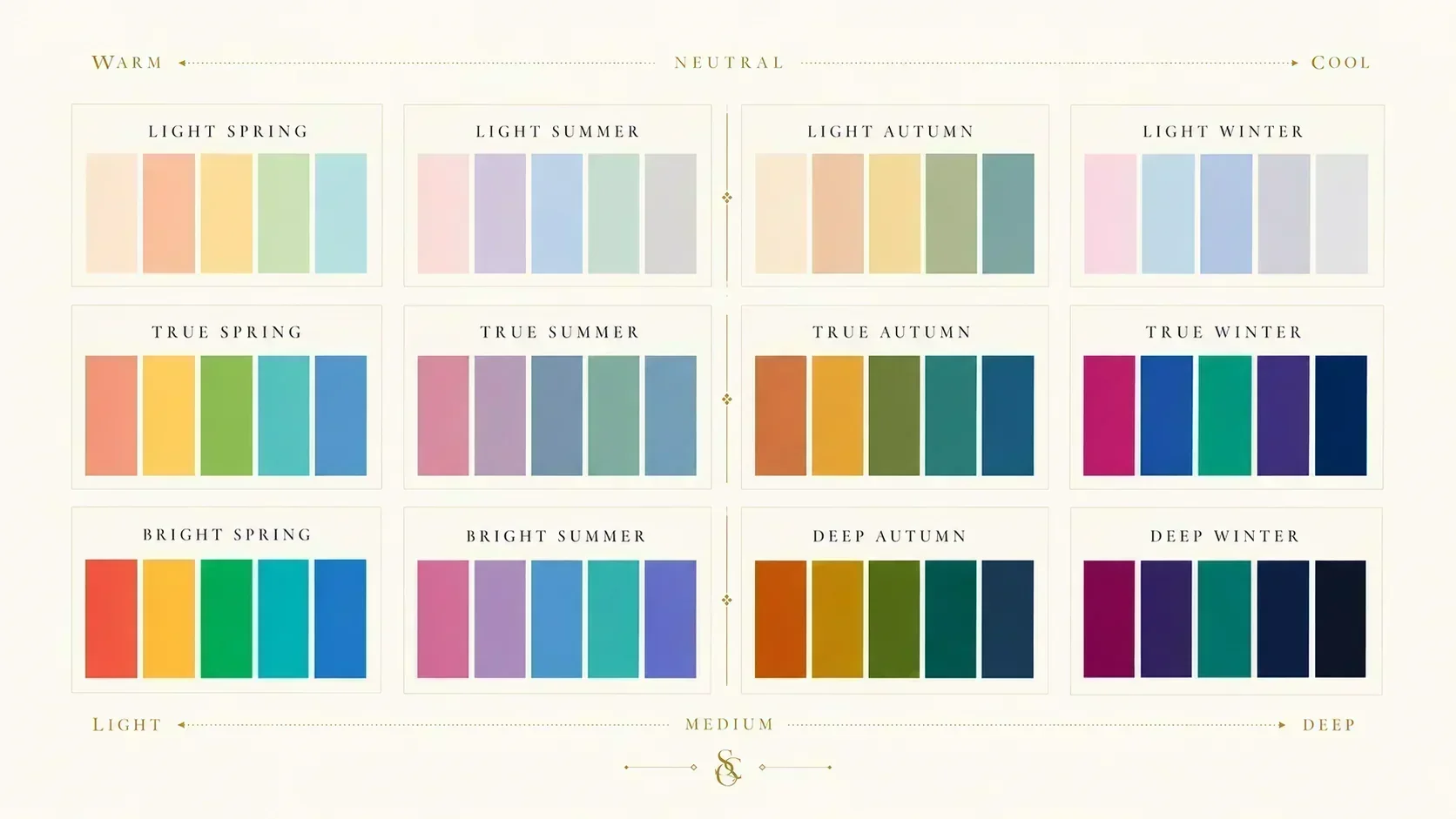
The 12 seasons are not arbitrary categories. They form a coherent geometric structure:
- ✦The four season families form the four quadrants of a temperature × value grid
- ✦Within each quadrant, the three sub-seasons occupy the low-chroma corner, the mid-chroma centre, and the high-chroma corner
- ✦Adjacent seasons on the grid are genuinely related — Bright Spring borders Bright Winter (both have high chroma); Soft Autumn borders Soft Summer (both have low chroma); Light Spring borders Light Summer (both are light value)
This means that the seasons at the borders are the most similar to each other. A Bright Spring and a Bright Winter have many similarities in chroma and contrast — they are adjacent in the system — but differ fundamentally in temperature. A Light Spring and a Light Summer are adjacent in value — but differ in temperature.
Understanding the structure explains why misclassification almost always involves adjacent seasons, not distant ones. Nobody misclassifies a Deep Autumn as a Light Summer. They misclassify a Soft Autumn as a Soft Summer, or a True Winter as a True Summer. The errors are always at the boundaries, in the adjacent seasons.
12-Season vs 16-Season
Some systems have extended the 12 to 16, 24, or even further subdivisions. These are not wrong in principle — colouring is continuous, and any finite categorisation is an approximation. But the practical utility diminishes with each subdivision.
The 12-season system produces categories specific enough to generate meaningfully different colour recommendations between adjacent seasons — the palette difference between True Summer and Soft Summer is visually and practically significant. The difference between hypothetical sub-seasons within those categories is small enough to be within the noise of any real-world colour application.
The 12-season system is the level of refinement at which the precision is clinically useful and the categories are comprehensible. It is the system used by the In My Colors analysis.
Getting Your Season

A season label without an understanding of what it means is limited. A season label with:
- ✦The specific palette of colours that suit you
- ✦The neutrals that form the foundation of your wardrobe
- ✦The makeup shades in your temperature
- ✦The hair colour guidance for your specific season
- ✦The contrast level guidance
— is one of the most practically useful frameworks for dressing and appearance decisions that exists.
The measurement that produces a 12-season result requires all three axes evaluated simultaneously. Temperature alone places you in a family. Temperature and value place you in a corner. Temperature, value, and chroma give you the specific season within the corner.
All three together give you the palette. The palette gives you the wardrobe.
The 12-season system development draws on seasonal colour analysis as extended from Carole Jackson, Color Me Beautiful (1980), through the work of Suzanne Caygill, Bernice Kentner, and subsequent systemisers. The In My Colors implementation uses Gaussian scoring across all three axes as described in the methodology documentation.